Why We Wanted to Be Knights
Knights survived long after they stopped ruling the battlefield. The reason may be that the knight became more than a warrior: an enduring ideal of courage, loyalty, restraint and strength used in service of something beyond himself.
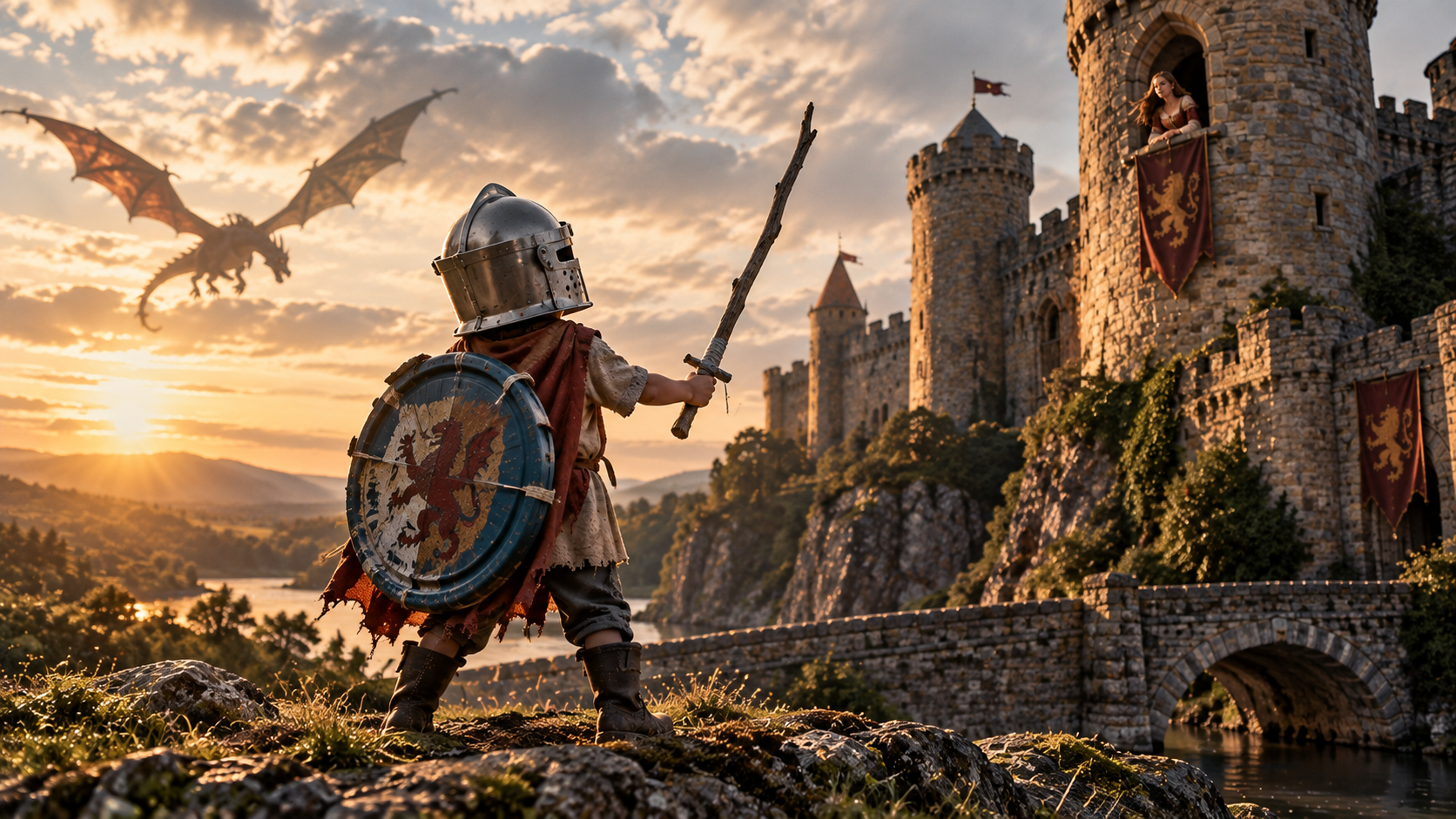
Opening
When you're eight, almost anything long enough can become a sword.
A stick will do. So will a cardboard tube, a plastic cricket stump or, if nobody stops you quickly enough, one of your mum's curtain poles.
The sofa becomes a castle. The garden fence needs defending. Someone is the king. Someone else is the enemy. There is usually a princess involved, although she may be represented by a cushion.
And you are a knight.
For generations of boys, knights were simply brilliant.
They had swords, shields, horses, castles, armour and banners. They fought dragons. They went on quests. They rode into battle. They rescued people. They defeated villains.
Obviously we wanted to be them.
But there is something else going on with the knight that is easy to miss.
Boys have always liked warriors. Romans, Vikings, samurai, commandos, cowboys. Give a small boy a reasonably exciting hat and some sort of weapon and you're halfway there.
The knight, though, came with something extra.
He wasn't simply supposed to be dangerous.
He was supposed to be good.
Before there were knights
The medieval knight didn't suddenly appear one morning in a suit of plate armour.
Humans had been putting warriors on horses for thousands of years. Rome had cavalry, and the Roman equestrian order, the equites, carried the prestige of the horse in its name and origins. But an eques was not simply an early medieval knight, and there is no neat line running from imperial Rome to Camelot.
More useful is the older idea behind both: the mounted warrior as someone set apart.
The Sarmatians made that image especially formidable. These peoples of the Eurasian steppe were famous for cavalry, including heavily armoured horsemen. Rome fought them, recruited from them and absorbed some of their military practices.
There is a wonderful British footnote. After Marcus Aurelius defeated the Iazyges, a Sarmatian people, in AD 175, ancient accounts say that thousands of their horsemen entered Roman service and 5,500 were sent to Britain.
That fact has helped inspire theories connecting Sarmatian warriors in Britain with later Arthurian legend. It is a great story. It is also unproven, and the Arthurian tradition we recognise was shaped centuries later.
The safer point is better anyway.
The knight belongs to a much older human fascination with the elite mounted warrior.
A man on a horse was faster than a man on foot. He could see further. He could pursue you. Add armour, training and an expensive warhorse and he became something most ordinary people could never hope to be.
The horse mattered so much that the language remembered it. The French chevalier is tied to cheval, horse, and chivalry comes from the same family of words.
Before the knight became an ideal, he was a warrior whose identity was inseparable from the horse.
Then we gave him rules
By the Middle Ages, the mounted warrior had become the knight we would recognise.
From around the ninth century, knights served lords through a mixture of military service, landholding, household ties, wages and personal loyalty. By the later 12th century, knighthood had become closely associated with nobility and with a culture of knightly behaviour we call chivalry.
This is where the knight becomes more interesting than the weaponry.
Societies had a problem with warriors.
You needed men capable of violence. Men willing to ride towards other armed men and fight them at extremely close range.
But you also had to live with those men when the battle was over.
So alongside the warrior grew an idea of how the warrior ought to behave.
Chivalry.
There was never one universal code neatly printed on a card and handed to every new knight. Chivalric ideals changed across centuries and places, shaped by aristocratic custom, Christianity, literature and the practical expectations of military life.
But the virtues attached to the ideal are recognisable: courage, loyalty, honour, courtesy, service and protection.
Real knights routinely failed the test. They robbed, pillaged, broke promises, changed sides and committed acts that sit rather awkwardly beside the romantic picture.
That doesn't make the ideal meaningless.
It tells us what an ideal is.
Chivalry wasn't a reliable description of how knights behaved. It was an argument about how a man with power ought to behave.
The interesting thing about knights isn't that they were good men. It's that they created an idea of what a good man ought to be.
The knight becomes something bigger
Once you give a warrior a moral code, storytellers can really get to work.
Arthur. Lancelot. Gawain. Galahad. Roland. The Round Table. The Holy Grail.
The knight escaped the battlefield and entered the imagination.
Medieval Europe became fascinated by stories of warriors undertaking quests, defeating enemies, serving kings, resisting temptation and proving themselves worthy.
By the early 14th century, the idea was strong enough to reach backwards through history. The Nine Worthies gathered Hector, Alexander the Great and Julius Caesar alongside Joshua, David, Judas Maccabeus, Arthur, Charlemagne and Godfrey of Bouillon.
Most of them had lived before medieval knighthood existed. Arthur may not have existed at all in the form later stories gave him.
That didn't matter.
They were being presented as exemplary warriors and rulers, men who could be folded into the chivalric imagination because they represented the qualities medieval culture wanted the knight to embody.
Even Julius Caesar could become a knight if the story needed him to be one.
And visually, the knight became almost unbeatable.
Mail, shields and open helmets developed into increasingly sophisticated armour. Heraldry made the warrior instantly identifiable. By the late Middle Ages, armour could encase almost the entire body in shaped steel.
Imagine seeing one coming towards you.
A horse carrying a man enclosed in metal, his face hidden, his identity announced by colours and symbols, sunlight flashing from polished armour.
No wonder the image stuck.
And then the knight stopped being necessary
Technology is rather unsentimental about romance.
From the later Middle Ages, weapons and tactics increasingly challenged the dominance of mounted armoured warriors. Longbows, pikes, halberds, cannon and eventually firearms changed what happened on a battlefield.
The knight gradually lost the military importance he had once enjoyed.
But the strange thing is that knighthood didn't disappear with it.
Heraldry became more elaborate. Tournaments became more spectacular. Knightly orders continued to flourish. Armour became ceremonial as well as practical. Stories kept being told.
The practical need for the knight was fading while the idea of the knight was getting stronger.
Armies moved on.
The knight stayed.
Then we found him
Centuries later, we met him as children.
Not the real medieval knight, obviously.
We got the distilled version.
The Playmobil knight. The Lego knight. The toy castle. The plastic sword. King Arthur. Robin Hood. The Sword in the Stone. Storybooks full of castles and dragons and men carrying shields with lions painted on them.
And something about him made immediate sense.
There was a bad thing happening.
Someone had to do something about it.
The knight did.
Children's games are wonderfully uncomplicated like that. Nobody spends twenty minutes establishing the geopolitical background to the siege of the climbing frame.
There's a castle.
We're defending it.
Get your sword.
Perhaps that's why the knight has lasted so long.
There are cooler warriors. There are certainly more effective ones.
But the knight offers something unusually complete.
He is dangerous, but his strength is supposed to be controlled.
He can fight, but he is supposed to have a reason to fight.
He has status, but status brings obligations.
He serves something beyond himself.
Even the objects around knighthood carried that meaning. Spurs were practical riding equipment, but they also became symbols of chivalry and could be presented as part of the ceremony of knighting.
The warrior wasn't merely being equipped.
He was being given expectations.
The man inside the armour
That distinction is probably too sophisticated for an eight-year-old running around the garden with a stick.
But perhaps the basic idea isn't.
Children understand heroes remarkably well.
The hero is strong enough to hurt people, but chooses to protect them.
He is frightened, but goes anyway.
He could run away, but doesn't.
He keeps his word.
He stands between the monster and everyone else.
That's the knight we were pretending to be.
The interesting part was never really the sword.
It was the obligation attached to the sword.
Be brave. Keep your word. Control your strength. Protect people who need protecting. Serve something worth serving.
Nobody ever managed all of that. The men who first created the ideal certainly didn't.
But perhaps that is what ideals are for.
When we were boys, we didn't know much about medieval cavalry, chivalric literature or the difference between a Sarmatian cataphract and a 13th-century knight.
We just knew knights were awesome.
Maybe we understood more than we realised.
There are worse things for a boy to pretend to be.