Why Switzerland built so many shelters
Switzerland's shelter network turns a collective promise of protection into buildings, maintenance and plans for residents.
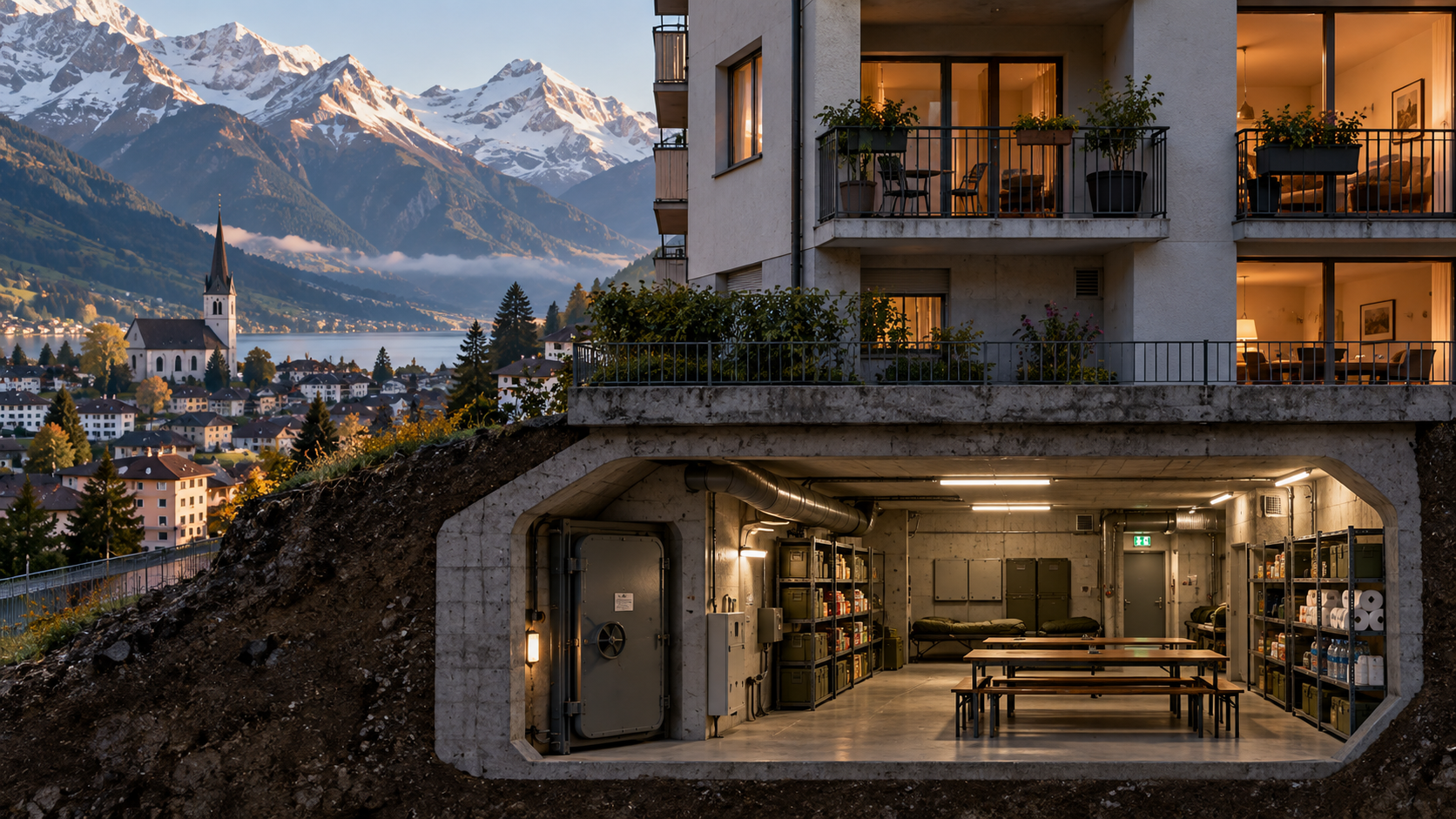
The other purpose of the basement
The Swiss National Museum illustrates its history of civil protection with a photograph of an air-raid shelter in Muri, near Bern, taken in 1968. It belongs to a story that often begins beneath ordinary buildings, rather than inside a secret mountain.
That is the interesting scale of Switzerland's shelter programme: homes, blocks of flats and public facilities, repeated across a country. A room can be part of everyday life and also have a second, much more serious purpose.
The museum describes a network largely built during the Cold War. Its historical account traces a constitutional civil-protection vote in 1959 and the establishment of the Federal Office for Civil Protection in 1963. Memories of wartime bombing and the prospect of nuclear conflict gave civilian protection a pressing context. The Swiss National Museum's history.
This wasn't a collection of unrelated household projects. It was a sustained decision to build protective space for the population.
What makes it a shelter
A basement is not automatically a protective shelter. Official Swiss guidance describes a reinforced-concrete enclosure, protected openings, an emergency exit and ventilation equipment. These are designed features with requirements behind them, rather than whatever happens to be downstairs.
The Federal Office for Civil Protection's guidance, published on 10 September 2026, gives approximately nine million places in around 370,000 private and public shelters. It reports national coverage above 100 percent while also noting local gaps. Current shelter guidance.
Both halves of that statement matter. A large national total is a remarkable piece of infrastructure. It does not mean a spare place is equally close to every person who might need one. Capacity has a geography.
That is easy to lose in the familiar claim that Switzerland has a bunker for everybody. A place is useful only as part of arrangements that connect people with somewhere suitable to go.
A policy about the neighbours
The federal office describes the organising principle as access to a shelter near a resident's home. Protective structures were primarily conceived for armed conflict, including the effects of weapons of mass destruction, while also being available for certain disasters and emergencies. Separate protected premises support command, rescue and medical functions. The protective-structures system.
There is a social idea inside the concrete. Protection is treated as something to plan collectively, not simply a product for whichever household can afford the most elaborate private retreat.
That doesn't make a shelter a promise that nothing bad can happen. Protection has limits, and different emergencies call for different responses. A system designed to reduce particular dangers cannot remove the need for judgement, warnings, transport, medical care or public instructions.
The ordinary residential scale is still significant. It asks planners to think about where people are likely to be, not just where impressive engineering can be built.
The work after construction
The current guidance permits everyday uses such as storage, subject to restrictions that preserve the protective structure and equipment. It also requires readiness: shelters must be capable of preparation for occupation within five days. Allocation plans are maintained by cantons and municipalities, and owners have maintenance duties. FOCP on use and readiness.
This is where the story becomes less photogenic and more revealing. Building a room is one event. Keeping it useful is an obligation that survives changes of owner, population and expectations.
A heavy door can make preparedness look satisfyingly complete. The continuing questions are less visible. Is the equipment maintained? Does somebody know who the space is for? Can its everyday contents be removed? Can the people responsible explain what happens next?
Those are not decorative details around the engineering. They determine whether the engineering can serve its purpose.
More than a Cold War souvenir
It would be easy to file these spaces alongside old public-information films and treat them as monuments to an anxiety that has passed. Swiss policy continues to maintain the shelter network. The federal protective-structures concept includes preserving capacity, with some obsolete small shelters potentially replaced by public provision or adapted protected premises.
The interesting question is not whether every country should copy the Swiss system unchanged. Geography, buildings, institutions, costs and assessed threats differ. The system also has to be judged by its practical limitations, not by its most dramatic photograph.
What Switzerland offers is an unusually concrete example of a long-term public choice. Generations have maintained space for a situation they would prefer never to experience.
Most of the time, an ordinary basement can remain an ordinary basement. Its other purpose is still there, waiting behind the stored furniture and the years of maintenance.