Why Save Private Ryan?
Saving Private Ryan took inspiration from the Niland brothers, but its rescue mission is fiction. That fiction creates the film's hardest question: why risk a group of ordinary men to save one soldier whose life is worth no more than theirs?
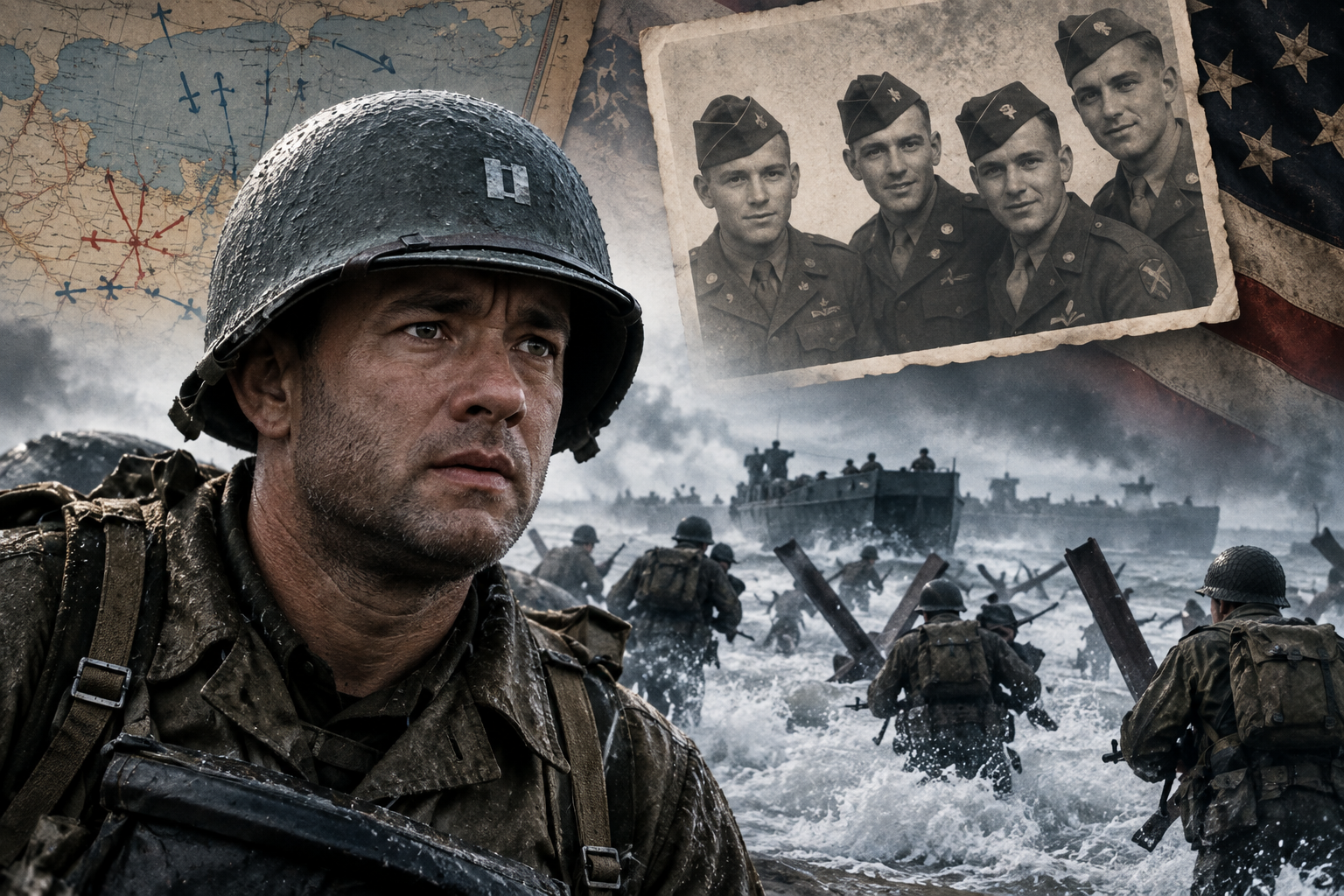
The family behind Ryan
Before there was James Ryan, there were four brothers from Tonawanda, New York.
Edward, Preston, Robert and Frederick Niland all served during the Second World War. By the middle of June 1944, their family had reason to believe that three of them were dead.
Robert Niland was a sergeant in the 505th Parachute Infantry Regiment of the 82nd Airborne Division. He was killed in Normandy on D-Day, 6 June 1944.
His brother Preston, a second lieutenant with the 22nd Infantry Regiment of the 4th Infantry Division, was killed the following day.
Their older brother Edward was half a world away with the US Army Air Forces. His B-25 went down over Burma in May. Edward survived, but was captured by the Japanese and became a prisoner of war. His family did not know that. He was missing, and for the purposes of the awful calculation taking shape back home, he was feared dead too.
That left Fritz.
Frederick 'Fritz' Niland was serving with the 501st Parachute Infantry Regiment of the 101st Airborne Division in Normandy. Once the scale of the family's loss became known, arrangements were made to remove him from combat. Fritz was eventually returned to the United States, where he completed the war serving as a military policeman in New York.
Then, in May 1945, the family discovered that Edward was alive. He had spent almost a year as a Japanese prisoner and was liberated in Burma.
Robert and Preston never came home. Today they lie beside one another at the Normandy American Cemetery above Omaha Beach.
It is an extraordinary family story.
It is not the true story of Saving Private Ryan.
What Hollywood changed
Screenwriter Robert Rodat said the idea for Saving Private Ryan grew partly from reading Stephen Ambrose's D-Day and encountering the Niland family, alongside another, simpler image: a war memorial in New Hampshire carrying repeated surnames from families that had lost several sons.
The film takes the emotional fact of the Nilands and invents almost everything required to turn it into a story.
There was no Captain John Miller. No eight-man Ranger patrol was sent across Normandy to find Fritz Niland. No trail of men died bringing him home. Fritz was not a private stranded with a unit defending a bridge at a fictional French town called Ramelle.
Even the policy behind his return is often tidied up after the fact. The modern US survivorship provisions commonly called the Sole Survivor Policy were put on a statutory footing after the war, including in the Selective Service Act of 1948. During the war, however, the armed forces had already begun changing practice around brothers and surviving family members, particularly after highly publicised family losses such as the five Sullivan brothers, who died when USS Juneau was sunk in 1942. The War Department had the administrative means to give special consideration to a family's remaining son.
So Fritz's return was real. The desperate patrol to retrieve him was not.
And that fictional patrol is where Saving Private Ryan becomes much more interesting than a dramatisation of the Nilands could have been.
Eight men for one
After the film's brutal opening on Omaha Beach, Captain Miller and seven men are given a peculiar order.
Three brothers from the Ryan family are believed dead. The fourth, James Francis Ryan, is somewhere in Normandy with the 101st Airborne. Miller is to find him and get him out.
The men immediately spot the problem.
The arithmetic is insane.
Why take eight men who have already survived D-Day and send them through enemy-held country to save one man? Why is Ryan's mother entitled to her son when the mothers of Miller, Horvath, Reiben, Caparzo, Mellish, Jackson, Wade and Upham might lose theirs in the attempt?
Ryan has done nothing to deserve this.
He is not a general. He does not carry vital intelligence. The war does not depend on him. The bridge at Ramelle does not matter because James Ryan happens to be standing on it.
He is one soldier.
That is the point.
The army has to count
War forces people into numbers.
Armies cannot function any other way. They count divisions, battalions, companies, replacements, ammunition, aircraft, tanks, objectives, miles and casualties. A commander responsible for thousands of men has to think in quantities because the scale of the thing is beyond individual comprehension.
Saving Private Ryan opens by making that scale horribly personal. The Omaha sequence is full of bodies, but Spielberg keeps dragging the camera back to individual men: a soldier searching for his severed arm, another calling for his mother, medics trying to stop one particular man bleeding while the beach carries on exploding around them.
Then the film pulls the opposite trick.
Out of the immense Allied invasion, the machinery of the US Army focuses on one name.
Ryan.
His life is not more valuable than Miller's. If anything, the film spends the next two hours proving how absurd that idea would be. Wade is a medic. Jackson is an extraordinary marksman. Miller, we eventually discover, was a schoolteacher before the war, a man with a wife and a life he desperately wants to see again. Caparzo dies trying to help a French child. Every man in the patrol has a claim on the future.
When Caparzo is killed before they have even found Ryan, the mission becomes harder to defend. When Wade dies, it becomes harder still.
The equation never improves.
The film could have made Ryan secretly indispensable. It refuses.
A decent thing in an indecent place
There is a moment when Sergeant Horvath offers Miller a way of looking at the mission.
Perhaps, he suggests, one day they will look back and decide that saving Private Ryan was the one decent thing they managed to pull out of the whole filthy mess.
That does not solve the arithmetic. It changes the unit of measurement.
A huge army has decided, for reasons of policy, grief and public obligation, that one family has given enough. Somewhere inside the machinery, somebody has looked at a casualty report and remembered that the names on it belong to the same mother.
The mission becomes a strange act of institutional humanity.
It is also horribly unfair.
Saving Ryan means exposing other sons to danger. The film never finds a clever argument that makes this disappear. Reiben's anger at the mission is not foolish. Miller cannot tell his men that Ryan's life is objectively worth eight of theirs because it plainly isn't.
Instead, they keep going.
That matters because Miller and his men are not presented as creatures who exist only to sacrifice themselves. They complain. They are frightened. They make mistakes. Miller's hand shakes. Wade cries for his mother as he dies. Reiben reaches the point where he is ready to walk away.
Their courage has weight because the film has spent time making clear that they would quite like to live.
Then they find him
The cleverest thing Saving Private Ryan does is make the rescue target disagree with the rescue.
Miller eventually finds Ryan at Ramelle and tells him his brothers are dead and he is going home.
Ryan refuses.
He cannot understand why he should abandon the men beside him when they have orders to defend the bridge. He asks Miller what he is supposed to tell his mother. His answer is that she should be told he stayed with the only brothers he has left.
For Miller, this is almost comically inconvenient.
The army has spent men reaching Ryan. Ryan now wants to risk himself anyway.
Miller could simply enforce the order. Instead, he and his remaining men stay to help defend the bridge.
At that point the mission changes again. They are no longer merely transporting a valuable parcel home. Ryan has become one of them, and the men who resented his existence are fighting beside him.
Most of them do not survive.
Earn this
Captain Miller is mortally wounded near the bridge.
Ryan kneels beside him.
Miller pulls him closer and gives him two words that follow him for the rest of his life.
“Earn this.”
It is a brutal thing to say to a young man.
Ryan did not ask Miller to come looking for him. He did not decide that Caparzo or Wade should die. He did not design the order that valued the grief of his mother above the risk to seven other families. The sacrifice arrives before Ryan has done anything to earn it.
Now a dying man hands him the bill.
What could possibly settle it?
A successful career? Children? Kindness? Public service? Fifty good years? Seventy?
There is no exchange rate for this.
One of the reasons the line lands so hard is that Miller himself cannot know what he is asking. He is dying. He wanted to get home to his own wife. Whatever life Ryan goes on to have will contain things Miller has just lost forever.
Ryan can honour that. He cannot make it equal.
The old man at the grave
The film waits until its final minutes to show what Miller's words did.
An elderly Ryan stands in the American cemetery at Normandy with his family. He has returned to Miller's grave.
He tells Miller that he has thought about that day on the bridge every day of his life. He says he tried to live as well as he could and hopes it was enough.
Then he turns to his wife.
“Tell me I'm a good man.”
She tells him he is.
Look behind him and the film gives us the only evidence it can: a wife, children, grandchildren, a life that continued.
But Ryan still has to ask.
That is the sting in the ending. Miller's instruction did not give Ryan a purpose he could neatly complete. It gave him a question that lasted a lifetime.
Have I earned this?
The film never really says yes. His wife can tell him he is a good man. His family can stand beside him. He can salute Miller's grave.
The dead remain dead.
Why save Private Ryan?
The real Niland story had no squad crossing Normandy and dying one by one for Fritz.
Perhaps that is why the fiction works.
Rodat and Spielberg take a real wartime decision, that one family had suffered enough, and push it until its logic becomes uncomfortable. They make us watch the cost of treating one ordinary soldier as someone worth saving.
The numbers never balance.
If the patrol had voted on it at the beginning, Ryan would have had a difficult case. Eight lives against one is not complicated mathematics.
But human beings are not interchangeable counters.
Robert and Preston Niland are not two marks in a casualty column. They were two brothers, now buried next to each other in Normandy. Edward was not simply 'missing'. He was a man enduring captivity in Burma while his family feared him dead. Fritz was not an abstract surviving son. He was the fourth brother in a family the war had already torn apart.
The same is true of Miller's fictional patrol. Their deaths hurt precisely because the film has refused to let them remain numbers.
So why save Private Ryan?
The film leaves the question where it should.
Ryan's life is not worth more than the lives spent reaching him. Miller's life cannot be repaid by Ryan becoming a dentist, a president, a saint or simply a good husband and father. Sacrifice does not work like a bank account.
Maybe the uncomfortable thing the film understands is that the moment we reduce the question entirely to arithmetic, something human has already gone missing.
Eight men for one still makes no sense.
And one life still matters.