Why ports quietly run the world
Ports are where geography, trade, energy, engineering and politics become physical.
Look around the room you're sitting in.
Your television may have come from South Korea or China. Your phone contains components made across several countries. The coffee might be Brazilian. The cotton in your shirt could have crossed an ocean before becoming a shirt, then crossed another one afterwards.
The chair, the speakers, the trainers by the door, the children's toys, the drill in the garage.
Trace enough of these things backwards and eventually you reach the sea.
More than 80% of the world's internationally traded goods by volume are carried by ship.
Which means an astonishing amount of modern life depends on places most of us rarely think about.
Ports.
Where the abstract world becomes physical
We talk about the global economy as though it exists somewhere in the air.
Supply chains. International markets. Imports. Exports. Globalisation.
Go to a major container port and all of that suddenly becomes solid.
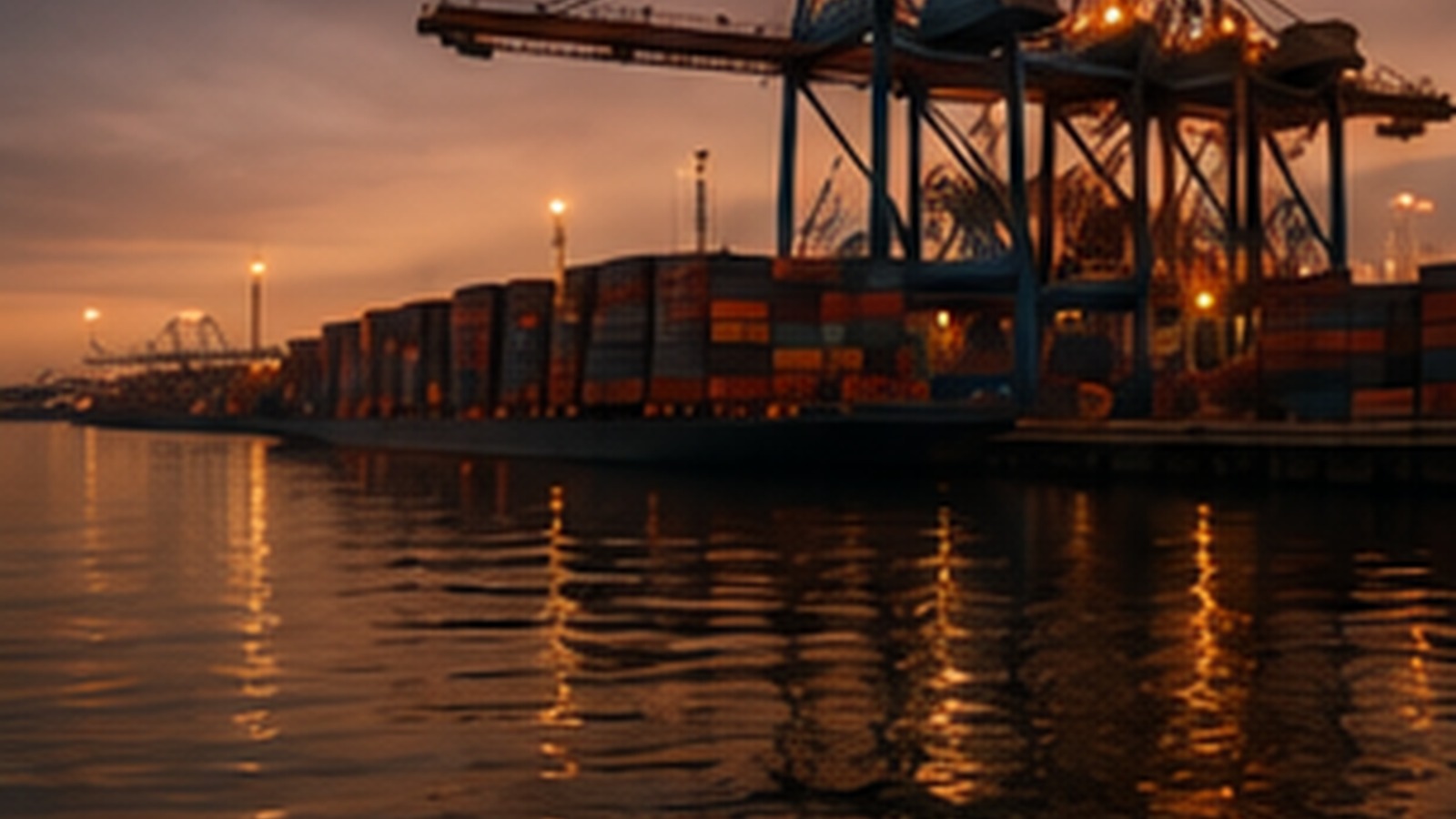
There are ships longer than skyscrapers are tall. Cranes loom over the quayside. Containers are stacked into great multicoloured walls. Trucks arrive and disappear. Trains carry boxes inland.
And almost everything is moving according to a plan.
A modern port isn't simply somewhere a ship stops. It is an enormous transfer machine connecting sea, road and rail.
Cargo arrives from thousands of miles away, spends surprisingly little time on land, then begins another journey.
The clever bit is the box.
The box that changed the world
A shipping container may be one of the least glamorous objects ever invented.
It is also one of the most important.
Before containerisation, cargo was often loaded and unloaded piece by piece. Sacks, barrels, crates and boxes had to be moved between ship, dock, warehouse, railway wagon and truck.
It took time. It took people. Things were damaged. Things went missing.
The container changed the problem.
Instead of designing the transport around the cargo, put the cargo inside a standard box and design everything around the box.
Ships could carry it. Cranes could lift it. Trains could take it. Trucks could haul it.
The cargo inside might be televisions, machine parts, clothes or thousands of rubber ducks. To the port, it is simply another container.
That standardisation helped make today's extraordinary movement of goods possible. In 2024, ports around the world handled the equivalent of roughly 920 million twenty-foot containers.
Not 920 million ships.
Boxes.
Ports have their own geography
This is where things become even more interesting.
You cannot simply build a major port wherever you fancy.
Water needs to be deep enough for large ships. There needs to be room to manoeuvre them. Containers need somewhere to go once they come ashore. Roads and railways need to connect the port with cities, warehouses and factories inland.
Then there are tides, bridges, rivers, canals and narrow stretches of water that ships must physically fit through.
The digital economy may feel weightless.
The physical economy is constantly negotiating with geography.
And because the network depends on particular places, some bits of coastline become extraordinarily important.
A harbour. A river mouth. A canal. A narrow strait between two countries.
On a map they can look insignificant.
To global trade, they can be anything but.
You notice the system when it breaks
Most of the time this enormous machine works so well that we don't think about it.
A container is loaded somewhere in Asia. Weeks later its contents appear in Britain. Eventually something ends up on a shelf and you buy it without giving the journey much thought.
Then a ship gets stuck.
A port closes.
A war makes a shipping route too dangerous.
A strike stops containers moving.
Suddenly something that happened thousands of miles away begins appearing in delivery times, factory schedules and prices.
The invisible system becomes visible.
That is the peculiar thing about ports.
They sit at the edge of our cities and countries, filled with cranes, ships, fuel, steel boxes and people working through the night.
Most of us rarely see them.
Yet much of what surrounds us has passed through places exactly like them.
Globalisation sounds like an idea.
Stand beneath the cranes at a container port and you realise it is also a machine.