Why a well-hung door feels right
Show the skill hidden in an everyday object through the small measurements, hinge work and adjustments that make a timber door close cleanly.
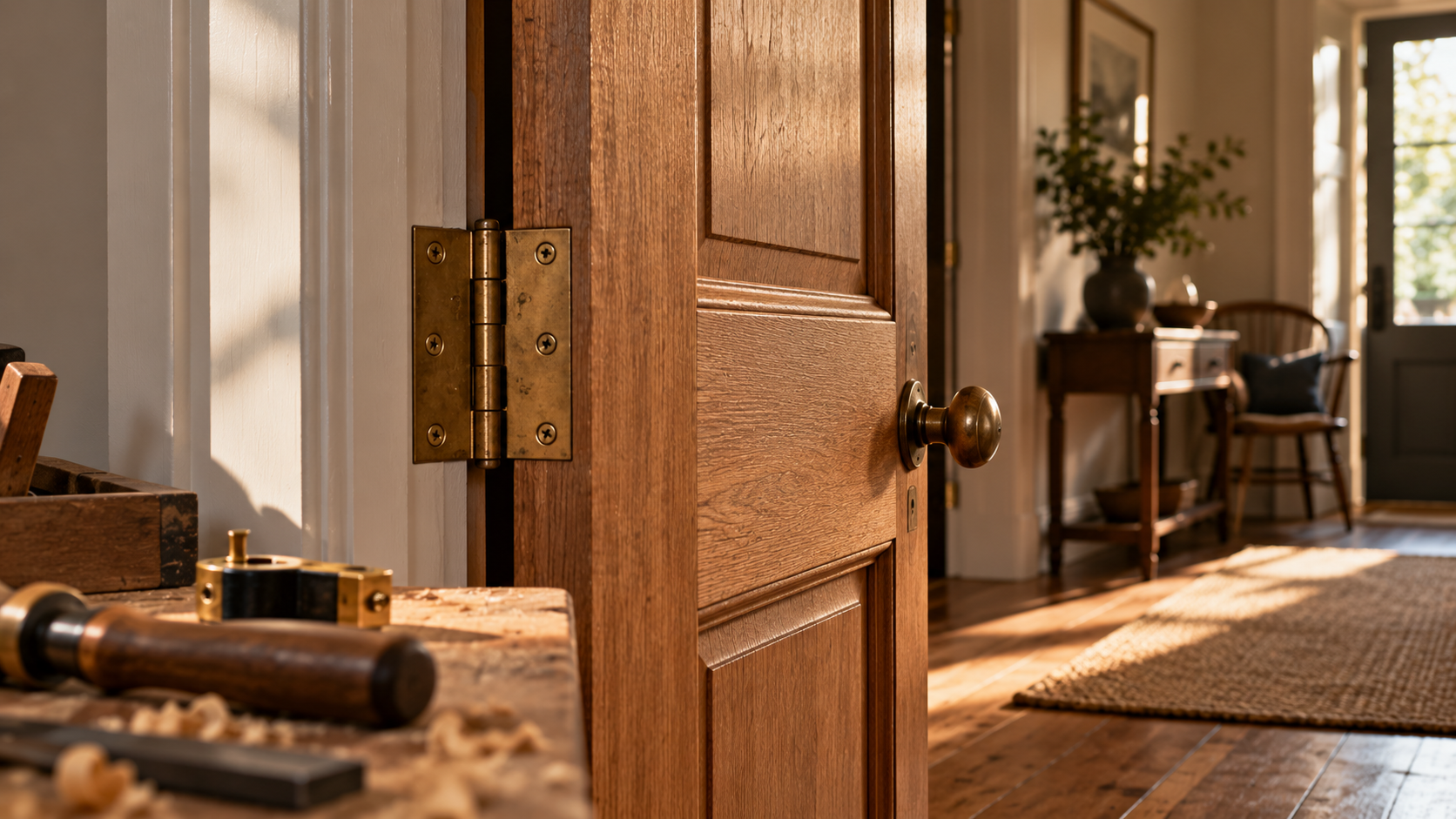
The door that catches
You know a badly hung door before you really look at it.
It scrapes the carpet. It needs a shoulder to persuade it shut. The latch misses unless you lift the handle slightly. Or it swings open again, as though the room has rejected it.
A good door is less noticeable. You push it and the weight moves cleanly through the hinges. The gap around it looks even. The latch finds the keep with a small, definite click. Nothing drags, bounces or needs explaining.
That quiet little movement hides a surprising amount of work.
An ordinary internal timber door is a large, heavy rectangle being asked to move repeatedly through the same arc while sitting inside another rectangle that may not be perfectly square. The carpenter's job is not simply to attach one to the other. It is to make the door look as though it belongs there.
Most of that happens before the handle ever goes on.
Fit before finish
Start with the gap. A door cannot be the same size as its opening because it needs room to move, but too much clearance looks crude and too little means timber can bind against the frame. A common fitting guide for a standard internal door uses a consistent clearance of about 3mm around the frame.
That sounds generous until you see it. Three millimetres is roughly the thickness of two pound coins stacked together. Across the top and down both sides of a full-size door, the eye notices when that narrow line wanders.
So the first skill is fitting the door to the opening that actually exists, rather than the opening you hope exists.
The door is offered up to the frame, supported on wedges and checked. High spots can then be marked and removed gradually. This is why a hand plane remains such a satisfying carpenter's tool. It can take away a thin shaving of timber rather than forcing a big correction all at once.
Then come the hinges.
A butt hinge works best when its leaf sits neatly into a shallow recess, or mortice, cut into the edge of the door and the frame. Too shallow and the hinge stands proud, pushing the door away from the frame. Too deep and the geometry shifts the other way. The recess wants to match the thickness of the hinge leaf closely enough that the metal finishes flush with the timber.
The position matters too. Fitting guidance commonly places the upper and lower hinges a set distance from the ends of the door, but an existing frame may already dictate where they need to go. Either way, the two halves have to meet accurately when the door is lifted into place.
This is the bit that reveals why door hanging is a craft rather than a job involving a box of screws. A small error at the hinge becomes a larger error at the opposite edge of the door.
The final swing
Once the screws are in, the door tells you what is wrong.
Close it slowly and watch the margins. Is the top gap even? Does one corner tighten as the other opens up? Does the leading edge meet the frame cleanly? Does the bottom skim the floor?
The corrections can be tiny. A little more planing on a tight edge. A hinge recess adjusted so the leaf sits properly. A screw tightened. A proud screw head replaced or seated correctly. Then the door is tried again.
Only when the movement is right does the latch really make sense. The latch bolt has to arrive at the strike plate in the right place and enter without the door needing to be lifted, slammed or pushed hard against the stop.
When all of those small decisions line up, the result feels oddly good. There is weight, then movement, then a clean stop and a click.
We tend to notice craftsmanship when it is decorative: a dovetail joint, carved stone, a beautiful weld. A well-hung door is the opposite. Much of the skill has been spent making sure you never have to think about it.
Until, of course, you use a bad one.