Who actually owns Antarctica?
Antarctic claims remain disputed while treaty rules support peaceful activity, science and environmental protection.
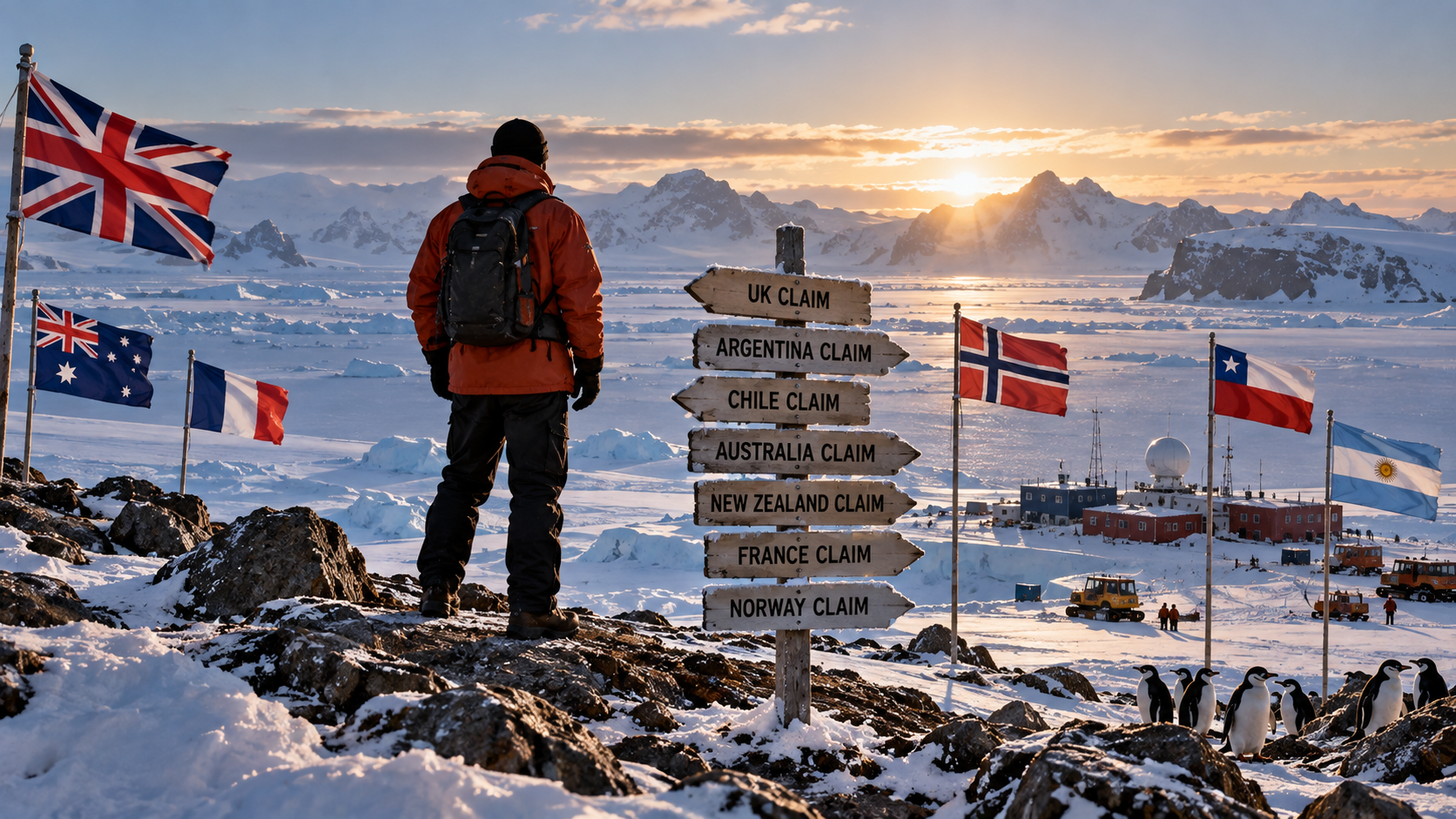
A map does not settle the question
Ask who owns Antarctica and two tidy answers tend to appear: nobody, or everybody. Neither explains the arrangement particularly well.
Seven countries maintain territorial claims: Argentina, Australia, Chile, France, New Zealand, Norway and the United Kingdom. Some claims overlap. Other countries do not recognise those claims, while the United States and Russia maintain a basis for a claim of their own. The continent does not have a single generally accepted owner.
Yet it is not a place without rules. The Antarctic Treaty provides a way for countries with different positions on sovereignty to conduct their activities without first resolving the argument about ownership. The important distinction is between a claim, agreement that the claim is valid, and the rules people agree to follow meanwhile.
Once those are separated, the unusual arrangement becomes easier to understand.
Put the dispute aside without erasing it
The treaty was signed in 1959 and entered into force in 1961. Article IV protects the participating countries’ different positions on sovereignty. It does not require a claimant to abandon its claim, or a non-recognising country to accept it. Nor can activities undertaken while the treaty operates establish new sovereign rights; new claims and enlargements are barred while it remains in force.
The Antarctic Treaty Secretariat’s explanation sets out those provisions. “The claims were abolished” is therefore wrong. So is the idea that building a research station automatically adds a new sovereign slice to the map.
Think of the difference between agreeing who owns a disputed place and agreeing how to behave there. The treaty achieves the latter while deliberately leaving the former unresolved. That is an unusual diplomatic accomplishment, because countries can participate without pretending their disagreement has disappeared.
A coloured map needs to make that clear. Its sectors represent asserted claims, not universally recognised national borders. Where colours overlap, the overlap is part of the story rather than a cartographic error.
Peaceful use has practical meaning
The treaty reserves Antarctica for peaceful purposes and protects scientific investigation and cooperation. It prohibits military measures such as establishing military bases or conducting weapons tests, while allowing military personnel or equipment for scientific research or other peaceful purposes. A military aircraft supporting a research programme is therefore not automatically evidence of a breach.
The treaty also provides for inspection by designated observers and prohibits nuclear explosions and the disposal of radioactive waste. Those are concrete arrangements, beyond an expression of goodwill. The treaty text explains the scope and qualifications.
None of this makes individual stations identical or removes national interests. Countries fund their own programmes, decide their research priorities and retain reasons to maintain a presence. Cooperation operates alongside those interests rather than requiring them to vanish.
Science is central to the system partly because it provides a continuing practical purpose for people to be there together. Weather, ice, oceans and living systems can be studied across national programmes even while the wider political relationship between the participating states is difficult.
Who gets to decide
The main diplomatic forum is the Antarctic Treaty Consultative Meeting. The original parties and later parties demonstrating substantial scientific research activity can hold consultative status. Other treaty parties and invited organisations can contribute to discussions, but decision-making belongs to the consultative parties.
The Secretariat describes decisions being adopted by consensus. It also distinguishes types of output. Measures become binding on consultative parties once approved by all of them; resolutions are recommendations rather than binding rules.
That matters because “the treaty countries agreed” can cover different things. The status of an instrument and whether it has entered into effect both matter. A headline about a meeting should not be treated as a complete legal account.
Consensus also brings a practical tension. It encourages agreements the participating decision-makers can accept, but it can make change difficult when interests diverge. There is no Antarctic world government able to impose any policy it chooses. Countries implement obligations through their own systems, alongside the treaty’s international processes.
The ice does not become available in 2048
Environmental protection adds another layer. The Madrid Protocol was signed in 1991 and came into force in 1998. It designates Antarctica as a natural reserve devoted to peace and science, and prohibits mineral resource activities other than scientific research.
A recurring claim says that protection expires in 2048. It does not. After that point, a consultative party can request a review conference under specified provisions. That is different from the mining prohibition ending automatically. Changes face demanding conditions, including additional safeguards around mineral activities. The Secretariat explicitly addresses the 2048 misunderstanding.
Tourism, environmental impacts and marine living resources add further questions and agreements to the wider system. An explanation of territorial claims is only the beginning of understanding how Antarctica is managed.
An agreement to keep working
The most interesting answer to the ownership question is therefore less tidy than a flag. Claims exist, recognition differs, and countries have built rules around an unresolved disagreement.
That arrangement should not be mistaken for the end of politics. It is a way of conducting politics while protecting space for peaceful work and scientific cooperation. Its continued value depends on countries carrying out the obligations they have accepted, even when doing so is inconvenient.
Look again at the map and the coloured wedges tell only part of the story. The more consequential lines are in a treaty: limits on what a claim can become, and commitments about what people will do while the argument remains open.