When the border goes through the building
One house in Baarle has two national addresses. Its front door reveals the extraordinary history of a divided town.
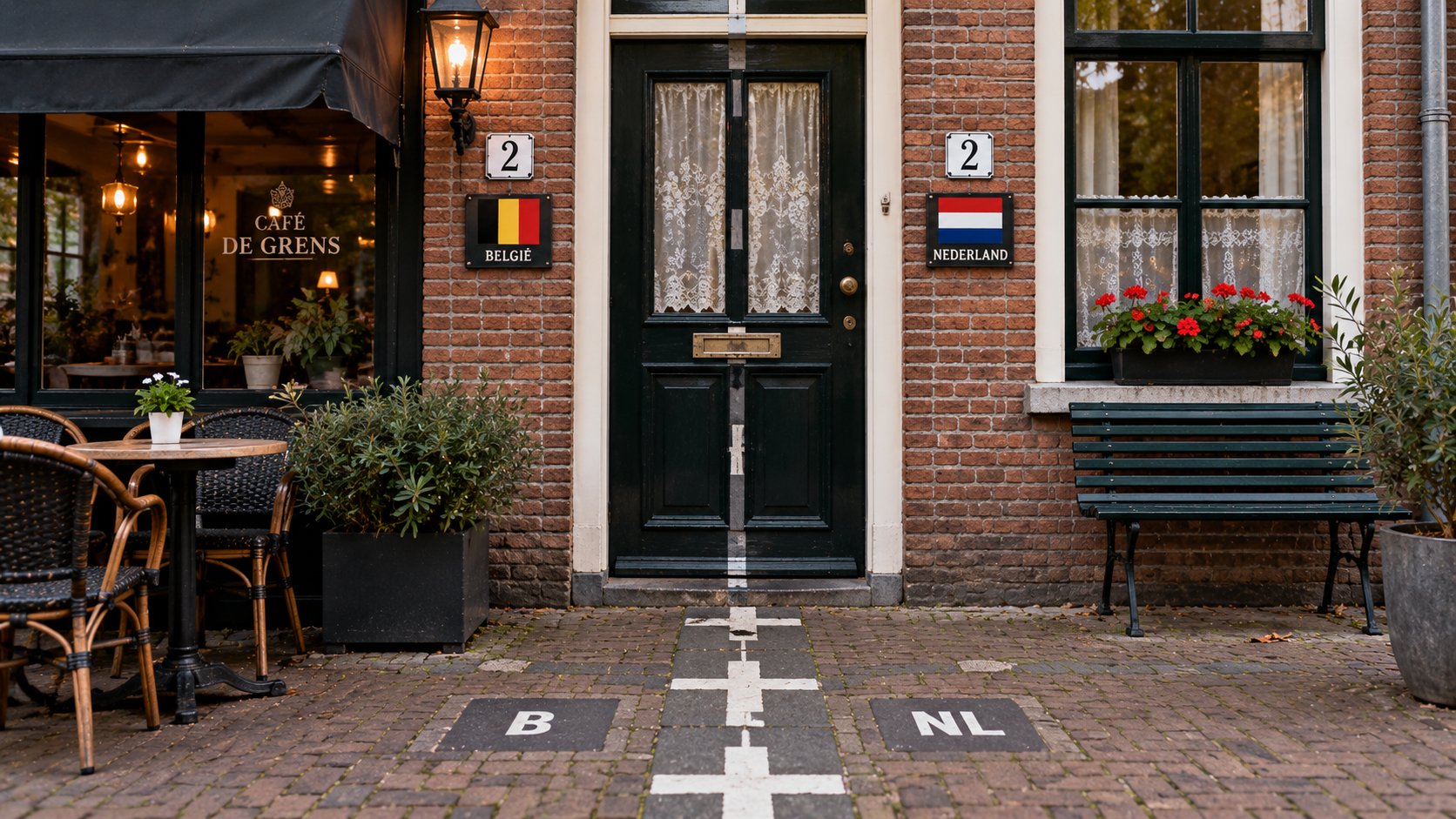
Number two or number nineteen
A house in Baarle has two numbers: the Belgian number 2 and the Dutch number 19. They belong to the same building. The international border passes through the middle of its front door.
The addresses are Loveren 2, Baarle-Hertog, and Loveren 19, Baarle-Nassau. Visit Baarle, the local visitor organisation, explains the arrangement and shows the entrance. The two number signs use the colours of the respective national flags. The house with two numbers.
It is a wonderfully domestic interruption to the usual picture of a border. There is no mountain pass or great river to explain it. There is a door through which someone needs to carry the shopping.
The map looks broken
Baarle combines Belgian Baarle-Hertog and Dutch Baarle-Nassau in a patchwork of territory. Belgian enclaves sit inside the Netherlands, with Dutch counter-enclaves inside some of those Belgian pieces.
An enclave is territory surrounded by another country's territory. A counter-enclave adds another layer: a piece of the surrounding country inside the first enclave. On a map, it can look as though someone has dropped pieces of one country onto another and then changed their mind about a few of the centres.
The oddity comes from history, not a modern attempt to create a tourist attraction. Medieval holdings associated with the lords of Breda and dukes of Brabant survived into later territorial arrangements. When Belgium and the Netherlands became separate states, the inherited divisions presented a boundary problem that couldn't be solved by drawing one neat line around the settlement. Visit Baarle on the town’s history.
The important detail is that the parcels came first. Today's streets and buildings have to coexist with the resulting international pattern.
What the front door decides
Visit Baarle says that the position of a house's main entrance is decisive for its inhabitants' domicile. At the Loveren property, the boundary runs through that very entrance, producing the famous two-address arrangement.
That is a specific local explanation. It doesn't mean moving a door anywhere in Europe lets you choose your taxes, citizenship or legal obligations. Nor does a line through a building automatically tell us how every activity inside it is regulated.
Those are the tempting additions which can turn an already excellent fact into a misleading story. The two number plates are strange enough without inventing an international legal escape hatch in the kitchen.
A border people live beside
A photograph lets you enjoy the visual joke immediately. A map explains why it exists. Together they reveal something more useful than either can alone: a country can be a continuous colour at one scale and a complicated set of parcels at another.
For visitors, the line is the attraction. For residents, it is also part of the ordinary arrangement of a place with homes, addresses and services. That mixture is what makes Baarle so interesting. The international and the everyday haven't taken turns; they've ended up at the same front door.
If you go looking for the house, remember that it is a home. You can admire the border from outside without testing which country its owner will ask you to leave.