What does the king actually do?
The King's formal role in government, legislation and national life, and the conventions which limit personal power.
The appointment after the politics
A new prime minister goes to see the King. The cameras wait outside. Inside, the monarch asks the prospective prime minister to form a government.
It can look as though the important decision is being made in that room. Usually the political answer is already clear: the person appointed must be able to command the confidence of the House of Commons. The King isn't choosing the candidate whose policies he likes best. His formal role sits inside constitutional rules and conventions which constrain personal choice. The Royal Household on appointment.
That distinction runs through the job. The monarch performs acts which matter to how the state operates, while elected politicians are responsible for governing. Watching only the ceremony can make the first part look larger than it is. Calling everything ceremonial can make it disappear altogether.
A head of state
The King is the UK's head of state. The prime minister is the head of government. Those roles are held by different people, and the distinction helps explain why a prime minister can leave office while much of the state's formal machinery continues under the same Crown.
Parliament itself comprises the Commons, the Lords and the Crown. The monarch opens sessions and formally approves legislation. “The Crown” can also be a legal way of referring to the state or executive authority, rather than a description of something the King personally decided that morning. Parliament and the Crown.
So a power described as royal need not be a power exercised according to the King's private preference. Much government business is conducted by ministers under authority associated with the Crown. Responsibility for the political decision lies with those ministers.
There are difficult constitutional edge cases, but they shouldn't be mistaken for the daily job. A useful account begins with ordinary practice rather than a fantasy in which the monarch dismisses everyone and starts again.
Whose speech is it
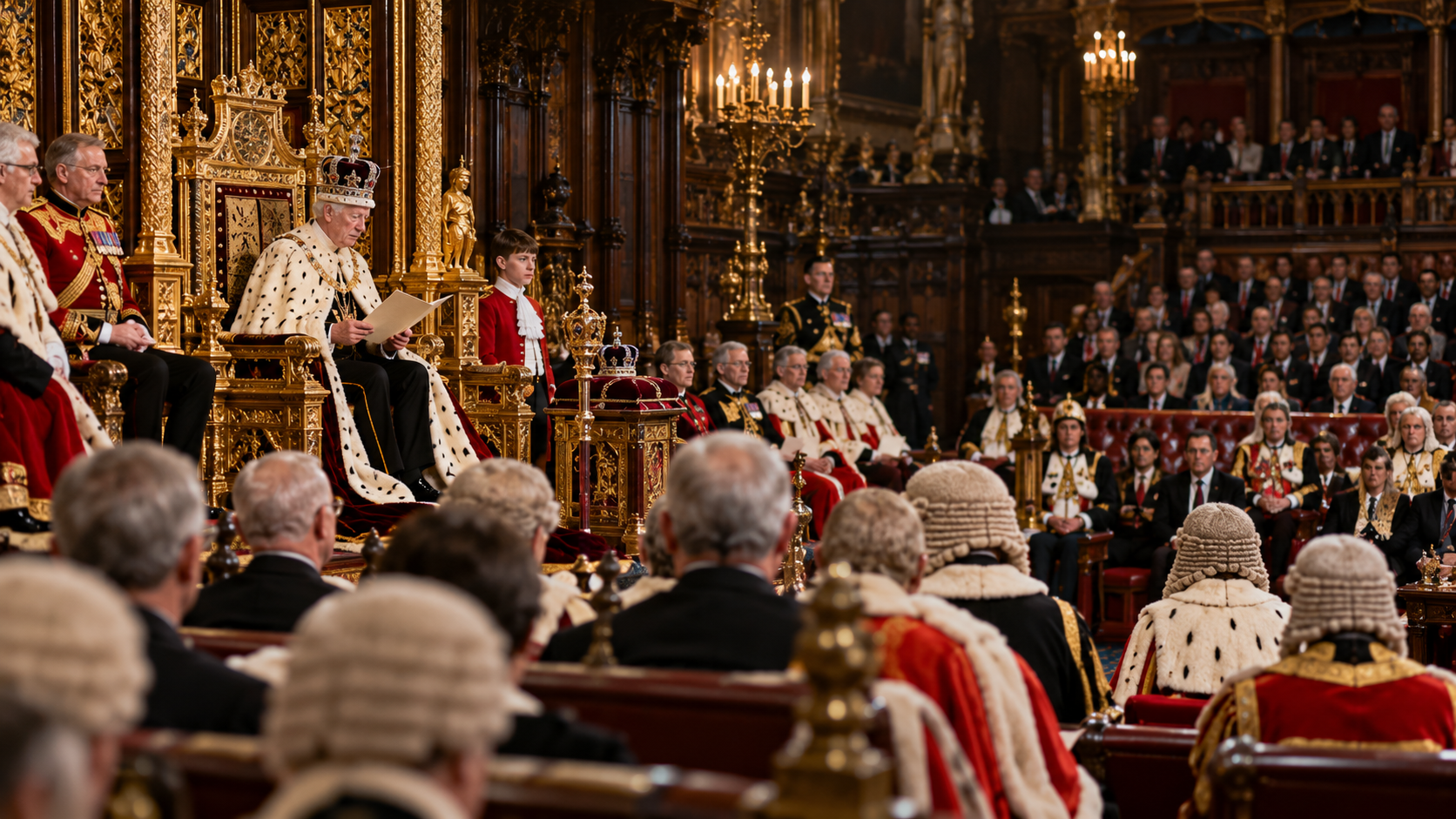
At the State Opening of Parliament, the King reads the King's Speech. It sets out the government's intended legislative programme. The government writes it.
That makes the ceremony an unusually grand example of reading someone else's words. The monarch is giving formal expression to the elected government's programme, not presenting a personal manifesto.
The speech doesn't itself turn proposals into law. Bills still have to go through the relevant parliamentary processes. Ministers can promise legislation in the speech and then face argument, amendment and opposition over the detail.
It is also why you shouldn't infer the King's personal enthusiasm for every line from his delivery. Political neutrality requires him to carry out the role for governments with different policies.
The signature at the end
Royal Assent is the monarch's formal approval of a bill, allowing it to become an Act of Parliament. In modern constitutional practice, assent is granted; it is not a routine opportunity for the King to veto policies he dislikes.
The Commons Library's detailed account traces both the legal process and the history of the power. The last refusal was by Queen Anne in 1708. That history is interesting partly because refusal is so remote from how ordinary lawmaking now works. Commons Library on Royal Assent.
This can feel contradictory: an act is required, yet its performer isn't expected to make an independent political choice. Many institutions contain formal steps of that sort. Understanding who is entitled to decide is as important as identifying whose name appears at the end.
The private meeting
The King also has regular audiences with the prime minister. The Royal Household describes the weekly meeting as private, with the monarch able to advise and warn while remaining politically neutral.
Privacy means we cannot reliably reconstruct those conversations from the photographs. It would be a mistake to turn every visit into evidence that the King endorsed a policy, rejected one or secretly persuaded a minister to change course.
Beyond the constitutional work, there is representation: state visits, diplomatic occasions, national commemorations and public recognition of service. These are visible parts of the role, and they are often what people mean when they describe the monarch as embodying continuity.
That is an argument for the institution, rather than a measurable fact about how every citizen experiences it. Some people value having a head of state outside party competition. Others object that the position is inherited, or question its expense and accountability. You can understand the work without being required to approve the arrangement.
Keep the geography straight
This account concerns the United Kingdom. The same person can be monarch of other independent countries, but that does not make those countries extensions of the UK government. Their constitutional arrangements must be considered separately. Crown dependencies are another distinct category.
The practical answer, then, is visible in that first appointment. The King supplies the formal act and the continuity of the office. The ability to govern depends on confidence in the elected Commons.
When the new prime minister leaves the palace, the difficult political job goes with them.