What are you paying for in a bottle of wine?
Tax, production, packaging and reputation all shape a wine's price. None can tell you exactly how much you'll enjoy it.
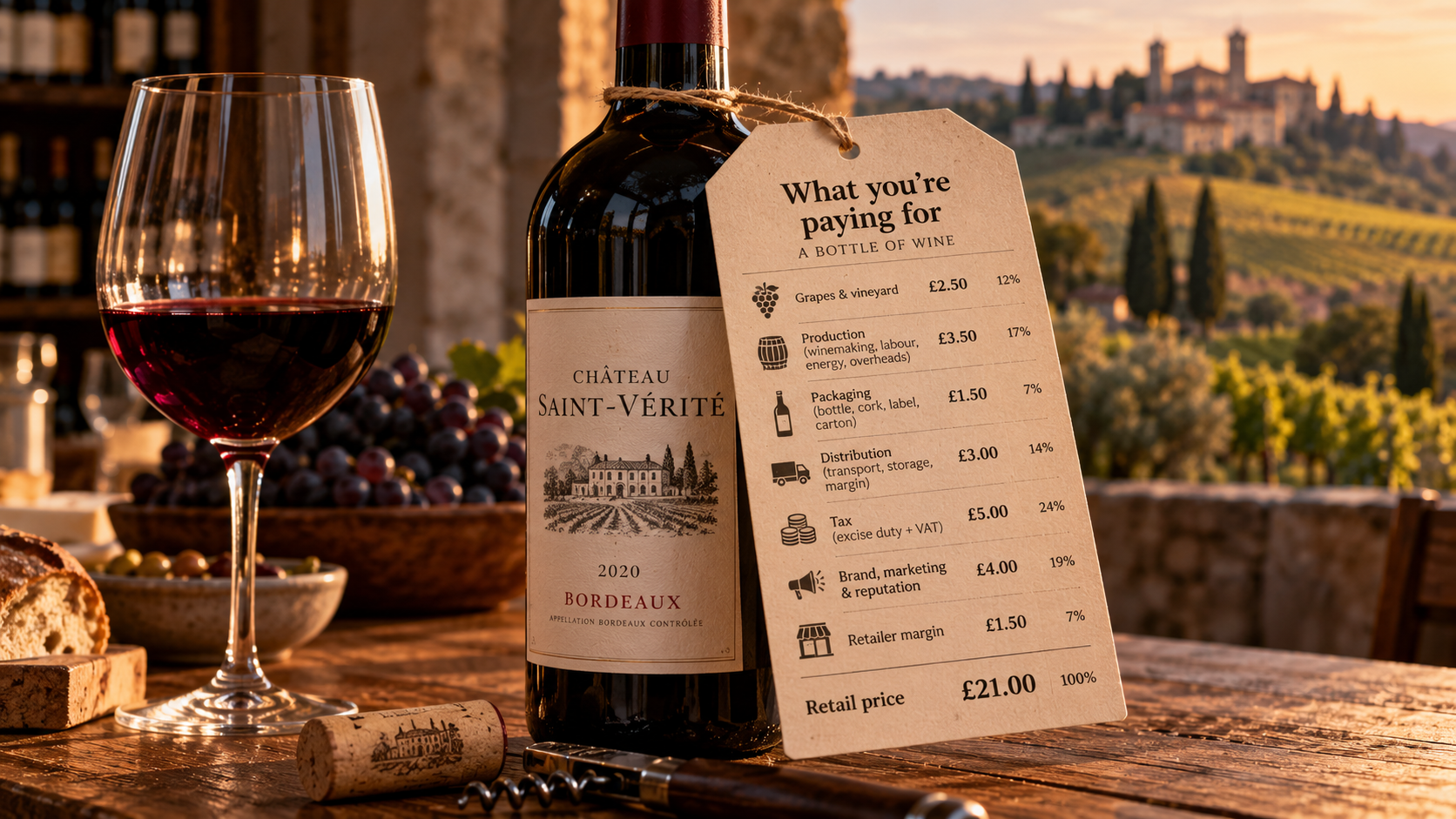
Two prices and one misleading conclusion
Imagine two 75cl bottles on a shop shelf. One costs £8, the other £16. Same size, roughly the same strength, neither obviously dressed for a royal wedding.
It is tempting to assume the second contains twice as much goodness. Or, if you're feeling suspicious, that the first proves everyone buying the second has been conned.
Neither conclusion follows from the label. A bottle's price pays for several things before it reaches your glass. Some change the wine. Some get it to the shop. Some pay for the reputation printed on the front.
The £8 and £16 bottles here are illustrative, rather than a comparison of named products. That matters: without the producers' and retailers' actual figures, a precise breakdown of their costs would be guesswork.
The part we can calculate
UK shop prices for wine include alcohol duty and VAT. VAT is charged at the standard rate of 20%, which means it accounts for one-sixth of a VAT-inclusive price, not one-fifth. GOV.UK on alcohol taxes.
In the illustrative £8 bottle, the VAT component is £1.33 to the nearest penny. In the £16 bottle, it is £2.67. Subtracting VAT leaves approximately £6.67 and £13.33 respectively, before accounting for duty and every commercial cost.
Those figures tell us something definite. They do not tell us the value of the liquid.
Duty is a separate charge, and the UK system links it to alcohol strength and category. A graphic built around one permanent duty charge for “a bottle of wine” will age badly. Bottle size and strength matter, and rates change. The two-bottle comparison becomes less tidy if their alcohol levels differ.
The safe conclusion is modest: there are costs in a shelf price which aren't the vineyard or winemaking, and they can occupy a larger share of a cheap bottle's total. It doesn't follow that every extra pound goes straight to the grapes.
Before the wine reaches the shop
Someone has to grow the grapes, harvest them and turn them into something worth drinking. Land, labour and equipment all have to be paid for. A producer farming a small, difficult site has a different business from one operating at large scale on easier ground.
Then come the production choices. Keeping wine in a cellar before selling it ties up stock and space. Oak barrels cost money. Using them also influences style, which isn't the same as guaranteeing quality. You may actively prefer a fresh wine made without an obvious oak character.
Packaging adds another bill: glass, closure, labels and the means of protecting bottles in transit. Transport, storage, importing and distribution have costs too. At the end of the chain, the retailer has staff, premises and a business to sustain.
None of this makes a cheaper wine inherently shabby. Scale can lower costs. Straightforward packaging can be sensible. A wine intended to be enjoyed young needn't spend years occupying a cellar merely to justify its existence.
It does explain why “How much did the grapes cost?” is a narrower question than “Why is this on the shelf at that price?”
The name on the label
Scarcity and reputation can also influence what buyers will pay. A sought-after bottle may command far more than its production cost. People can be buying access to a limited supply, confidence in a familiar producer, or the pleasure of owning something with a story.
That doesn't make the wine fraudulent. It means you should be clear about what you're interested in. A collector's reason for buying a bottle may have little to do with what you want alongside Tuesday's dinner.
The bottle itself can make a persuasive entrance. Heavy glass feels substantial. A restrained label looks expensive. Neither gives you a reliable preview of the flavour.
And flavour still has to meet your preferences. More intensity, more oak or more maturity may be exactly what you want. It may also be the opposite. Paying more for a style you dislike is an expensive way to confirm that you dislike it.
Ask a better question in the shop
Tell a wine merchant what you've enjoyed, what you're eating and the budget you actually want to spend. Ask what changes between two suggestions: grape, region, producer, ageing or style. A useful answer should give you something more specific than “This one's better.”
If you choose to compare wines, small pours are enough, and nobody has to finish a glass. Cover the labels if you want to notice how much they influence your expectations. This is a preference exercise, not a tasting exam.
You might find a clear favourite. You might prefer the cheaper one. You might discover that the extra money bought a difference you can recognise but don't particularly value.
That's useful knowledge. The best answer to “What am I paying for?” includes whether you enjoyed it.