What £100 a month could become
A worked illustration of regular monthly contributions, compounding, inflation, fees and the uneven reality behind investment returns.
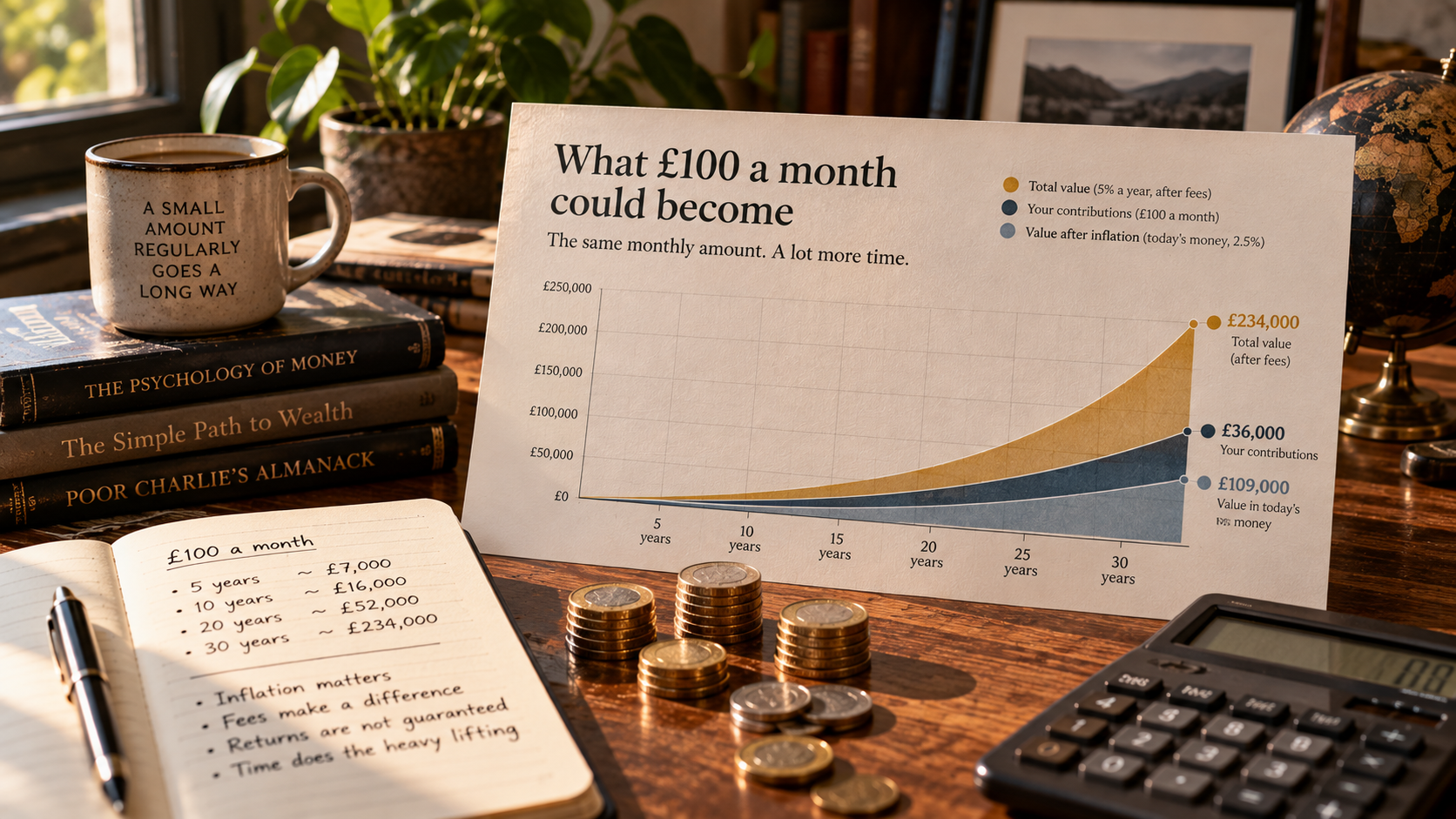
The money you put in
Put £100 aside every month for 30 years and you will have contributed £36,000.
That part is not finance. It is multiplication.
The interesting part begins when the money earns a return and those returns are allowed to earn returns of their own.
This is compounding. It is often illustrated with enormous numbers and breathless promises about becoming a millionaire by giving up coffee. A better way to understand it is to separate the money you actually put in from the hypothetical growth around it.
So take a deliberately plain example: £100 at the end of every month. No initial lump sum. No clever trading. No attempt to predict a particular investment.
After 10 years you have paid in £12,000. After 20 years, £24,000. After 30 years, £36,000.
If there were no growth at all, those are also your ending balances. Everything above them in the examples below comes from the assumed return, compounded over time.
Three possible paths
Now give the same £100 monthly contribution three hypothetical annual growth rates: 3%, 5% and 7%. These are illustrations, not forecasts. Real investments do not produce a fixed return every year, and fees, tax and losses can all change the outcome.
At 3% annual growth, £100 a month becomes roughly £13,945 after 10 years, £32,685 after 20 and £57,871 after 30.
At 5%, the same contributions become roughly £15,436 after 10 years, £40,580 after 20 and £81,538 after 30.
At 7%, the illustration reaches roughly £17,105 after 10 years, £50,754 after 20 and £116,945 after 30.
The point is not that you should expect 7%. The point is to look at the shape of the numbers.
In the 7% illustration, you personally contributed £36,000. The other roughly £80,945 is hypothetical growth. More importantly, much of that growth arrives late. At year 20 the balance is around £50,754. Ten years later it is around £116,945, despite only another £12,000 of contributions going in during that final decade.
Time has had more money to work on, and the earlier returns have themselves had time to compound.
That is also why fees matter. A small annual charge does not merely remove money once. It removes money that could otherwise have remained invested and potentially compounded for years. The FCA explicitly warns that charges can mount up over time and eat into investment returns.
Then there is inflation.
£100,000 in thirty years will not buy what £100,000 buys today. If inflation averaged 2% a year for the whole period, the purchasing power of our £116,945 future balance would be roughly equivalent to £64,600 in today's money. The 5% illustration would be worth about £45,000 in today's purchasing power.
Those inflation figures are also illustrations. Future inflation will not politely remain at 2%. They simply show why a large future number and a large increase in real buying power are not the same thing.
The uneven reality
The neat examples above contain one enormous fiction: the line is smooth.
Markets are not.
A real investment might rise sharply one year, fall the next, recover, go nowhere for a while and then fall again just when you have become convinced you understand it. Some investments can lose a substantial part of their value. Some can fail completely. Higher potential returns generally come with higher risk, and there is no guarantee that accepting more risk will actually deliver the higher return you hoped for.
That makes regular investing psychologically different from the spreadsheet version. The arithmetic asks whether you can keep putting in £100. Real life asks whether you can keep doing it when the balance has just fallen and the news is telling you why everything is terrible.
There are practical questions before that one. The FCA advises getting immediate finances in order before investing, including dealing with short-term debt and keeping emergency cash available. Money you may need soon is a poor candidate for an investment whose value can be down at the moment you need to sell.
None of this makes compounding less interesting. It makes it more honest.
The useful lesson in the £100 example is not that £100 a month becomes £116,945. It might not. The lesson is that regular contributions, time, returns, costs and inflation interact in ways that are hard to feel intuitively.
You control the contribution. You partly control the costs and the amount of risk you choose to take. You do not control the market return.
That distinction is a better place to start than any promise about where £100 a month will definitely end up.
You control the contribution. You partly control the costs and the risk. You do not control the market return.