Twenty-four and running Britain
William Pitt the Younger became Prime Minister at 24, outlasted the men who laughed at him, reshaped government and spent much of his short life fighting the consequences of revolution in Europe.
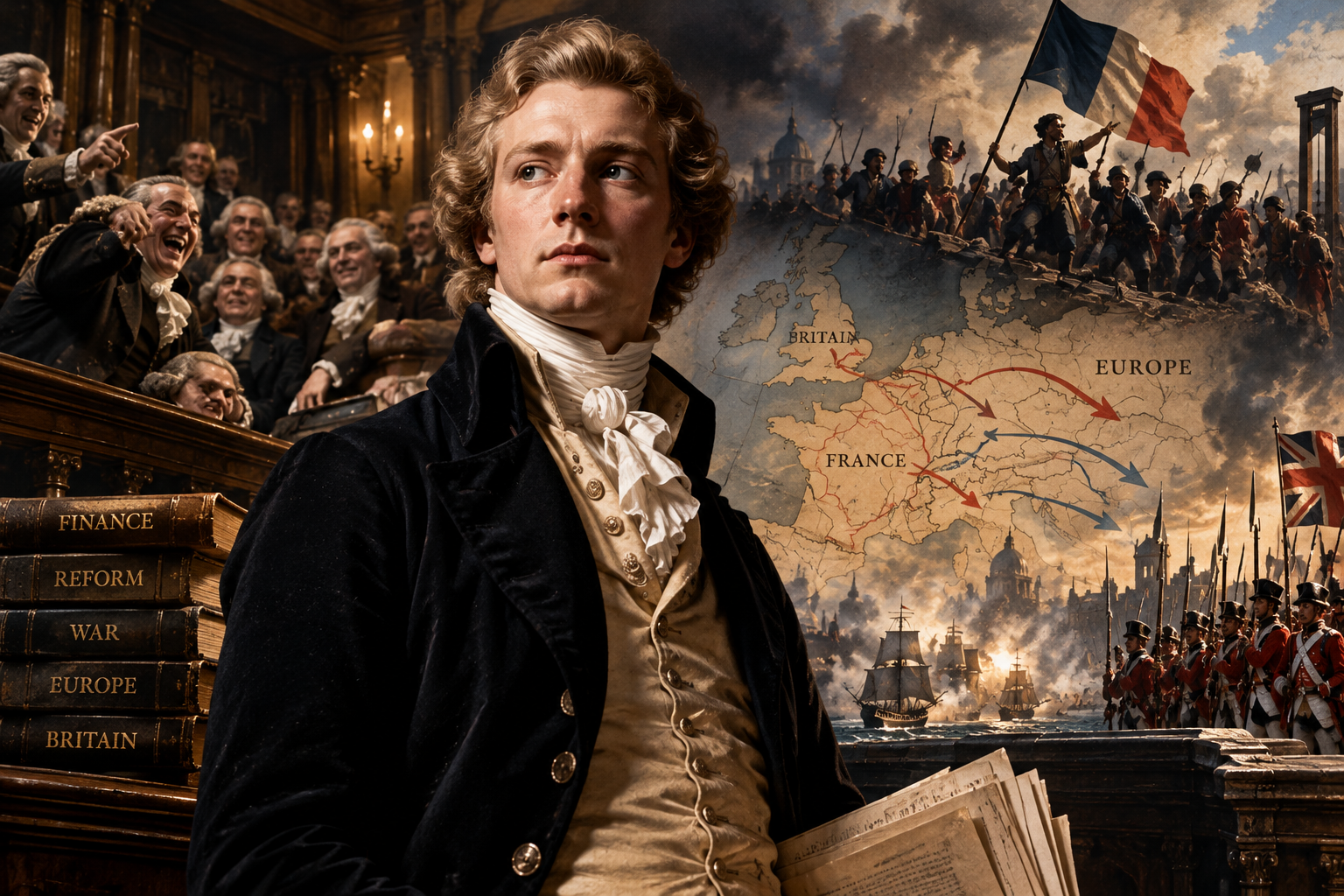
Opening
When William Pitt walked into Downing Street as Prime Minister in December 1783, he was 24 years old.
Charles James Fox laughed. His friends called Pitt’s new government a “mince-pie administration”, because they expected it to be finished by Christmas.
It was a reasonable joke. Pitt was young even by the standards of political prodigies. He had been in Parliament for less than three years. He had no great party machine behind him. His opponents controlled the House of Commons and treated him as a boy put in place by George III.
They got the boy right. They got almost everything else wrong.
The boy with the famous name
Pitt was not a rags-to-riches story. His father was William Pitt the Elder, the Earl of Chatham, one of the towering political figures of the eighteenth century. The younger Pitt grew up around politics, argument and public life. He went to Cambridge at 14 and trained in law at Lincoln’s Inn.
A famous surname opened doors. It did not remove every obstacle. Pitt’s finances were insecure enough that he could not simply pay the considerable expense of fighting a parliamentary election. His first seat, Appleby, came in 1781 through the influence of Sir James Lowther.
Once inside Parliament, the speed of his rise was ridiculous. Chancellor of the Exchequer at 23. Prime Minister and Chancellor at 24.
The more interesting question is what happened after the door opened.
The administration that refused to die
Pitt took office with the Commons against him. Fox and Lord North had the numbers and expected to force him out. Pitt simply kept going. He endured defeats, resisted pressure to resign and waited while public opinion shifted. George III dissolved Parliament in March 1784. The election that followed gave Pitt the position his first ministry had lacked.
He then stayed in office for seventeen years.
Pitt had a gift that is less glamorous than great oratory but often more useful in government: he liked the machinery. Finance, administration, trade, debt, taxation, the East India Company. He was interested in making the state work better.
His government attacked some of the corruption and inefficiency that had accumulated around eighteenth-century politics. He created a sinking fund intended to reduce the national debt and pushed through the India Act of 1784, increasing government control over the East India Company’s political affairs.
He also tried and failed to reform Parliament. Pitt was no modern democrat, but the young Prime Minister was prepared to challenge parts of the system that had helped men like him get into it.
Then France exploded
Pitt might have preferred to be remembered as a financial reformer. History had other plans.
The French Revolution began in 1789. Louis XVI was executed in 1793. Britain went to war with revolutionary France, and much of the rest of Pitt’s career became an attempt to find the money, allies and political endurance to survive it.
The young reformer became a wartime Prime Minister. His government introduced repressive measures against radical movements at home. His attempts to build coalitions against France repeatedly ran into the military reality that France, and later Napoleon, was very difficult to beat.
War also forced Pitt into something British taxpayers have been enjoying ever since. In 1799 he introduced Britain’s first income tax to help pay for the conflict.
There was Ireland too. The rebellion of 1798 was followed by Pitt’s Act of Union, which joined Great Britain and Ireland into the United Kingdom of Great Britain and Ireland from 1801. Pitt believed Catholic emancipation should follow. George III did not. Rather than abandon the policy, Pitt resigned.
A Prime Minister with pistols
There are details that stop Pitt becoming a marble bust.
In 1798, while Prime Minister, he fought a duel on Putney Heath with the opposition MP George Tierney after an argument in the Commons. Neither man was hit. Pitt later wrote to his mother that the business had ended without anything unpleasant happening to either party, which is an impressively calm description of two politicians firing pistols at one another.
His private finances remained messy. He drank heavily. He never married. Politics consumed almost all of his adult life.
And he returned.
When war with France resumed, Pitt came back as Prime Minister in 1804. By then his health was failing. Trafalgar in 1805 destroyed Napoleon’s hopes of invading Britain, but on land the news was worse. Napoleon smashed the allied armies at Austerlitz.
Forty-six
Pitt died in January 1806. He was 46.
That number is worth sitting with. He had first become Prime Minister at 24 and, apart from three years out of office, had spent the rest of his life carrying the government of a country at war or preparing for one.
He began with advantages most people could never have had: education, family, connections and a name that everyone in British politics knew. But none of those things explain seventeen years in power after his enemies had expected seventeen days.
The interesting part of Pitt is the distance between opportunity and achievement. A door opened unusually early. He walked through it and then worked until, quite literally, there was not much of him left.
Go further
William Hague’s William Pitt the Younger is a very readable full biography and a good place to go next if Pitt has got under your skin. Hague understands the politics, but the book also keeps sight of the strange fact at the centre of Pitt’s life: just how young he was when all of this began.