Try standing on one leg
Try a supported one-leg stand as balance practice, with no competitive target or prediction about your health.
Find something solid to hold
Standing on one leg is the kind of movement that can become a competition almost before anyone agrees to compete. Somebody starts a timer, somebody else announces a personal best, and an ordinary exercise acquires the atmosphere of a school sports day.
You can leave all of that out. Try it as a small piece of balance practice, with support close enough to use and no number that determines whether you have passed.
Choose a clear, level floor beside a fixed worktop or another secure support. Avoid a chair that might move, a loose rug or a place where another person could bump into you. Keep your eyes open. Leave the toothbrush, hot drink and phone elsewhere so you have one job at a time.
If you already feel unsteady, have fallen recently or have a condition affecting balance, ask a physiotherapist or appropriate clinician for an exercise that suits you. The supported version is not a requirement to attempt something that feels unsafe.
Lift one foot a little
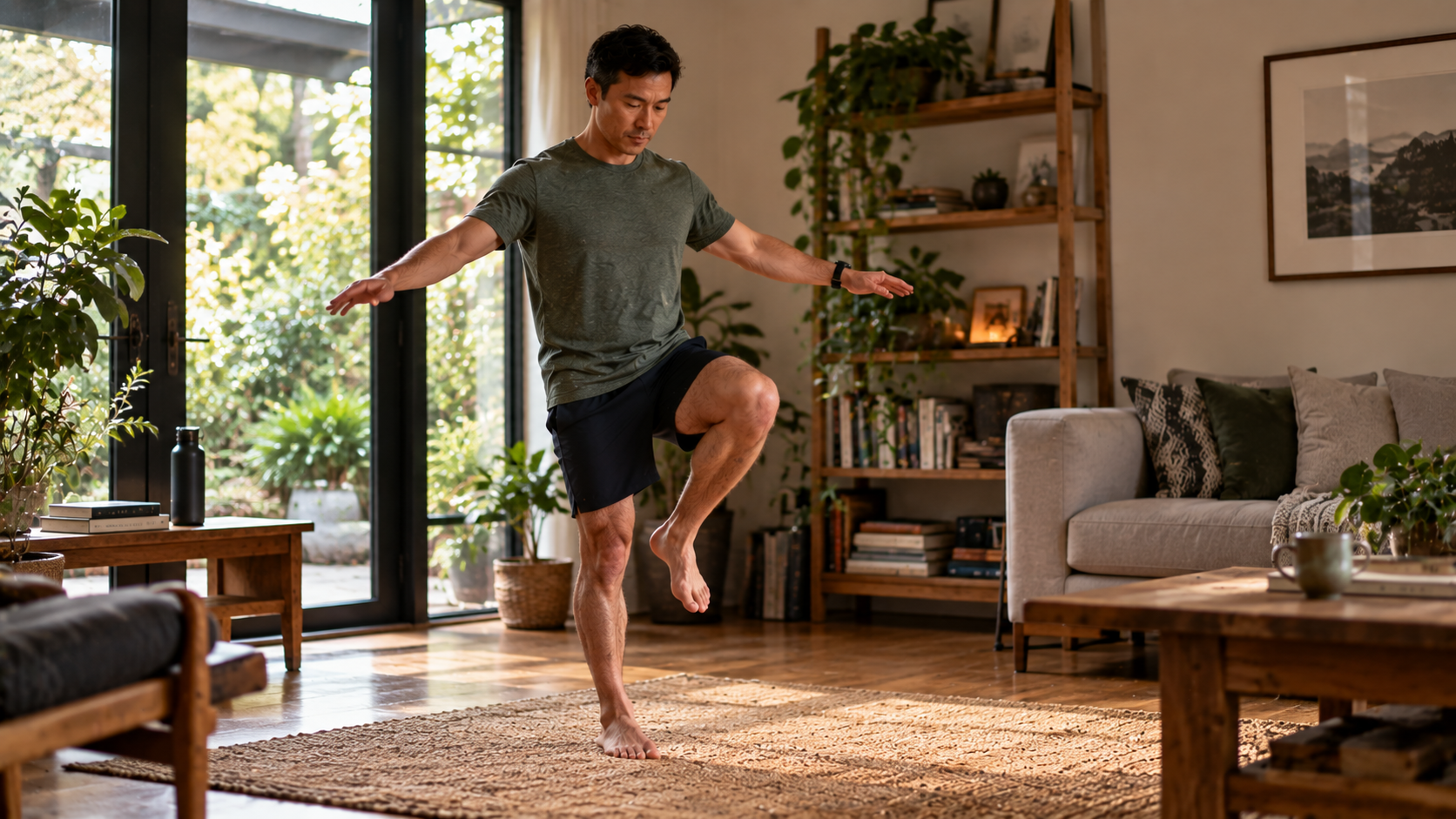
Begin with both feet on the floor and a hand on the support. Stand comfortably tall. Shift your weight gently onto one leg, keeping that knee softly bent rather than locked. Lift the other foot a small distance, keeping your hips level, then put it down under control.
You do not need to raise the knee high. The task is to manage the change in support. If lifting is too much, keep the other toes lightly touching the floor and ask for guidance on a suitable starting exercise.
The NHS balance guide describes a supported one-leg stand held for five to ten seconds, repeated three times on each side. Treat that as something to work towards comfortably, rather than a reason to stay up while you are losing control. Start with less time if needed and rest between attempts.
Keep breathing. Use the support whenever you need it. Put the foot down before a wobble turns into a scramble.
Notice what happened
One side may feel different from the other. You might find yourself gripping the support tightly or looking down. Those observations can help you choose a manageable version next time. They do not, by themselves, diagnose a condition.
Nor does an improvised test at home tell you how long you will live. A headline about balance and health cannot turn one attempt on your kitchen floor into an individual prediction. The surface, footwear, fatigue and way you perform the task all affect what happens.
If a new or persistent problem with balance concerns you, seek medical advice rather than repeatedly testing it. The exercise is there to provide practice, not a private examination that you must keep retaking until the result feels reassuring.
Make the next attempt familiar
If the movement is comfortable, try another brief session on a different day in the same safe place. Familiar conditions make it easier to notice whether it feels more controlled.
There is no need to introduce a wobble board, close your eyes or stand somewhere precarious to make the exercise look more impressive. Progression can wait until the current version is secure and, where appropriate, someone qualified has helped you choose the next step.
Then finish. Both feet on the floor, hand away from the support, back to whatever you were doing. A little balance practice can stay little. It does not need to become a verdict on the rest of you.