The pubs Britain forgot to modernise
A handful of British pubs still preserve the rooms, hatches, screens and awkward layouts of an older drinking culture. Step inside and you can still see how the Victorian pub actually worked.
Opening
Walk into the Turf Tavern in Bloxwich and, for a moment, the modern pub disappears.
There is no open-plan dining area. No wall of identical beer taps. No reclaimed-industrial lighting hanging over tables that were probably installed last Tuesday.
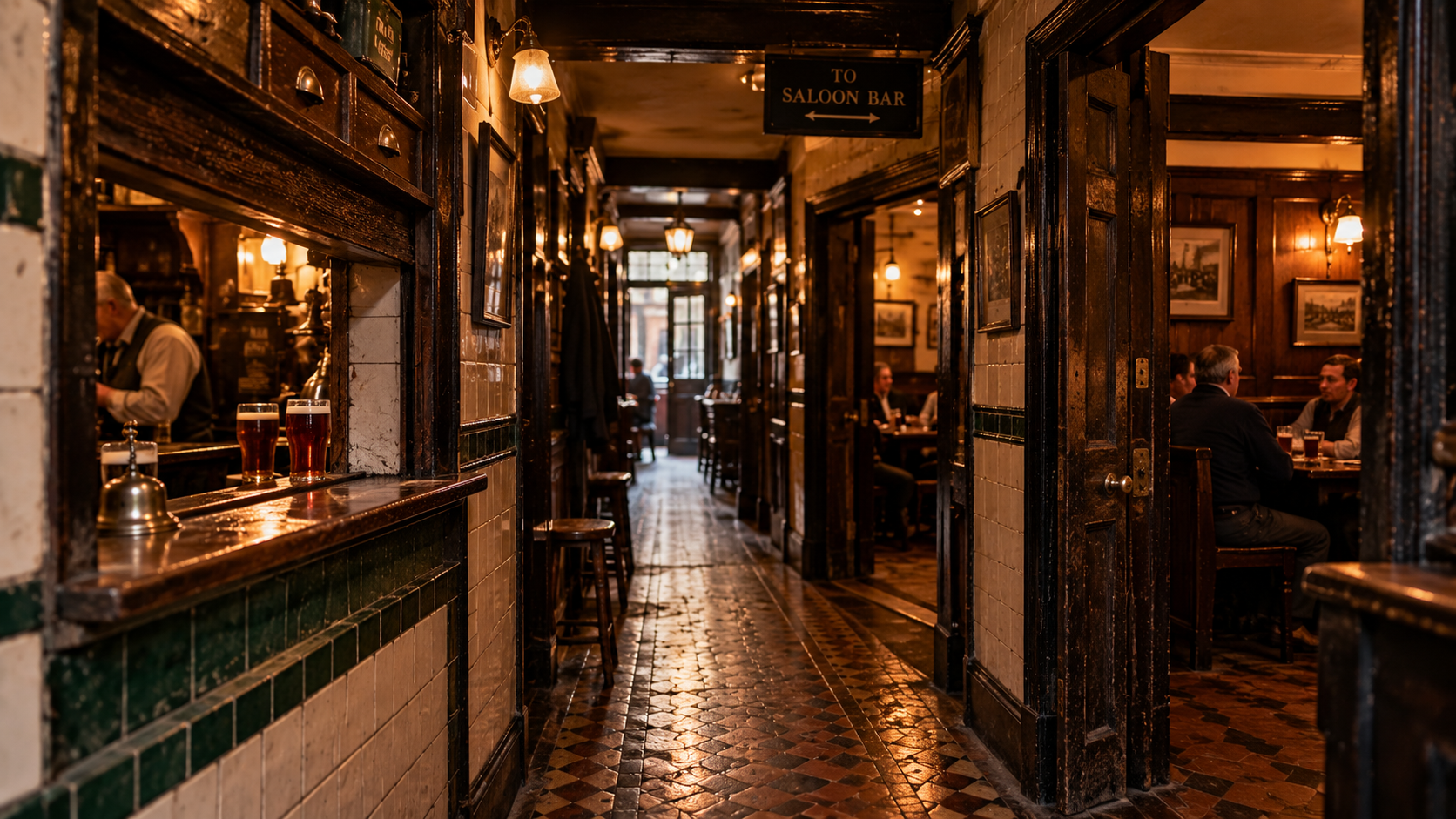
Instead, there is a tiled passage running through the building, little rooms leading off it and serving hatches cut into the wall. The Victorian bar-back still has its drawers. The hand pumps are stamped 1927. Out the back are the remains of the old home brewery, including a malt room and three pigsties.
The same family has owned the place since 1871.
CAMRA describes it as the last truly unspoilt terraced pub of its kind in the country. Once, places like this existed in their thousands. Now the Turf is rare enough to be Grade II listed and its interior is considered of outstanding national historic importance. (https://camra.org.uk/pubs/turf-tavern-bloxwich-119229)
That is the strange thing about Britain's oldest pubs.
The buildings aren't necessarily the interesting bit.
Britain has plenty of ancient inns. Some claim medieval origins. Others have beams, fireplaces and stories involving highwaymen that become slightly more impressive each time they're told.
But there is another, much rarer kind of survivor.
The pub that nobody completely redesigned.
Before pubs became one big room
The Victorian pub was often divided into a collection of small spaces.
There might be a public bar, saloon, snug, smoke room, private bar and an off-sales counter where you could buy beer to take home. Different rooms had different prices, customers and degrees of respectability.
Walls mattered.
Doors mattered.
Even the route you took to the bar could tell you something about who the room was intended for.
Then Britain spent much of the 20th century knocking those walls down.
Changing drinking habits, brewery ownership, new licensing expectations, food service and the simple desire to fit more people into a building transformed thousands of pubs. Small rooms became large bars. Serving hatches disappeared. Snugs were opened up. Old counters were ripped out.
Which makes the ones that escaped rather wonderful.
At the Crown Inn in Glossop, the building dates from the 1840s and sits at the end of a terrace built in 1847. Inside, a small lobby bar still feeds separate rooms. There is an old mahogany counter, fixed seating and shelves where people can stand with a drink. The pub deliberately operates without food or electronic distractions. (https://camra.org.uk/index.php/pubs/crown-inn-glossop-121082)
The Free Trade in Berwick-upon-Tweed is another survivor. Built in 1847, it has had no major alterations since 1910 and is one of the very small number of pubs in Northumberland recognised by CAMRA for an interior of outstanding historic importance.
Then there is Ye Horns Inn in Goosnargh, Lancashire.
Its origins go back to at least the late 18th century. Inside is something almost absurdly rare: a bar counter with functioning sliding screens. Behind the servery sits a snug that can only be reached through the serving area, one of just three known surviving examples in England. (https://historicengland.org.uk/listing/the-list/list-entry/1439858)
These aren't recreations.
Nobody has bought a job lot of Victorian mirrors and attempted to manufacture atmosphere.
The awkwardness is part of the point.
A pub is a piece of social history you can order a pint in
Stand in one of these rooms and you begin to see what pubs once were.
Not simply somewhere to drink, but a complicated little map of British society.
The snug offered privacy. The public bar was plainer and cheaper. The saloon was more comfortable and usually charged a little more. Some pubs had separate entrances so customers didn't even need to mix on the way inside.
At the British Oak in Blackheath, two large public rooms remain completely separate. To move from one to the other, you have to go outside. That would be an eccentric design decision today. Historically, it made perfect sense. (https://londonpubsgroup.camra.org.uk/viewnode.php?id=206165)
Once you notice these things, old pubs become much more interesting.
That little hatch isn't decoration.
That blocked doorway once had a purpose.
The oddly positioned screen, the bench fixed to the wall, the separate entrance nobody uses anymore. They're bits of evidence.
You are effectively sitting inside the archaeological remains of a night out.
Except the archaeology serves bitter.
Go while they're still pubs
There is something especially good about history that hasn't been placed behind glass.
You don't need to whisper in these places. You don't need a ticket. Nobody hands you an audio guide.
You open the door.
Someone is sitting in the corner reading the paper. Two people are arguing amiably about football. There is a fire going. Somebody asks what you're having.
And a room designed for exactly this purpose more than a century ago carries on doing its job.
Britain has grander historical survivors.
Castles. Cathedrals. Country houses.
But there is something rather brilliant about a Victorian bar counter still having elbows rested on it.
Find one.
Order a pint.
And have a proper look around.