The most beautiful car ever made? Let's argue.
The early E-Type coupé makes a persuasive case for automotive beauty. The Miura makes a very different one.
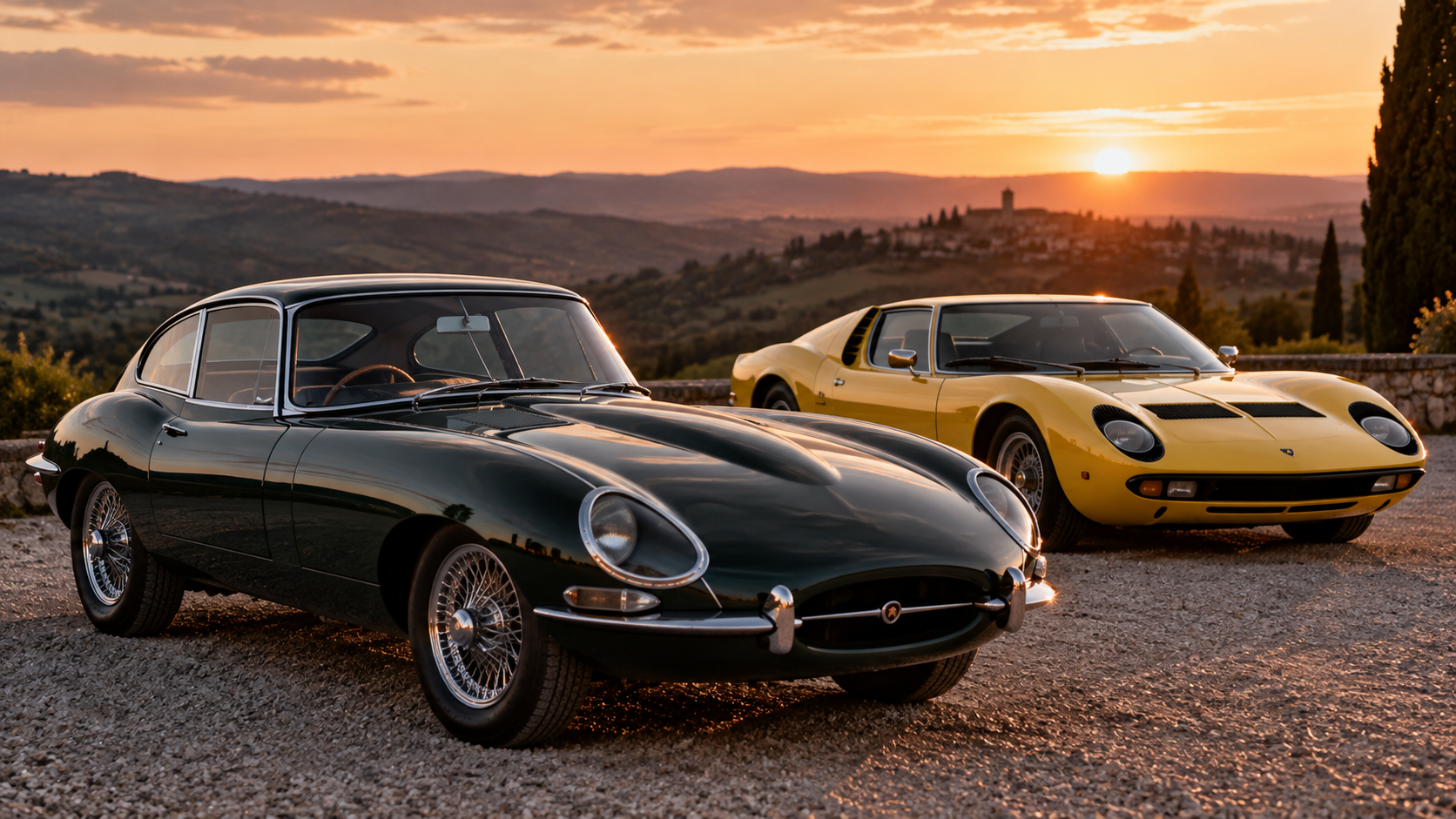
Start with the roof
The most beautiful car ever made is the early Jaguar E-Type fixed-head coupé. Specifically, the two-seat, 3.8-litre Series 1. Yes, the one with the roof. We might as well begin the argument properly.
The open car gets the sunlight, the glamour and the photograph of someone looking terribly pleased with themselves at the wheel. The coupé gets that long curve from the windscreen over the cabin and down towards the tail. It completes the shape. Take the roof away and you lose one of the best lines on the whole car.
This is a vote, not a finding. There is no international unit of automotive beauty, and acceleration figures cannot settle it. Put the stopwatch away. We're looking.
Follow it from the side
The bonnet is almost unreasonable. The cabin sits well back, as though the engine has been allowed to reserve most of the car. Yet the body doesn't appear to sag between the wheels. Its lower edge stays taut, and the rear wheel sits inside a rounded haunch rather than underneath a decorative lump.
That matters because length alone isn't elegant. A limousine is long. A delivery van can be long. Here the length creates anticipation: your eye travels along the bonnet, rises over the small cabin and comes down towards a tail that seems to draw the whole thing together.
Then look at the front. The oval opening is small, the covered headlamps sit back inside the wings, and the centre of the bonnet rises between them. There is detail, certainly, but your eye still reads a complete surface. Nothing has been stuck on to inform you that this is a fast car.
Jaguar introduced the E-Type in 1961. Malcolm Sayer is central to its shape, but the familiar lone-genius credit is too neat. MoMA credits Sayer alongside William Lyons and William M. Heynes for its E-Type roadster. These cars came out of an organisation of designers, engineers and people who had to turn a line into metal. MoMA's collection record.
You can admire the calculation behind the form without pretending beauty is a maths problem. The proportions still have to please you.
The Miura walks in
The strongest objection is a Lamborghini Miura P400. Preferably in a colour that would look absurd on your kitchen cupboards.
Lamborghini presented it in 1966, with its V12 mounted across the car behind the cabin. Bertone supplied the body. Its layout gives it a different balance from the Jaguar: the mass sits around the occupants rather than stretching away in front of them. The low nose, curved wings and headlamp “eyelashes” make it theatrical without turning it into a collection of sharp edges. Lamborghini's model history.
The Jaguar looks drawn out. The Miura looks gathered up, ready to move. Where the E-Type's roof finishes a long sentence, the Lamborghini's cabin feels tucked inside the body. Both are coherent; they're simply pursuing different kinds of beauty.
And the Miura has mischief. The front can look almost friendly, which is quite an achievement for something with that much presence. It doesn't need to scowl at you.
A preference you can point to
The E-Type still wins here because of the roof, the bonnet and the way the tail resolves them. Three parts which, from the side, become one shape. The coupé would remain worth looking at if you knew nothing about its speed, its value or who had owned one.
You might prefer the Miura's compact drama. You might bring a Ferrari 250 GT SWB, a Citroën DS or an Alfa Romeo into the discussion and ruin the evening's timetable.
Good. But bring a photograph, and point to the bit you love.