The horse that could do maths
A performing horse fooled crowds without anyone deliberately cheating. The explanation turned out to be better than the trick.
Opening
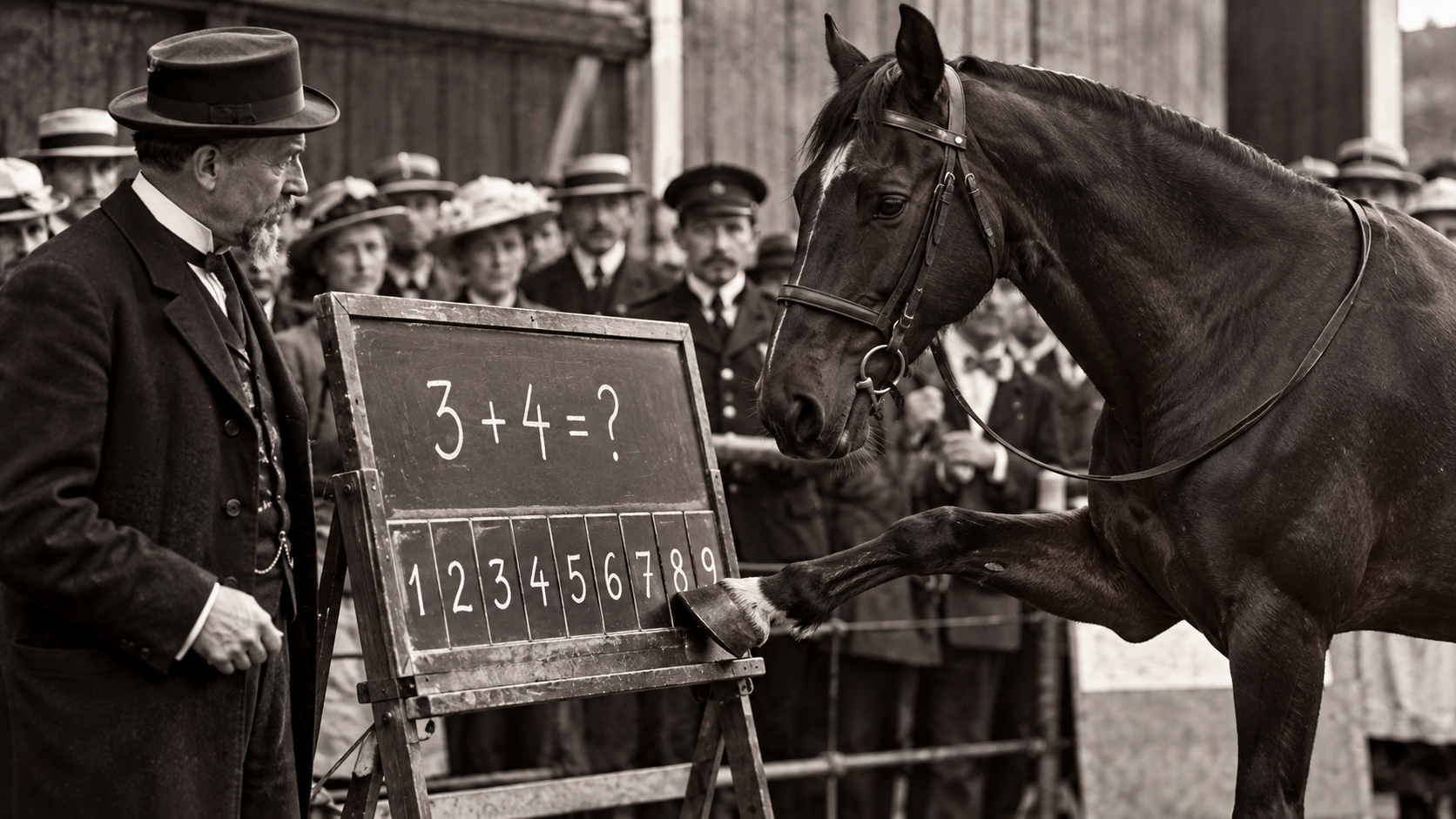
At the start of the twentieth century, Berlin had a horse that could apparently do arithmetic.
Ask Clever Hans to add numbers and he would tap the answer with his hoof.
He could subtract. Work with fractions. Tell the time. Pick out dates.
There was an obvious explanation.
Someone had trained a very clever horse.
Herr von Osten's pupil
Hans belonged to Wilhelm von Osten, a retired teacher who had spent years educating him. Von Osten did not present himself as a magician. He seems to have genuinely believed the horse had learned to reason.
The performances attracted public attention and scepticism. Was the owner secretly signalling the answers?
A commission investigated and found no straightforward fraud.
That made the puzzle better.
The psychologist Oskar Pfungst began a more systematic investigation. He changed who asked the questions. He changed what the questioner could see. He changed what Hans could see.
And the horse's intelligence developed a very specific weakness.
If nobody present knew the answer, Hans usually could not give it.
If Hans could not see the person who knew the answer, his performance also collapsed.
What Hans was actually reading
Pfungst realised the horse was responding to tiny movements made by the humans around him.
When Hans began tapping, people who knew the answer would subtly change their posture as the correct number approached. A slight inclination, a tightening, a shift in the head or body. When the hoof reached the expected answer, that tension released.
Stop.
Hans had learned that part brilliantly.
The extraordinary thing is that the cues did not need to be deliberate. The questioner could be completely honest and still give the answer away.
Pfungst went further. He studied the movements in people and showed that humans could produce these signals without being aware of them.
There was no conspiracy between a fraudulent owner and a trained animal.
There was a horse paying extremely close attention to humans who did not know they were talking with their bodies.
A better trick
Clever Hans became the name behind what researchers now call the Clever Hans effect: an experimenter can unintentionally influence a subject through subtle cues.
The story is usually told as a debunking. Horse cannot do maths. Mystery solved.
That undersells Hans.
He had not learned arithmetic, but he had learned something most of the audience had missed entirely. Human beings leak information.
The people watching were looking for a trick. Pfungst changed the conditions and asked when the trick stopped working.
That difference cracked the case.
And somewhere in Berlin, a horse kept staring at people closely enough to notice things they did not know they were doing.