The experiment where everyone else was obviously wrong
A simple line test became one of psychology's most famous demonstrations of what happens when your own eyes disagree with the room.
Opening
The question was almost insultingly easy.
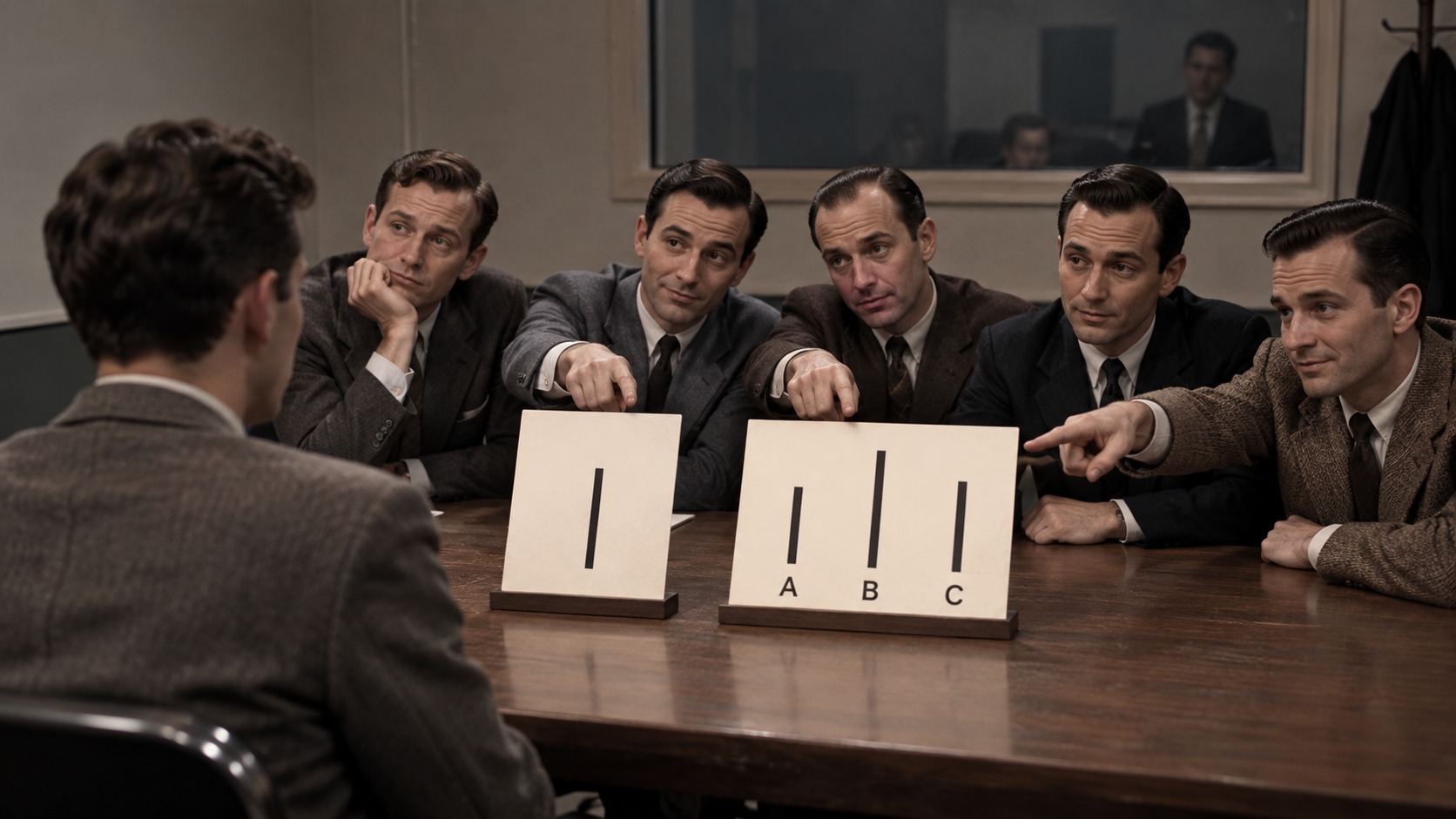
A man sat at a table and looked at a card with one vertical line on it. Beside it was another card showing three lines marked A, B and C. One of those three was clearly the same length as the first.
Which one?
He gave his answer aloud. So did the other men in the room.
At first, nothing strange happened. Then the answers started going wrong.
Not slightly wrong. Obviously wrong.
And everyone else agreed.
A room full of wrong answers
In the 1950s, the psychologist Solomon Asch ran a series of experiments into conformity. The real participant believed he was taking part in a visual judgement test with several other volunteers. In fact, the others were working with Asch.
On selected trials they had been told to give the same incorrect answer before the real participant spoke.
Imagine the awkwardness of it. You can see that line B matches the example. The first man says C. Then the next says C. Another says C. Around the table it goes.
Now it is your turn.
In control conditions, people made almost no mistakes on the simple line task. Put them in a room with a unanimous majority giving the wrong answer and something changed. Across the critical trials, participants went along with the incorrect group roughly a third of the time. Around three quarters conformed at least once.
That also means a sizeable minority never did. The experiment is not proof that people mindlessly follow crowds. It is stranger than that. Some held their ground every time. Some gave in occasionally. Some later said they had doubted their own judgement. Others knew the group was wrong but did not want to be the odd one out.
One other person
Asch kept changing the room.
One of the most revealing changes was to break the unanimity. If another person gave a different answer, the pressure to follow the majority fell sharply. The dissenter did not even have to become your wise and loyal ally. The simple fact that the room was no longer speaking with one voice mattered.
There is an odd physical quality to this experiment even when you only read about it. The lines are right there. No hidden knowledge is required. No expert has information you lack. There is no complicated calculation.
You are being asked what you can see.
And still the answer of the room can get inside the answer in your head.
The uncomfortable bit
It is tempting to enjoy Asch's experiment from a safe distance. Look at those poor subjects in the 1950s, folding under pressure over three little lines.
But the clever part of the experiment is how little is at stake.
Nobody is threatening them. There is no career on the line, no friendship to lose, no political tribe, no money, no public post that can be screenshotted forever. They are strangers answering a dull visual test.
And even there, the room has weight.
Asch did not need propaganda, a charismatic leader or an angry mob. He needed some cardboard, a few straight lines and several people saying the same wrong thing with confidence.
That was enough.