The cavalryman who learned to fight with tanks
Patton struggled at school, repeated his first year at West Point, rode with the cavalry, competed at the Olympics and studied war obsessively before becoming one of the most aggressive armoured commanders of the Second World War.
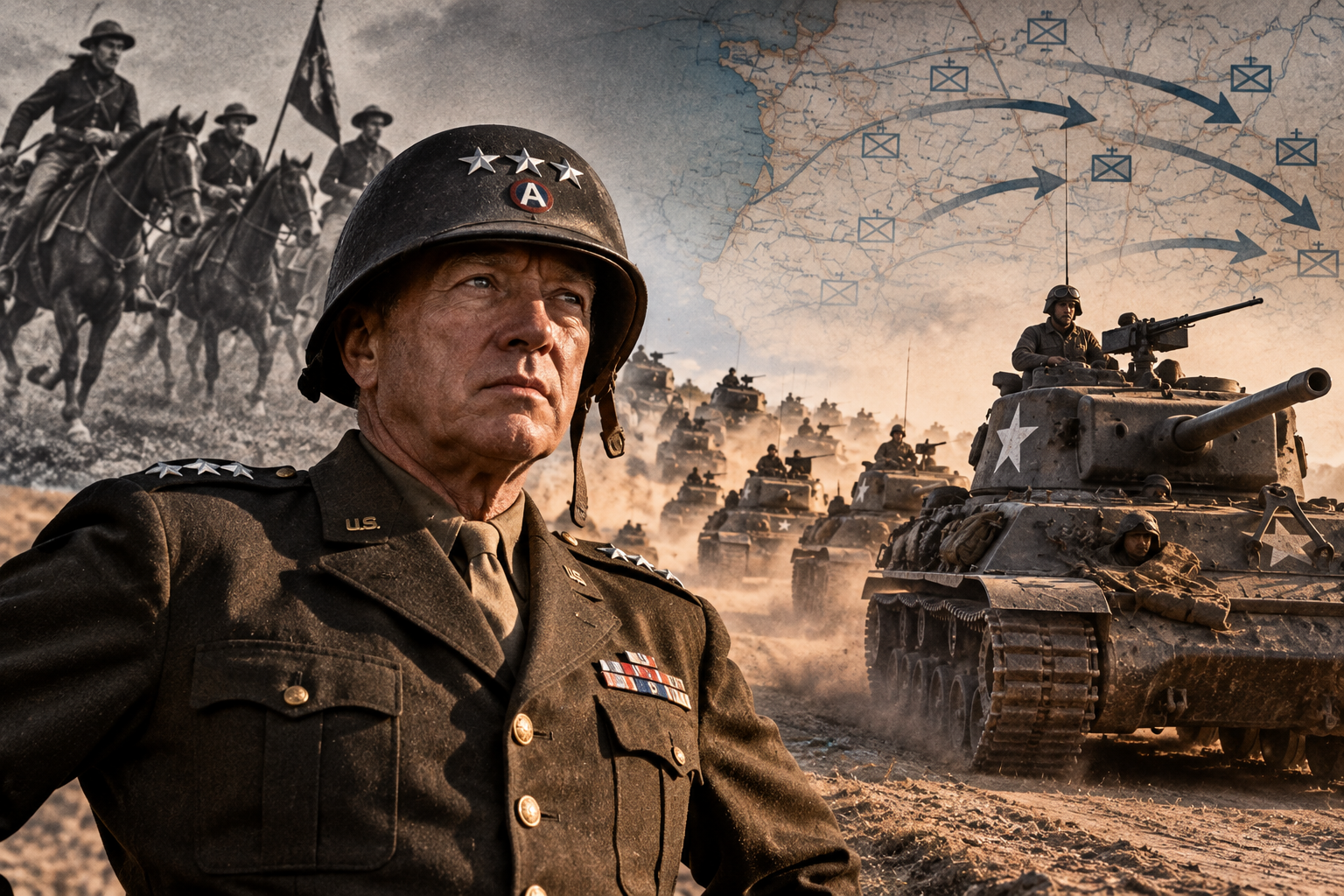
Opening
George Patton began his army career on a horse.
He graduated from West Point in 1909 and joined the 15th Cavalry. He learned swordsmanship, became an accomplished rider, played polo and later taught at the Mounted Service School at Fort Riley. He even designed a new cavalry sabre.
Thirty-five years later he was commanding an American army of tanks, trucks, artillery and aircraft racing across France.
That journey from sabre to Sherman is the easiest way into Patton. He looked like a man from an older age and, in many ways, wanted to be one. Yet when war changed, he changed with it.
The part that did not come easily
Patton did not come from humble beginnings. His Californian family was wealthy, educated and steeped in military history. Stories of soldiers and war surrounded him from childhood. He grew up expecting that he too would become a soldier.
School was harder.
Patton is now widely described as dyslexic, although the term was not used as a diagnosis in his childhood in the way it is today. Army histories describe his difficulty with reading and his struggle with mathematics. He wanted West Point badly enough that when he did not initially secure an appointment, he spent a year at the Virginia Military Institute instead.
He finally entered West Point in 1904 and failed mathematics in his first year. He had to repeat it.
For a young man convinced that he was meant for military greatness, that could have been humiliating enough to break the idea. Patton responded by working.
He graduated in 1909. Not brilliantly, but successfully. More importantly, he had begun a habit that stayed with him for the rest of his life: when he found something he did not know, he studied it.
Building a soldier
Patton treated soldiering almost as a craft to be mastered.
He read military history constantly. Ancient campaigns, Napoleon, cavalry, weapons, tactics. He fenced seriously enough to train in France. In 1912 he represented the United States in the first Olympic modern pentathlon, an event built around the imagined skills of a military officer: riding, fencing, shooting, swimming and running. He finished fifth.
At Fort Riley he attended the Cavalry School and became an instructor in weapons. The connection with the old American cavalry world is real, although Patton was not a member of Custer’s 7th Cavalry. Custer’s regiment had been formed at Fort Riley decades earlier. Patton arrived there in a later generation, when the horse was still central to the Army but its future was already narrowing.
Then Mexico gave him a glimpse of what was coming.
Horseman, motor cars, tanks
In 1916 Patton joined General John J. Pershing’s expedition into Mexico in pursuit of Pancho Villa. During the campaign he took part in an armed action using motor cars. A cavalry officer was already discovering that speed no longer had to come from a horse.
When America entered the First World War, Patton went to France with Pershing. He soon moved into the new Tank Corps. Tanks were crude, slow, mechanically unreliable and deeply unromantic compared with cavalry. Patton threw himself into them anyway.
He helped establish the American tank school, trained crews and commanded tanks in combat. At Saint-Mihiel and during the Meuse-Argonne offensive he saw what armoured vehicles might become. He was wounded in 1918 while directing tanks forward.
The cavalryman had found his next horse.
The general people remember
The Patton of the Second World War is the one most people recognise: polished helmet, stars, riding breeches, pistols, profanity and a voice designed to make soldiers move.
Behind the theatre was decades of preparation.
He commanded in North Africa and Sicily, then took over the Third Army after the Normandy landings. Once released into France in August 1944, Third Army became famous for speed. Patton pushed men and machines hard, exploited gaps quickly and hated giving an enemy time to recover.
His most celebrated operational turn came during the Battle of the Bulge. With American forces under pressure around Bastogne, Patton redirected elements of Third Army north and attacked into the German flank. It was the sort of movement that looked spontaneous from the outside but depended on a staff and commander who had already thought about the possibility.
Patton’s aggression could be extraordinarily effective. It could also become cruelty.
The same engine
In Sicily in 1943, Patton struck two hospitalised American soldiers whom he believed were avoiding combat. The men were suffering what would then have been described in terms such as battle fatigue or nervous exhaustion. Patton’s behaviour caused a scandal and nearly ended his combat career.
It belongs in the story because it came from the same man.
The relentless standards he imposed on himself were standards he could impose brutally on others. His certainty could produce speed and decisiveness. It could also produce arrogance, offensive remarks and serious failures of judgement.
Patton was not an uncomplicated model of anything. He was a man who spent most of his life trying to turn himself into the soldier he had imagined as a boy. He studied, trained, competed, failed, repeated, adapted and kept going.
The odd thing is that the warrior he imagined belonged to the age of horses and swords. The war that made his name belonged to engines, radios and mass production.
He mastered both.
Go further
Carlo D’Este’s Patton: A Genius for War is the book to pick up if you want the man behind the film version. It is big, detailed and very good on the contradiction at the centre of Patton: the swaggering public general and the intensely driven, often uncertain man who spent a lifetime preparing himself for war.