The Arctic town where you supposedly cannot die
The illegal-to-die story is a myth. Burial restrictions and limited healthcare reveal the real demands of Arctic life.
A law nobody could obey
There is a very shareable story about an Arctic town where dying is illegal. Longyearbyen, it says, has taken such a firm line on mortality that residents must do it somewhere else.
It is an excellent pub fact with one substantial disadvantage: it isn't true.
Visit Svalbard explicitly identifies the claim as an urban myth. Longyearbyen is a town on Spitsbergen, the largest island in the Svalbard archipelago. Its unusual arrangements concern burial and the services a remote settlement can provide. They are not a prohibition on death. Visit Svalbard's FAQ.
The correction makes the place more interesting. Instead of a comic law, there is a community negotiating what it means to live far from the facilities most of us assume will be nearby.
The ground has a say
According to the local visitor authority, coffin burials are not permitted in Svalbard. Permafrost is one reason: it affects decomposition, while cycles of freezing and thawing can move coffins upwards.
That does not mean the cemetery has ceased to have any role. Urn burials are permitted for certain people, including those resident in Svalbard when they died. The difference between burying a coffin and burying ashes disappears easily when a complicated arrangement becomes a one-line curiosity.
It is worth keeping the distinction. “You cannot die here” and “there are restrictions on how people can be buried here” tell entirely different stories. One makes residents sound like characters in a fable. The other describes a practical response to the ground beneath their feet.
A hospital with limits
Longyearbyen does have a hospital. The University Hospital of North Norway, which operates it, explains that its services are more limited than those of mainland Norwegian hospitals. There is no delivery room, no CT or MRI scanner and no programme of scheduled operations. Longyearbyen Hospital's information.
Having a hospital, in other words, doesn't mean having every sort of hospital care. A building can provide valuable local treatment while still depending on facilities elsewhere.
The Norwegian government's 2023–24 Svalbard white paper describes emergency medical arrangements involving mainland services and air ambulance transport. It also explains that Longyearbyen does not provide the full range of long-term care, such as nursing-home places and homecare. People needing those services must obtain them in their home municipalities or countries. The government's account of health and other services.
None of this is a claim that someone approaching death becomes a criminal. It is a statement about what a particular settlement can support.
The things a town quietly depends on
Think about the geography hidden inside an ordinary appointment. A specialist needs equipment, staff, supplies and a population large enough to sustain the service. If the appointment turns into a hospital stay, another set of arrangements follows. If someone later needs continuing care, the question changes again.
In a large town, those dependencies can disappear behind a phone number. Distance makes them visible.
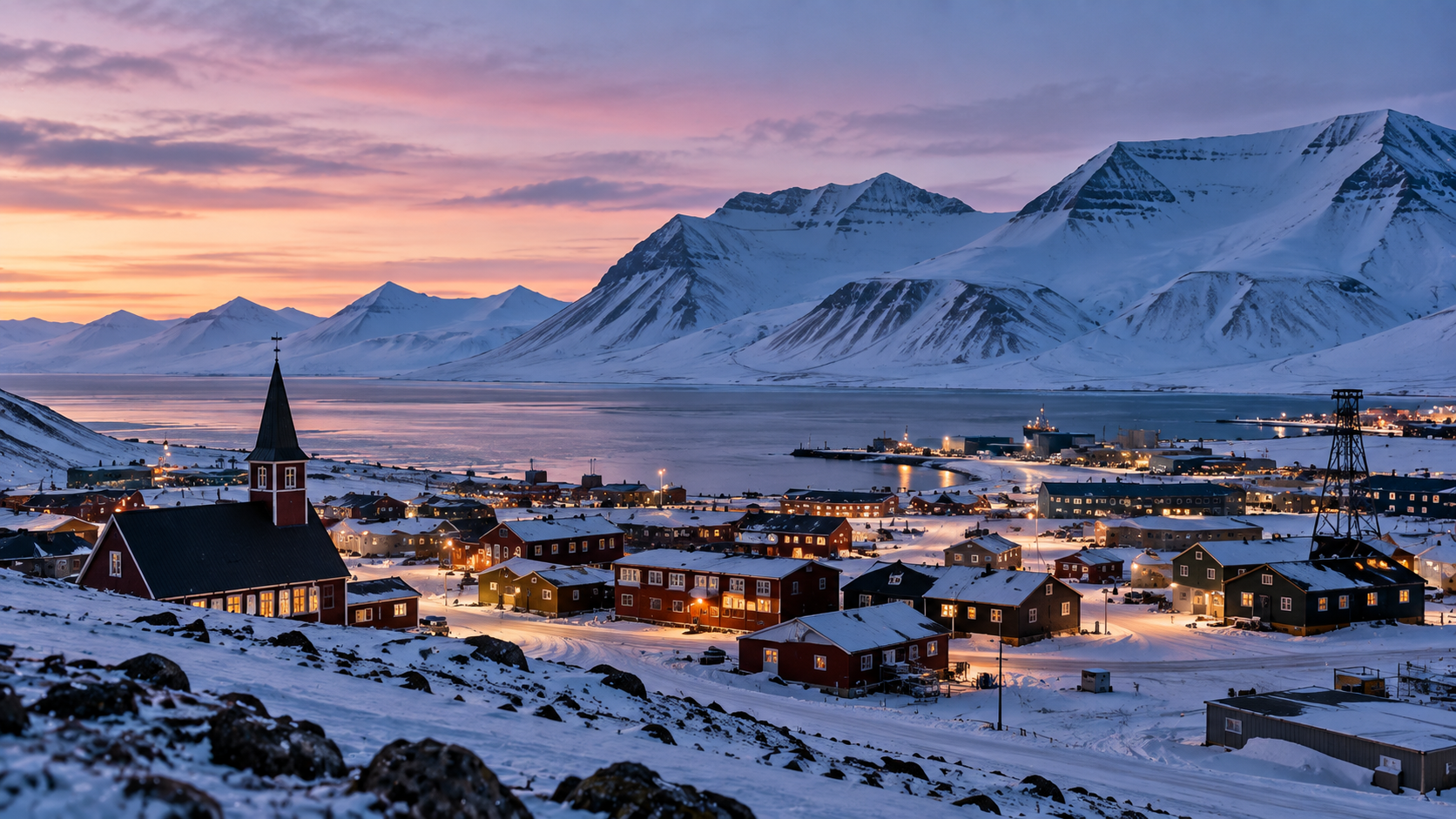
That visibility also changes how we should look at a photograph of Longyearbyen. Houses, roads and a bright patch of windows against the landscape are not evidence that remoteness has been abolished. They show people making a functioning place within it.
There is a temptation to collect remote communities as bundles of strange rules. It keeps the observer comfortable: these people live somewhere peculiar; we live somewhere normal. But every town relies on arrangements about water, waste, medical care and the dead. Some simply make those arrangements harder to ignore.
Longyearbyen's real story is not that people have defeated death through local administration. It is that living somewhere extraordinary still requires decisions about very ordinary human needs.