Number 1 London
Napoleon under the stairs, paintings recovered from his brother and gifts from kings and emperors. Wellington’s London home tells his story through the extraordinary things still inside it.
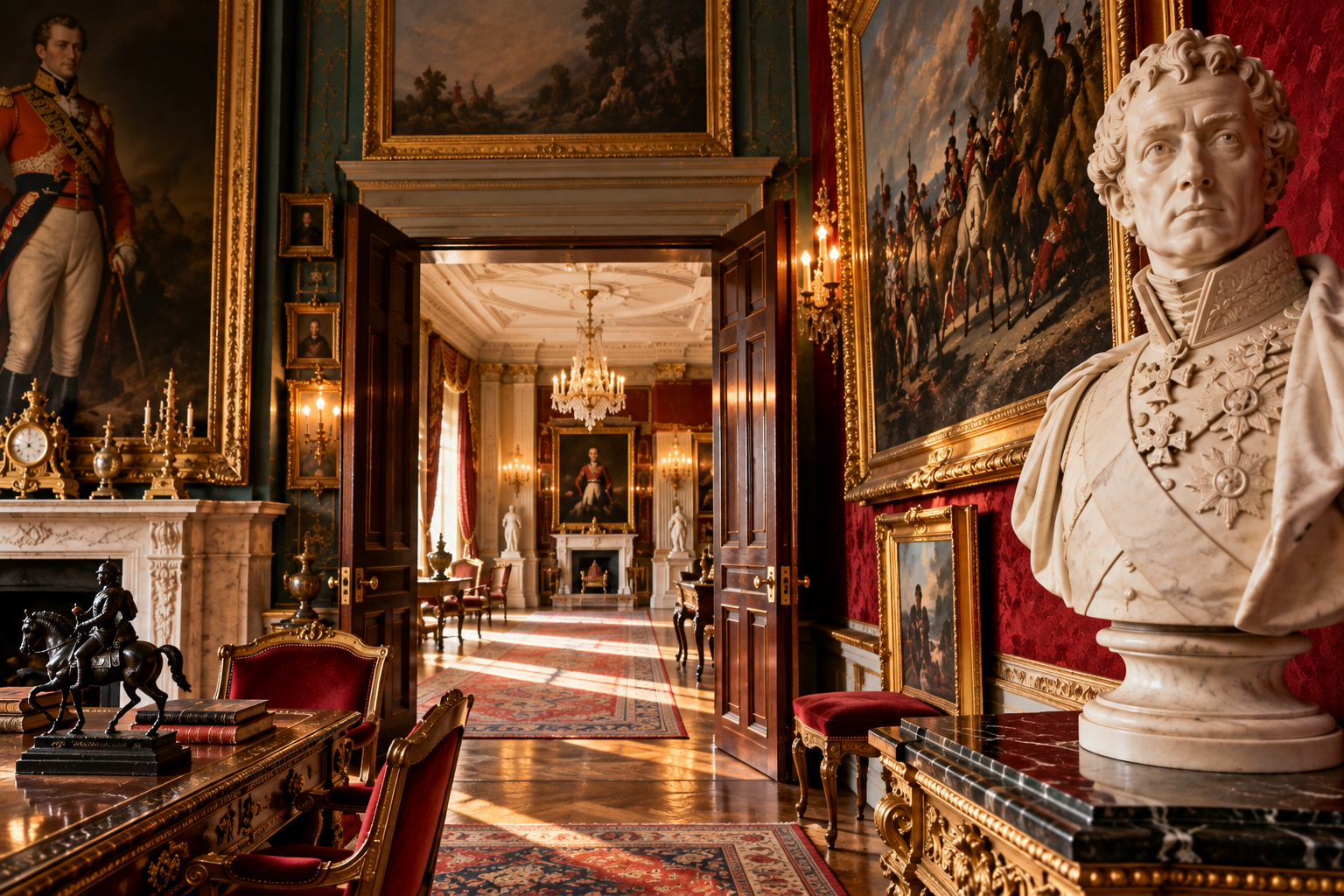
Opening
There is a colossal naked Napoleon standing at the bottom of the Duke of Wellington’s staircase.
He is more than three metres tall, carved from marble and built like a Greek god. In one hand he holds a staff. In the other, a winged figure of Victory.
Napoleon commissioned the statue himself. He hated it.
Antonio Canova had depicted him as Mars the Peacemaker, turning the French emperor into an idealised classical hero. Napoleon thought the finished statue was “too athletic”, and it was never put on public display in Paris.
Then Waterloo happened.
After Napoleon’s defeat, the British government bought the statue and presented it to the Duke of Wellington. So Napoleon’s enormous marble likeness ended up at Apsley House, standing in the stairwell of the man who had defeated him.
As interior decorating goes, that is difficult to beat.
And it is not even the best story in the house.
The first house in London
You can still find Apsley House at Hyde Park Corner, sitting in the middle of modern London among buses, traffic lights and streams of cars.
When Robert Adam built the original house for Lord Apsley between 1771 and 1778, this was the edge of town. Apsley House stood at the formal entrance to Hyde Park, opposite a turnpike and its toll houses. It was the first house on the north side of Piccadilly.
So it became known as Number 1, London.
Its actual address today is the rather less theatrical 149 Piccadilly.
The house was not built for Wellington. His elder brother Richard bought it in 1807, spent heavily on its interiors, and by 1817 was close to bankruptcy.
Arthur Wellesley, meanwhile, had recently defeated Napoleon at Waterloo and been made Duke of Wellington. Parliament had voted him £700,000 to build a new Waterloo Palace. Instead, Wellington anonymously bid £40,000 for his brother’s house, helping Richard out of his financial trouble and acquiring one of the most extraordinary addresses in London.
Then he began turning it into a house fit for the man Europe now regarded as Napoleon’s conqueror.
The paintings Napoleon’s brother left behind
One of the finest collections of Spanish art in Britain ended up inside Number 1 London because Napoleon’s brother had a very bad day in Spain.
In 1813 Wellington’s army defeated the French at the Battle of Vitoria. Joseph Bonaparte, Napoleon’s elder brother and the French-imposed King of Spain, fled. His baggage train was captured in the chaos.
Among the possessions recovered were paintings from the Spanish Royal Collection.
About 200 works were recovered, including paintings by Velázquez, Rubens, Goya and Brueghel. After the war, Wellington tried to return them. King Ferdinand VII of Spain formally gave them to him instead.
Eighty-three still hang at Apsley House.
Among them is Velázquez’s The Waterseller of Seville, painted when the artist was still a young man. It had travelled from Seville into the Spanish Royal Collection, been carried away during the French occupation, abandoned after Vitoria, recovered by Wellington’s army, offered back to Spain and finally installed in a house beside Hyde Park.
Some paintings have had a busier life than most people.
Europe sends its thank-you presents
Wellington did not have to buy everything that filled Apsley House.
After Napoleon’s defeat, monarchs and governments across Europe sent him gifts. The house accumulated silver, porcelain, swords, batons, paintings and sculpture, much of it presented by rulers grateful for his part in ending the Napoleonic wars.
Portugal’s contribution was particularly restrained.
It gave Wellington an enormous silver and silver-gilt dinner service. Its centrepiece still sits in the State Dining Room.
You begin to understand what Apsley House became. It was not simply where Wellington lived.
It was where Europe sent the thank-you notes.
Then there is the shield
In 1822 the merchants and bankers of London presented Wellington with something that makes a commemorative carriage clock look a little mean.
The Waterloo Shield is a huge silver-gilt ceremonial shield inspired by Homer’s description of the Shield of Achilles in the Iliad.
At its centre, Wellington sits on horseback while Victory crowns him. Around him, ten reliefs show scenes from his military career.
It is not subtle.
It is magnificent.
And Wellington did not hide it away. The shield was displayed every year at the Waterloo Banquets held at Apsley House.
Dinner with the survivors of Waterloo
Wellington began holding annual dinners at Apsley House to commemorate Waterloo in 1820.
At first they were held in the State Dining Room. But Wellington’s house kept growing with his status. After he became Prime Minister in 1828, he commissioned another major remodelling.
The result included the Waterloo Gallery, a double-height room running along the western side of the house. It was grand enough for a palace: gilding, mirrors, paintings and space for the annual Waterloo Banquet, which moved there from 1830.
Imagine the room on 18 June.
Wellington at the table. Around him, men who had commanded at Waterloo. The Waterloo Shield on display. Paintings covering the walls. Silver and porcelain given by the rulers of Europe. Downstairs, Napoleon standing silently in the stairwell.
The dinners continued throughout Wellington’s life.
And every year, inevitably, there were fewer men left who remembered Waterloo first-hand.
The battle stayed fixed in paintings, shields and silver. The people who had actually been there did not.
The hero behind iron shutters
If Wellington’s life had ended at Waterloo, the story would have been remarkably tidy.
It did not.
He was 46 when Napoleon was defeated and lived for another 37 years. That gave Britain’s great military hero plenty of time to discover that domestic politics could be rather less forgiving than a battlefield.
Wellington became Prime Minister in 1828. His government passed Catholic Emancipation in 1829, but his opposition to parliamentary reform helped make him deeply unpopular.
In 1830, amid political unrest, the windows of Apsley House were smashed. Wellington had iron shutters and railings installed to protect it.
English Heritage notes that this may have contributed to his famous nickname, the Iron Duke, although the origin is not certain.
It is a wonderful reversal.
The man celebrated across Europe as Napoleon’s conqueror, sitting in a house filled with gifts from kings and emperors, now had metal shutters over the windows because people in London were throwing stones at them.
Number 1 London
Wellington died in 1852, aged 83.
The following year his son opened part of Apsley House to the public. A Museum Room displayed Wellington’s trophies, military memorabilia and gifts. Nearly a century later, the 7th Duke offered Apsley House and a significant part of the Wellington collection to the nation. The Wellington Museum Act was passed in 1947, and the house opened in its modern public form in 1952.
Part of Apsley House remains a family residence. The public rooms preserve something stranger and more interesting than a conventional memorial.
They preserve a life in objects.
Paintings recovered from Napoleon’s brother. Gifts from monarchs. A shield depicting Wellington as an almost Homeric hero. A gallery built to remember Waterloo. Iron shutters from the years when the hero became unpopular.
And, in the stairwell, Napoleon.
Two centuries later, the Duke of Wellington is gone.
Napoleon is still waiting in his house.
Worth knowing
Apsley House is at Hyde Park Corner in London and is open to the public through English Heritage. Its official address is 149 Piccadilly, London W1J 7NT.