Magna Carta: The Failed Peace Deal That Changed the World
King John wanted it gone, the Pope annulled it and England fell into civil war. How did a failed medieval peace deal become one of the defining texts of the English-speaking world?
Opening
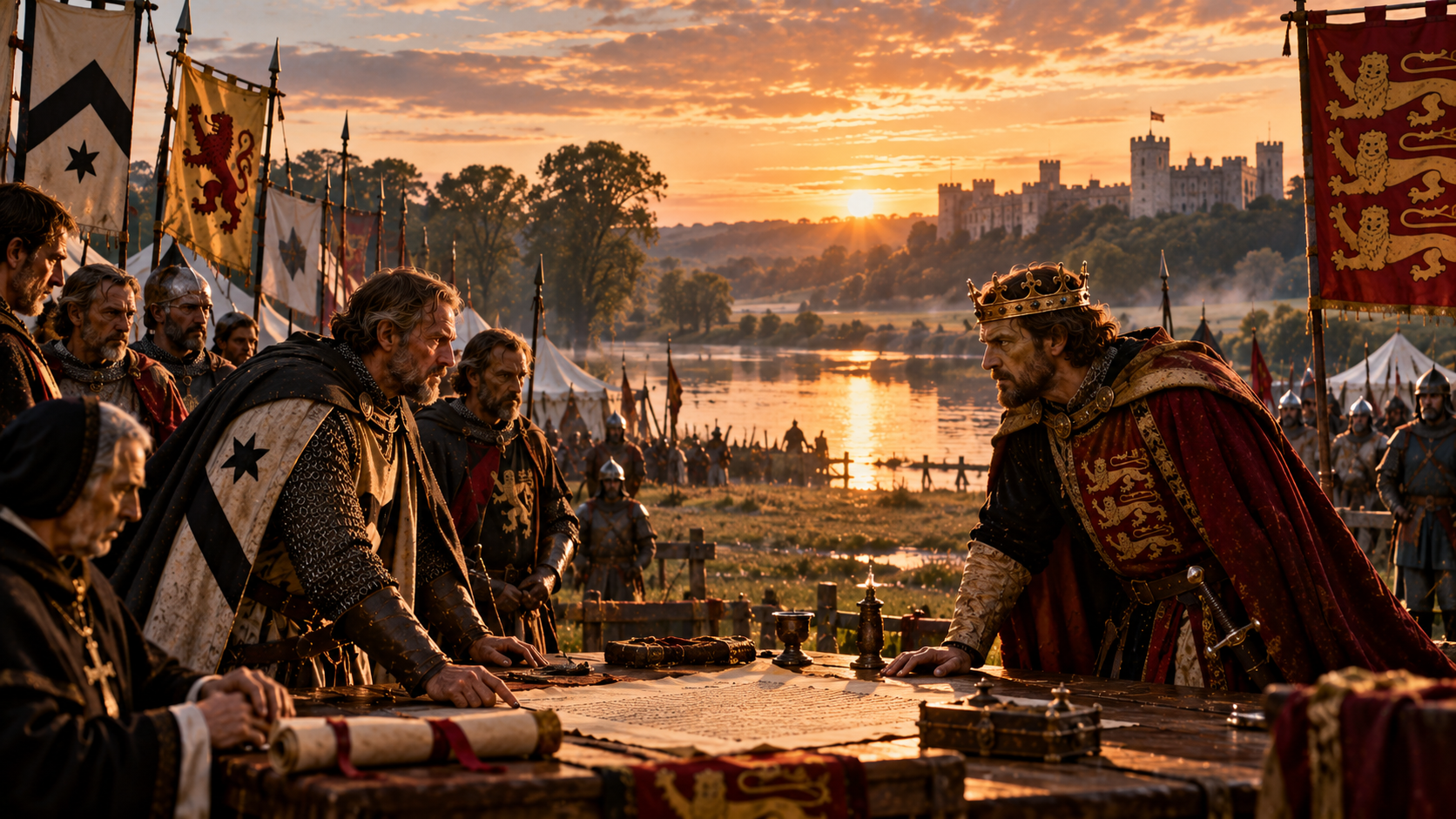
On 15 June 1215, in a water meadow beside the Thames, the King of England found himself negotiating with men who had already renounced their allegiance to him and taken London.
Runnymede sits between Windsor and Staines. Close enough to the royal castle to be convenient, open enough for two armed camps to watch one another. King John was on one side. Rebel barons and churchmen were on the other. The thing they were arguing over was not a grand theory of liberty. It was a peace deal.
John did not sign Magna Carta with a flourish, despite what centuries of paintings and schoolbook shorthand might suggest. Medieval royal charters were authenticated with a seal. Nor did the men at Runnymede think they were inventing liberal democracy. Most of the people forcing concessions from the king belonged to the wealthiest and most powerful layer of medieval society.
And yet the parchment produced by that ugly political crisis became one of the most famous documents in the world.
Magna Carta has been invoked by parliamentarians, judges, revolutionaries, American colonists, campaigners and people who would have been completely invisible to the men who wrote it. Its most famous clauses helped shape the language of due process and the rule of law. Its shadow reaches into modern constitutions.
Which is odd, because the original Magna Carta was a failure. King John tried to destroy it almost immediately. The Pope annulled it within ten weeks. England slid into civil war and the rebels invited a French prince to take the throne.
The interesting question is not simply why Magna Carta was written. It is how something that failed so quickly became almost impossible to kill.
A king who needed money
John became king in 1199 with a formidable inheritance. The Plantagenet lands stretched far beyond England into France. Five years later, Normandy and Anjou were gone, taken by Philip II of France.
John wanted them back. War required money, and the English crown became very good at finding it.
Medieval kings had plenty of ways to raise cash from the people who held land from them. There were payments connected to inheritance, wardship and marriage, as well as scutage, money paid in place of military service. None of this was new. What angered John's opponents was the scale and ruthlessness with which royal rights were being used.
The military payoff was not exactly reassuring. In 1214 John's attempt to recover his continental position ended in defeat at Bouvines, a battle in northern France that wrecked his strategy and weakened him at home.
By the spring of 1215 a group of barons had had enough. On 5 May they formally renounced their allegiance. Less than two weeks later the rebels entered London and took the Tower. That mattered. A quarrel with difficult nobles had become a rebellion with possession of the kingdom's largest city.
John still had supporters, castles and troops. The barons had armed force of their own. Neither side arrived at Runnymede as a debating society.
The charter that emerged was an attempt to make the king govern inside limits his opponents could live with.
What was actually on the parchment
There is a temptation to imagine Magna Carta as a medieval Bill of Rights: a compact page of timeless principles about liberty, courts and government.
It is much stranger than that.
The 1215 charter contained 63 clauses. There are rules about inheritance, debts, wardships, taxation, towns, trade, the Church, royal forests and the machinery of justice. One clause orders the removal of fish-weirs from the Thames, the Medway and other rivers. Another demands standard measures for wine, ale and corn, along with standard widths for cloth.
It is constitutional history mixed with the kind of practical grievance list you get when powerful men have spent years being annoyed by the administration.
Even the name came later. Magna Carta simply means Great Charter, and Parliament records that the term was first used in 1217 to distinguish it from the separate Charter of the Forest.
Most importantly, this was not a promise of equal rights for everyone. The famous protections referred to a "free man". In thirteenth-century England that did not mean every person. Large numbers of people were unfree, and the men negotiating with John were primarily trying to secure their own liberties, property and customary rights.
Still, there are sentences in the charter that refuse to stay in the thirteenth century.
Clause 39 said that a free man could not simply be seized, imprisoned, dispossessed or ruined by royal will. There had to be lawful judgment or the law of the land. Clause 40 followed with a line that still sounds startlingly clean more than 800 years later: "To no one will we sell, to no one will we deny or delay right or justice."
Magna Carta did not create the modern jury trial, universal human rights or democracy. Those claims turn a complicated history into a fairy tale. What it did put into unusually durable written form was a principle with enormous potential: the king's power was not simply whatever the king could get away with.
The extraordinary thing about Magna Carta is not that it arrived in 1215 as a modern charter of liberty. It is that later generations kept finding more inside it.
The peace treaty that lasted ten weeks
There was a problem. John had no intention of living happily under the arrangement.
The 1215 charter included an extraordinary enforcement mechanism. A committee of 25 barons could act against the king if he broke its terms. For a monarch who understood kingship as something considerably more personal, this was not a small concession.
John appealed to Pope Innocent III, who was not only head of the Church but, by this point, John's feudal overlord. The Pope annulled Magna Carta within ten weeks of its sealing, condemning an agreement extracted from the king under pressure.
So much for the settlement.
The First Barons' War followed. The rebels turned to Prince Louis, son of the French king, and offered him the English throne. Louis landed in England in 1216 and was welcomed in London. For a while, the possibility of England ending up with a French Capetian king was not remotely theoretical.
Then John died at Newark on 18 October 1216.
His heir was a nine-year-old boy.
That changed everything.
William Marshal picks it back up
The boy became Henry III. Around him stood a small group of royal loyalists trying to hold together a kingdom in civil war. The most important was William Marshal.
Marshal was by then an old man by medieval standards, a veteran knight who had served Henry II, the Young King, Richard I and John. He had remained loyal to John even as other barons rebelled. After John's death he became protector of the young Henry and effectively led the royal government.
The clever move was not to defend John's behaviour. It was to separate the new king from it.
Henry's government reissued Magna Carta in November 1216. The most explosive parts were removed, including the machinery that had allowed the 25 barons to coerce the king. But many of the charter's restrictions and protections remained. The message to the rebels was simple enough: John is dead, the boy is not your enemy, and the grievances that brought you into rebellion can still be addressed.
It worked well enough to start peeling support away from Prince Louis.
In 1217 Marshal led the royalist army to victory at Lincoln. Louis' position collapsed further after a French fleet was defeated off Sandwich. The war ended, and Magna Carta was issued again as part of the settlement. This time the forest clauses were separated into the Charter of the Forest, giving the other document the name by which we know it: Magna Carta.
Henry issued another version in 1225 under his own seal, in return for a grant of taxation. In 1297 his son Edward I confirmed Magna Carta and it entered the statute roll.
The original bargain at Runnymede had died. A revised charter had survived it.
How a grievance list became an idea
For the next few centuries Magna Carta was confirmed, cited, interpreted and occasionally ignored. That is part of what makes its history more interesting than the neat version.
Its influence did not work like a blueprint. Nobody in 1215 designed the constitutional system that England, Britain or the United States would later develop. Instead, later generations kept returning to the charter when they needed old authority for a new argument about power.
In the seventeenth century the lawyer and parliamentarian Sir Edward Coke gave Magna Carta a particularly energetic second life. In struggles with the Stuart monarchy, Coke treated the charter as evidence of ancient English liberties and of limits on royal power. His reading was often broader than the intentions of the medieval barons, but political ideas do not stay politely inside the intentions of their original authors.
Magna Carta became part of the constitutional language surrounding the Petition of Right in 1628, the long conflict between Crown and Parliament, habeas corpus and the Bill of Rights of 1689. The connection is not a straight line of clauses being copied from one document into another. It is a tradition being built by people repeatedly pointing backwards and saying: the ruler is under law too.
That distinction matters. Magna Carta is important partly because of what was written in 1215, and partly because of what later centuries decided it meant.
Most of its medieval provisions have long vanished from active law. According to the House of Commons Library, only three clauses of the 1297 statutory version remain in force today. The fish-weirs, wardships and feudal payments have mostly gone where you would expect thirteenth-century administrative law to go.
The idea proved more durable than the detail.
Runnymede to Philadelphia
The charter's afterlife crossed the Atlantic with English law.
American colonists grew up with the language of the "rights of Englishmen". When relations with Britain broke down in the eighteenth century, Magna Carta became one of the historical authorities they reached for. It offered a familiar argument: government was not entitled to act simply because it possessed power.
The American National Archives describes the Fifth Amendment's protection against deprivation of life, liberty or property without due process of law as a direct descendant of Magna Carta's promise of proceedings according to the law of the land.
Again, the route from Runnymede to Philadelphia is not straight. Locke, Montesquieu, colonial assemblies, English common law, the conflicts of the seventeenth century and the lived experience of colonial government all sit in between. Magna Carta did not contain a hidden draft of the United States Constitution.
What crossed the centuries was a habit of thought. Law could stand above a ruler. Government could have limits. A person could appeal to something other than the goodwill of whoever happened to hold power.
That is a much more interesting legacy than pretending a group of angry barons accidentally invented modern democracy beside the Thames.
Four pieces of parchment
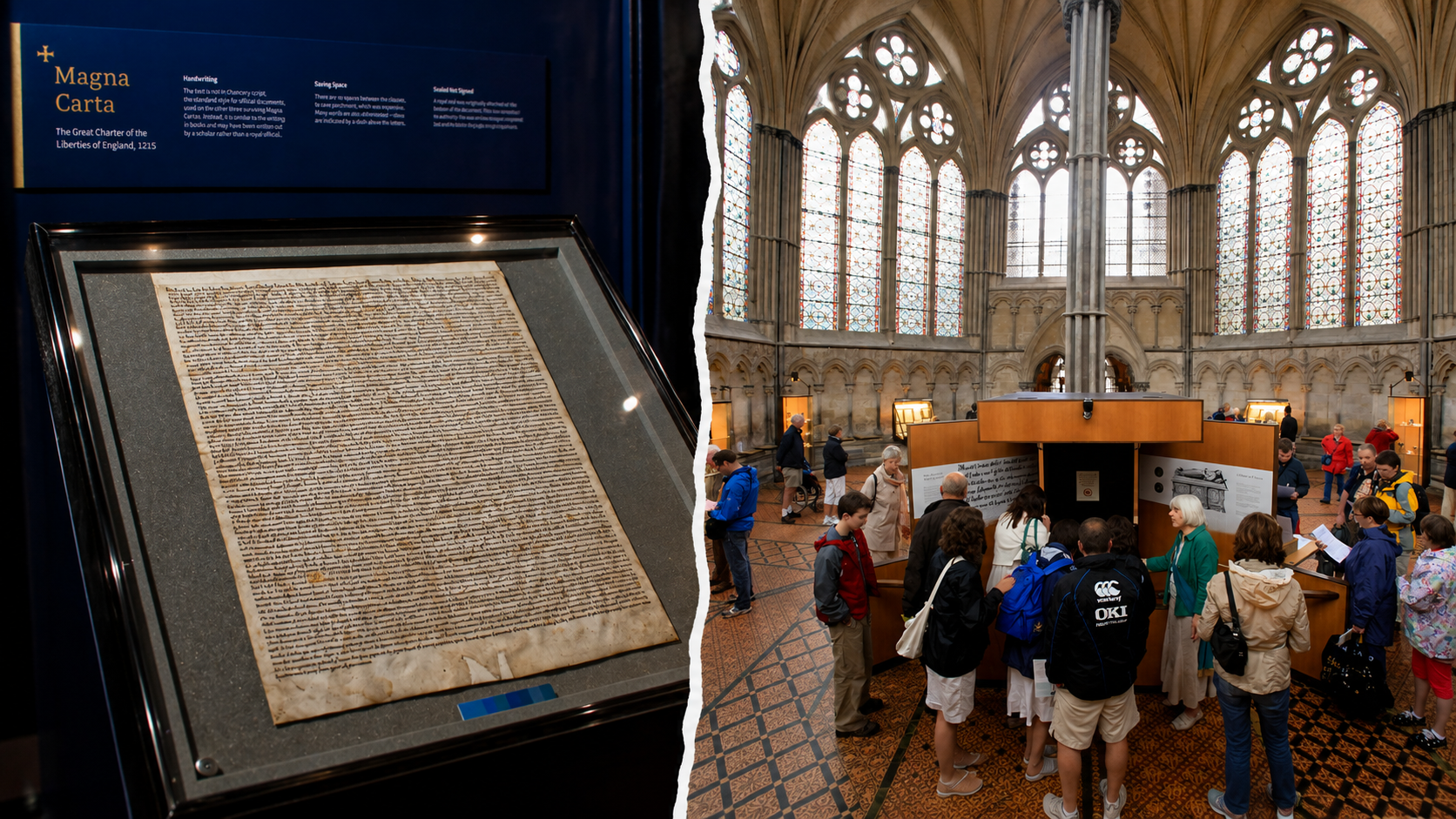
There are four surviving copies of the 1215 Magna Carta.
Two are held by the British Library. Lincoln Cathedral has one. Salisbury Cathedral has the best-preserved copy, kept in its Chapter House.
They are not grand objects in the way you might expect. No monumental stone tablet. No huge illuminated title announcing that Western constitutional history is about to begin. They are sheets of parchment covered in dense medieval Latin, products of a working royal administration that sent copies around the kingdom.
That physical ordinariness is part of their appeal. One of the most famous documents on earth began as paperwork from a crisis.
And perhaps that is the best way to understand Magna Carta. It was not born pure. It was a bargain between powerful people. It failed. It was rewritten. Its meaning was stretched, argued over and sometimes mythologised. People who were excluded from its original promises later used its language to demand much more than its authors had imagined.
So is it the most important document in English or Western history? There are too many serious contenders to settle that across a table without a fight. The Bible, the works of classical philosophy, the Declaration of Independence, the Constitution, the various great charters and codes of law all have claims of different kinds.
But Magna Carta has earned its place in that conversation for a wonderfully untidy reason. A peace deal that could not keep the peace helped give later generations a language for restraining power.
King John wanted it gone. He got his wish in 1215.
The idea came back.