Learn Go over your first game
A first game of Go on a 9 x 9 board, with the few rules you need to get stones down and finish a game.
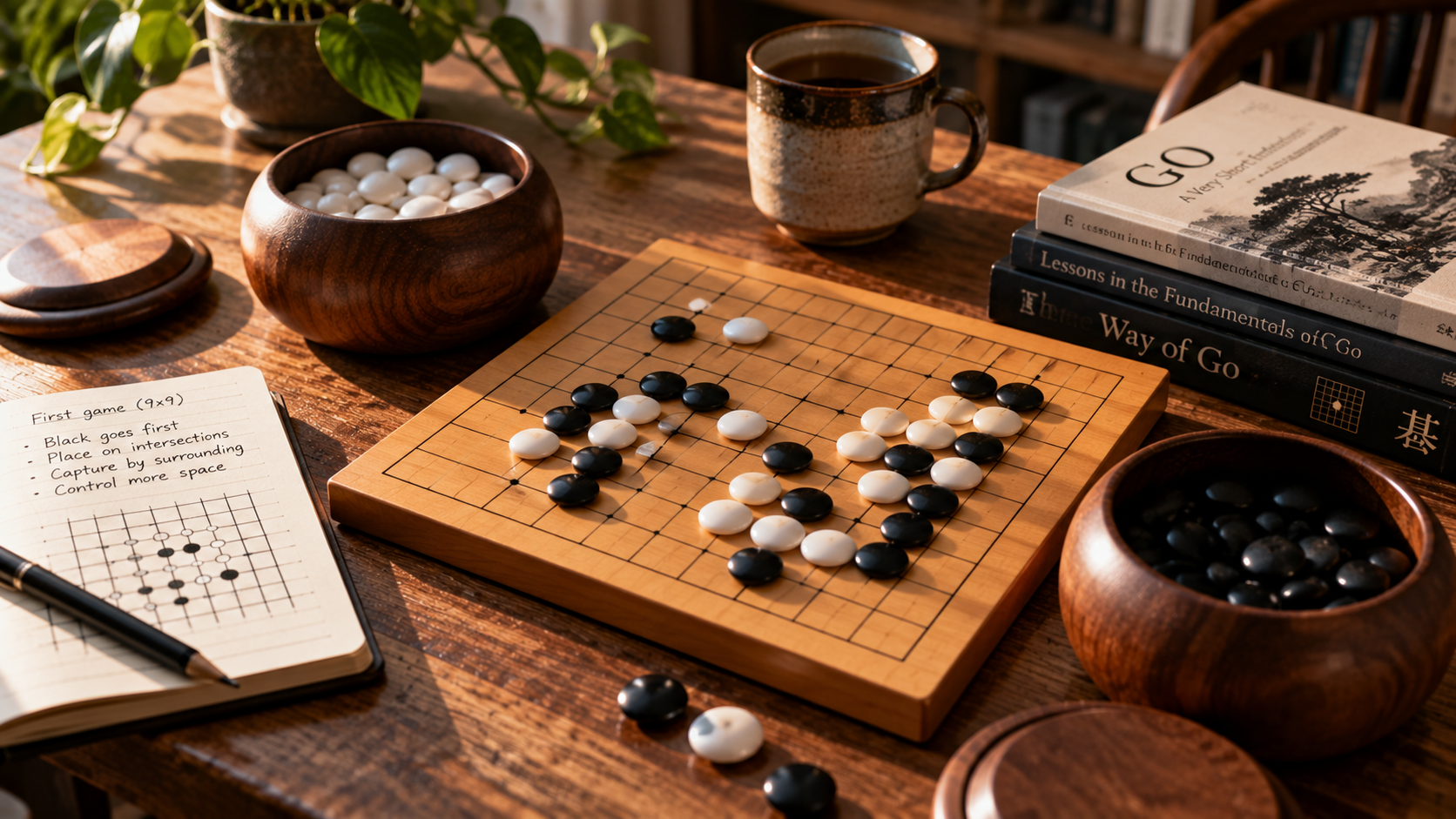
A small board
Go has the reputation of being one of those games you need to understand before you are allowed to enjoy it. Ignore that.
Your first game does not need the full 19 x 19 board, centuries of strategy or a vocabulary lesson in Japanese. Use a 9 x 9 board. The British Go Association recommends it for beginners because it is less daunting and gets you to the consequences of your moves much faster.
Two players take black and white stones. Black goes first. Put a stone on any empty intersection, not inside the squares. Once a stone is down, it stays there unless it is captured.
The broad aim is to control more of the board than your opponent by surrounding empty space. Capturing helps, but Go is not really a game about hoovering up enemy stones. It is about space.
That is enough to begin.
Play through a position
Before the first proper game, learn one idea: liberties.
A stone in the middle of an empty board has four liberties, the empty intersections immediately above, below, left and right. Diagonals do not count. Put one of your stones directly beside another and they form a connected chain that shares its liberties.
If your opponent fills the final liberty of a stone or connected chain, those stones are captured and removed from the board.
You can see the rule more easily than you can read it. Put a single white stone near the middle of the board. Place black stones on three of its four adjacent intersections. White now has one liberty left. Black plays on that final point and the white stone comes off.
Try the same thing with two white stones connected side by side. Now you have to surround the whole chain. That little exercise is enough to make the board start making sense.
There are a couple of rules that stop impossible or endlessly repeating positions. In ordinary play you cannot place a stone so that your new group has no liberties unless the move itself captures opposing stones. There is also the ko rule, which prevents an immediate capture and recapture from repeating the same position forever. For a first game, if a ko appears and neither of you is sure what happened, look it up then. Do not spend twenty minutes learning exceptions before you have played a move.
Finish one game
Now play.
- Use the 9 x 9 board and start empty. Black plays first.
- Take turns placing one stone on an empty intersection. Remove opposing stones when their last liberty disappears.
- Keep going until both of you agree there is nothing useful left to do. Passing is a move, and two consecutive passes end the game.
For this first game, use one scoring method consistently. A simple British Go Association introduction uses territory scoring: count the empty points you have surrounded, then add the opposing stones you captured. White also receives compensation for moving second under formal even-game rules, although the exact komi depends on the ruleset you are using.
Your first score may involve staring at the board and asking whether a patch of empty space really belongs to anyone. That is normal. The end of a Go game is one of the things that becomes clearer by playing, not by memorising another paragraph.
Then clear the board and play again.
The second game will already feel different. You will see liberties before they disappear. You will notice that a group can be safe without capturing anything. You may even stop chasing one lonely stone across the board and realise your opponent has quietly taken half the territory.
That is Go beginning to happen.