How Singapore became a global trading hub
Singapore’s established port grew through industrial development, infrastructure and adaptation to changing trade.
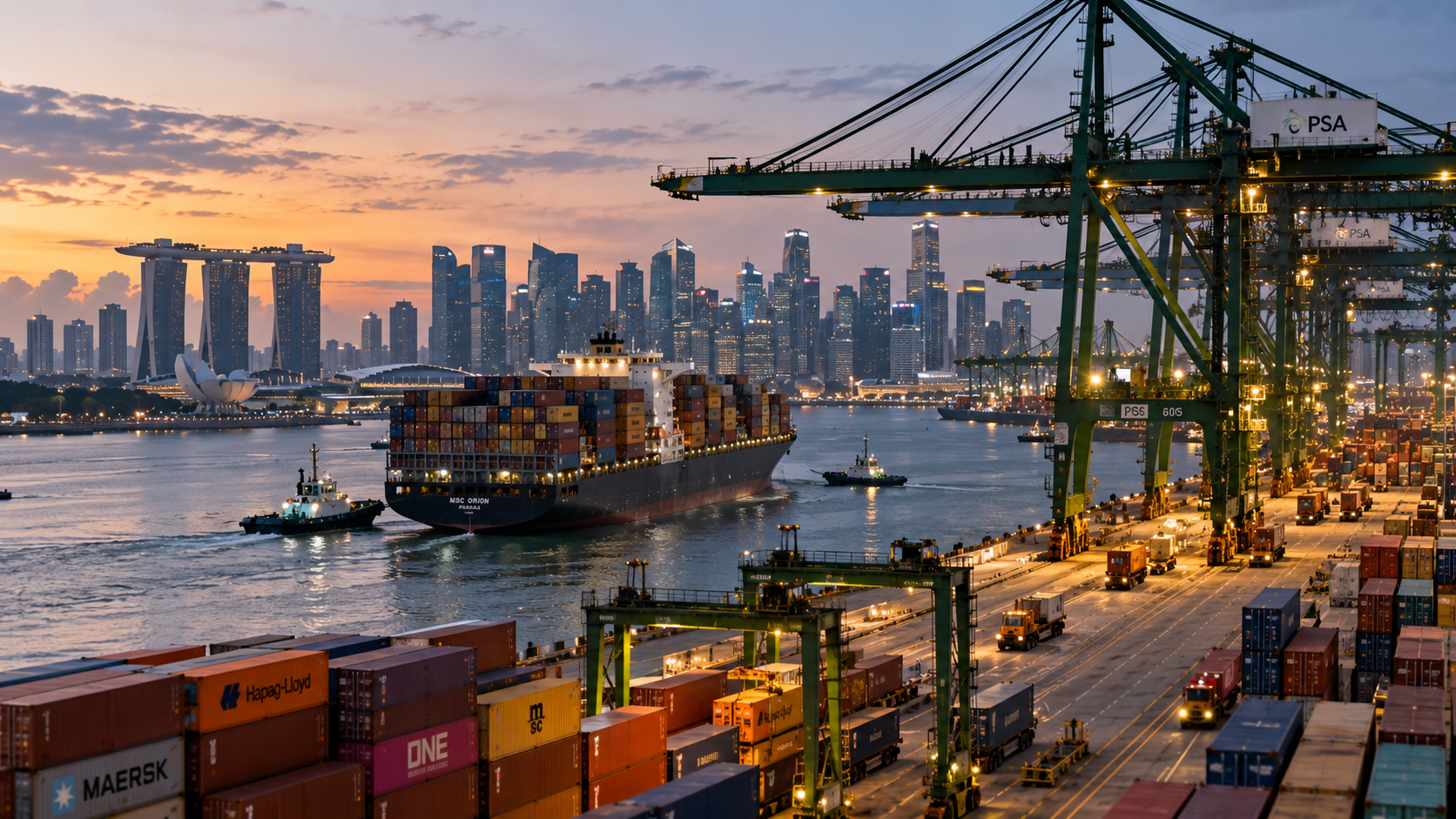
Begin with the ships already there
Singapore did not begin as an empty patch of swamp waiting for somebody with a plan. Long before independence in 1965, it was a commercial city with a busy port, established businesses and communities whose connections extended far beyond the island.
Its trading history also predates British rule. Medieval Singapore belonged to the maritime world of Southeast Asia. When Stamford Raffles established a British trading post in 1819, he was entering an existing region of rulers, ports and commercial networks. The British settlement dramatically changed the island’s trajectory; it did not invent trade there.
That distinction matters because the familiar miracle story asks the wrong question. Singapore’s modern achievement was not discovering that ships could stop at the southern end of the Malay Peninsula. It was repeatedly making that stop useful as shipping, manufacturing and finance changed around it.
The history of the port sets out those earlier trading networks. They supplied something no development plan could create overnight: connections between people who knew where goods could be bought, financed and sold.
A favourable position still needs work
Look at a map. Singapore sits beside the sea passage linking the Strait of Malacca with the South China Sea, on a major route between the Indian and Pacific oceans. That position made it attractive to traders and imperial powers alike.
But geography offers an opportunity, not a permanent contract. Ships need places that can handle cargo reliably. Merchants need storage, credit, information and confidence that a transaction will work. A port that saves sailing time but loses days unloading can squander its natural advantage.
The colonial free port attracted commerce, while migrant merchants and workers gave that commerce its daily reality. British imperial connections were part of the story, alongside Asian trading networks. Treating the city as the creation of one foreign founder obscures the people who made it operate.
There is another reason to resist a seamless success narrative. War and occupation disrupted the city, while the postwar population faced serious housing and employment pressures. Having a valuable position on a map did not make everyday life secure.
Build more than a warehouse
Singapore joined Malaysia in 1963 and became independent after separation in 1965. For the new state, providing jobs could not depend solely on receiving goods and sending them elsewhere. Manufacturing offered another source of work and exports.
Industrial development was already under way. Work on Jurong Industrial Estate began in 1961, before independence, with the Economic Development Board central to the drive. Factories required more than plots of land: roads, power, water and workers able to reach them were part of the undertaking. The National Library’s industrial history documents Jurong’s place in that transformation.
This is where the story becomes more interesting than a slogan about markets or government. Public agencies prepared sites and sought investment; private companies brought production, customers and capital. The practical question was how those contributions would fit together.
A factory creates demands beyond its gate. It needs components delivered, products shipped, people trained and homes within reach of employment. Housing and transport therefore belong in an account of commercial development, even though cranes and ships make the more obvious photograph.
Change the port as the cargo changes
Containerisation provided another test. Cargo packed into standardised containers could move between ships and land transport in a different way from goods handled individually. Taking advantage of that change meant investing in berths, cranes, storage areas and the organisation around them.
Tanjong Pagar’s container berth opened on 23 June 1972. The National Library’s account of the Port of Singapore Authority records the milestone. Singapore was adapting its established role to a new shipping system.
The value of a hub grows through connections. A shipping line has more reasons to call where it can exchange cargo with other services. Businesses have more reasons to locate where customers, suppliers and specialist services are already available. That can reinforce an advantage, provided the system keeps working.
It also explains why looking only at the waterfront misses part of the port. Documentation, insurance, finance and the coordination of onward journeys all help goods move. A container may be physically still while important work happens around it.
A success with obligations
This model has demands as well as rewards. Land devoted to industry, transport or housing cannot simultaneously serve every other purpose. Infrastructure needs maintenance and further investment. A trading economy remains exposed to decisions and disruptions beyond its borders.
The distribution of benefits matters too. National prosperity is not a complete account of wages, housing costs or the experience of migrant labour. To understand the bargain, one must ask who performs the work and which choices they have, alongside how efficiently goods move.
Nor does the history establish that every other country should copy Singapore. An island city-state beside a major sea route has opportunities and constraints different from those of a large inland economy. Institutions and circumstances travel less easily than an admiring phrase.
What the story does show is a long sequence of decisions about usefulness. An existing port gained new industries, new infrastructure and new services as the world’s trade changed. Singapore’s influence grew from making those connections dependable. The ships are the visible part of a much larger piece of work.