How Shackleton got his men home
How the twenty-eight men of Endurance survived a lost ship, drifting ice and an open-boat journey for help.
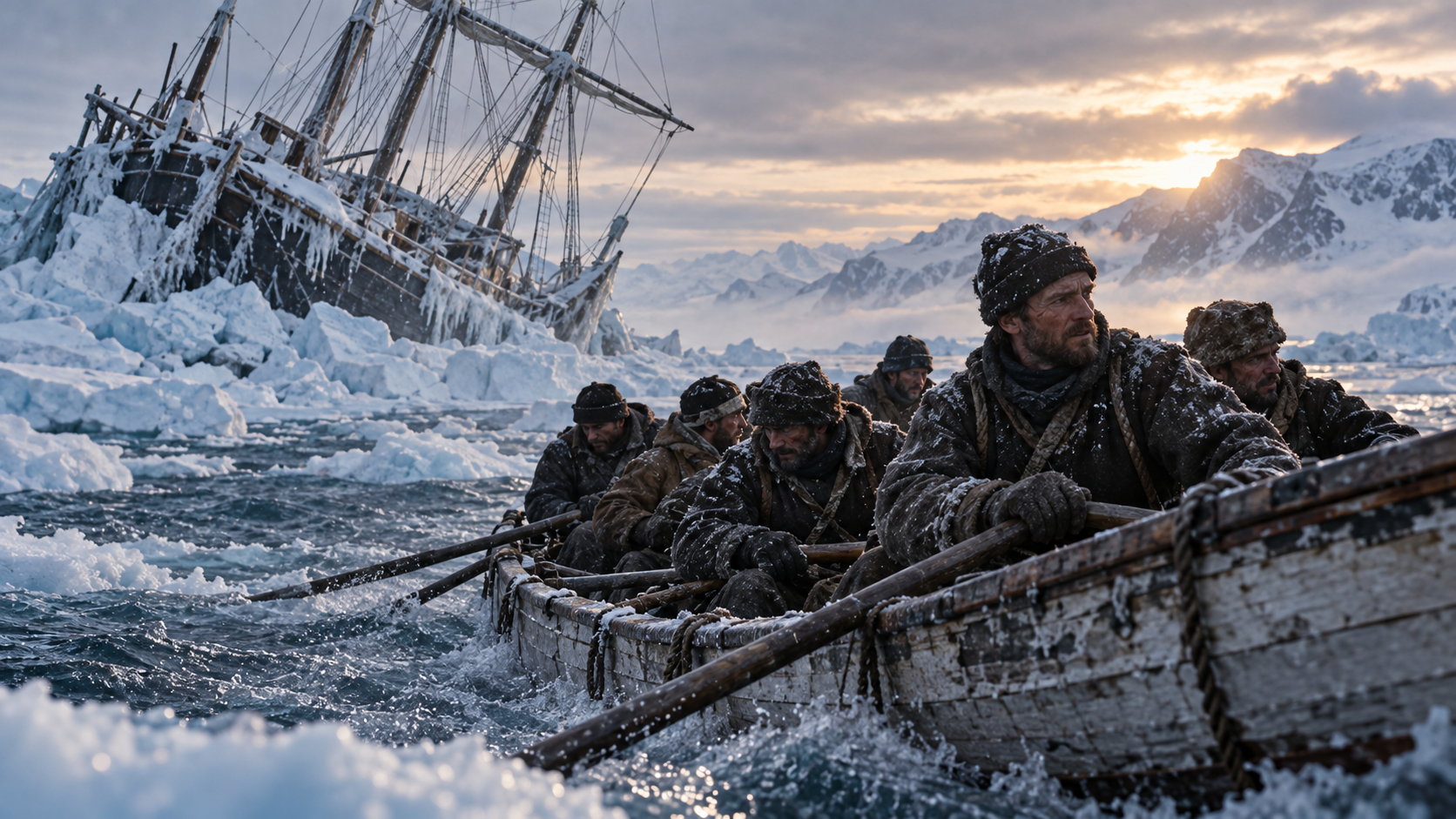
The ship was no longer a ship
On 27 October 1915, Ernest Shackleton ordered his men to abandon Endurance. The ice had been pressing against her for months. Now water was entering the damaged hull, and the pumps couldn't save her.
Twenty-eight men moved onto the sea ice with supplies, equipment and three boats. Their expedition had been designed to cross Antarctica. They hadn't even reached the coast from which that crossing was supposed to begin.
The distinction between failure and disaster was now very simple. A failed expedition could come home. These men still had to find a way to do that.
Living on something that moved
Endurance had become trapped in the Weddell Sea in January 1915. Through the Antarctic winter, the ship drifted with the pack. Once she was abandoned, the ice remained both their platform and their problem.
They tried hauling boats and supplies across it. The loads were heavy, the surface broken, and the progress miserable. Eventually they camped and drifted, waiting for conditions which would let them move by water. Endurance sank on 21 November.
A camp on sea ice could not be made secure in the ordinary sense. The surface could crack. The drift might help them, or carry them somewhere worse. Food required careful use of stores and hunting. There was no neighbouring settlement, and no rescue service receiving updates on their position.
Shackleton's account, South, records routines, work, meals and the business of keeping the party together. It also records decisions that modern retellings sometimes hurry past, including the killing of the expedition's dogs. Survival was a sequence of costly choices, not one glorious act of resolve.
In April 1916, the breaking ice finally forced the men into the boats. They reached Elephant Island after days of exposure and difficult navigation. Solid land was an enormous improvement. It was not a route home.
Someone had to go for help
Elephant Island lay away from the regular traffic on which they might reasonably hope to depend. Waiting indefinitely meant gambling on someone finding them by chance.
Shackleton decided to take a boat to South Georgia, where there were whaling stations. It was a journey of roughly 800 miles through the Southern Ocean. The boat, James Caird, was about 22 feet long.
Carpenter Harry McNish strengthened and adapted it for the voyage, including raising the sides and making a covered deck. Ballast helped its stability. Those alterations were fundamental: the story depended on a small craft remaining usable in conditions that could overwhelm it.
Six men left on 24 April: Shackleton, navigator Frank Worsley, Tom Crean, McNish, John Vincent and Timothy McCarthy. Twenty-two remained under Frank Wild.
The split created two ordeals. The six had to cross the sea and find a small island. The twenty-two had to stay alive without knowing whether the boat had reached anywhere at all.
Finding the island
Worsley's navigation deserves a share of the fame usually reserved for Shackleton. There was no satellite position on a screen. Observations had to be made from a moving boat when the sky allowed them, then combined with calculations and estimates of their progress.
South Georgia was not a generous target. Miss it, and there was no comfortable second destination a little farther along the road.
The men lived among equipment and ballast, managing water, bailing and trying to rest in a cramped, wet boat. Ice accumulating on the craft threatened its stability. Conditions demanded constant work from people with very little reserve.
After sixteen days, they landed on South Georgia. They had reached the correct island, but the wrong side for the whaling stations. Sailing farther along the coast was judged too dangerous in their circumstances. Help remained beyond the mountainous interior.
Shackleton, Worsley and Crean set out across it. McNish, Vincent and McCarthy stayed at the landing place. The three walkers travelled through unfamiliar mountain country, negotiating snow and glaciers with limited equipment, until they reached Stromness on 20 May.
They could now speak to people who had ships, food and a connection to the outside world. But the story was still not finished.
The men waiting on the beach
The three men left on South Georgia could be collected. Reaching Elephant Island was much harder. Ice defeated repeated attempts to get back.
Meanwhile, Wild's party sheltered beneath the two remaining boats, supported to create a makeshift hut. They hunted for food, dealt with illness and waited. The fact that help might be coming offered no timetable, and no proof that Shackleton was alive.
On the fourth rescue attempt, the Chilean vessel Yelcho, commanded by Luis Pardo, reached the island. It was 30 August 1916, more than four months after James Caird had left.
Shackleton described the urgency of getting everyone aboard before conditions changed. There was no leisurely inspection of the camp. The ice had opened a way in, and they needed to use the same opportunity to get out.
All twenty-two were alive. Together with the six who had sailed for help, that meant every member of the Endurance party had survived.
The qualification the story needs
The wider Imperial Trans-Antarctic Expedition had another group, the Ross Sea party, laying supplies for the planned crossing from the opposite side of the continent. Three of that party died: Arnold Spencer-Smith, Aeneas Mackintosh and Victor Hayward.
So “Shackleton lost nobody” is too broad. All twenty-eight of the Endurance party survived. The expedition as a whole suffered deaths.
That precision doesn't diminish what happened on Elephant Island. It keeps other men from disappearing inside a better-known story.
Nor does sharing the credit reduce Shackleton. His rescue required McNish's work on the boat, Worsley's navigation, Wild's management of the camp, the efforts of their companions, and Pardo and the Chilean crew bringing Yelcho south.
After so many months, the final departure happened quickly. The men were aboard. The vessel headed north. For once, the thing beneath them was taking them where they needed to go.
Source: Ernest Shackleton, South, especially chapters I–XIII.