How chess found a new online audience
The 2020 chess boom brought together streamers, online play and television, with several routes for newcomers.
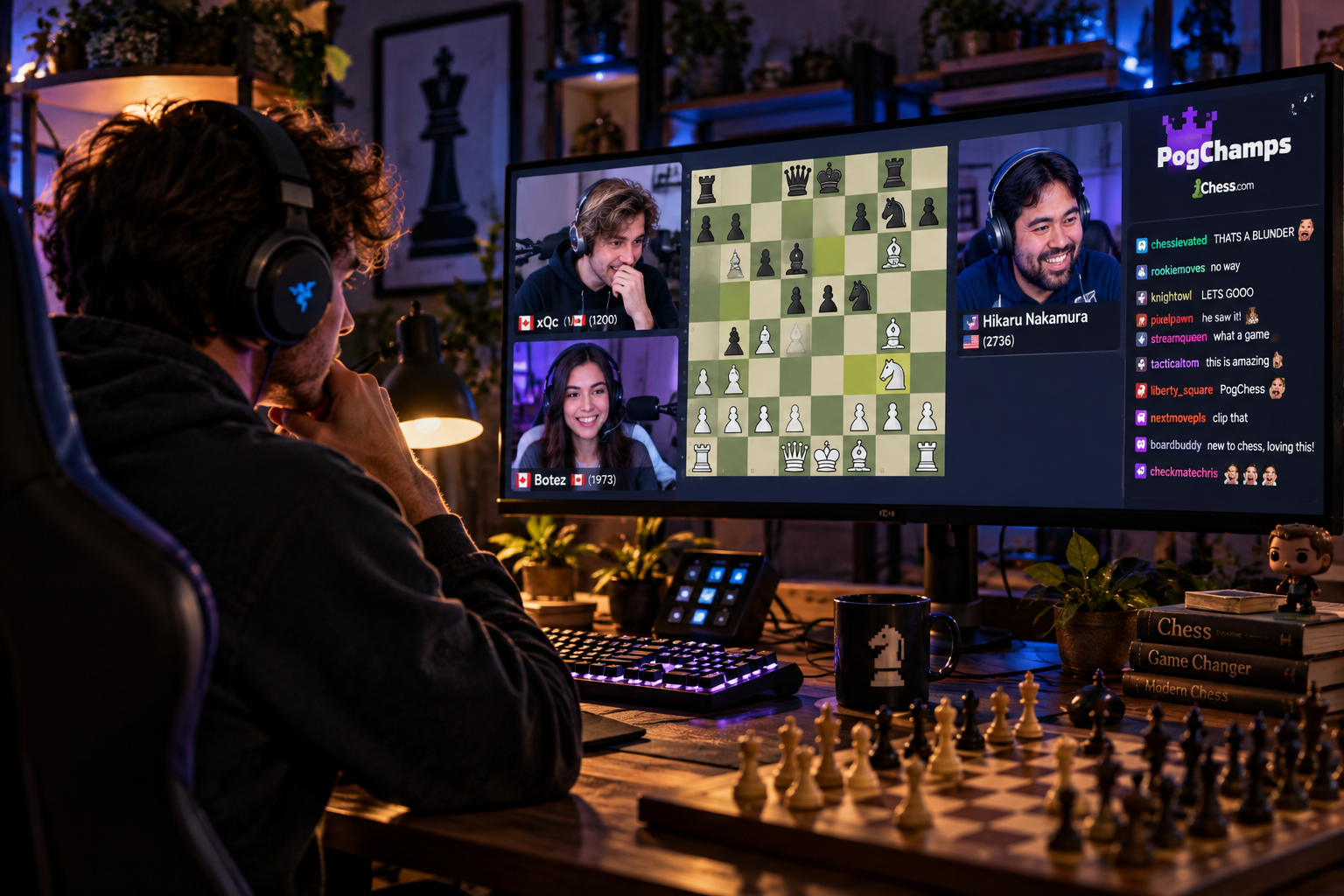
The newcomers were part of the show
On 5 June 2020, the first PogChamps tournament began with a proposition quite different from a world championship. Sixteen streamers would play chess. Their appeal did not depend on being the best chess players available. Viewers already knew them from elsewhere, and now they could watch them learn, compete and make mistakes.
Chess.com’s announcement of the inaugural event named Hikaru Nakamura and Alexandra Botez among the coaches and commentators. Expertise was present, but it was helping an audience follow players of widely differing abilities.
That changed the point of entry. You could arrive because you liked a streamer and stay because you wanted to see whether they would notice the threat to their queen. Understanding a world champion’s position was no longer the only route to enjoying a chess broadcast.
The game itself had not needed reinvention. The invitation had changed.
Learning became visible
At elite level, a chess move can be difficult for a newcomer to appreciate. The obvious threat may not be the important one. A quiet adjustment can matter more than a dramatic capture, and much of the calculation remains inside the players’ heads.
A coached beginner supplies a different story. You can hear the uncertainty, recognise an elementary mistake and understand the pleasure of getting something right. The expert’s explanation connects the action to an idea the viewer can use.
There is entertainment in the gap between intention and result. A player believes a plan is working; a commentator sees the problem; the audience waits to discover whether the player will spot it. Chess can produce that tension without elaborate graphics or a fictional villain.
It would be unfair to reduce the appeal to laughing at weak play. Visible improvement provides a reason to come back. Someone who was confused by a position can return with a better answer. The audience has seen the work in between.
This is an interpretation of why the format was accessible, rather than a measurement of what motivated every viewer. Different people arrived for different reasons, and experienced players were watching too.
Several doors opened in the same year
The pandemic gave online activities a different place in daily life. With ordinary social and sporting routines disrupted, playing and watching from home became more useful. Chess already had the necessary machinery: online opponents, clocks, puzzles, lessons and broadcasts.
Then The Queen’s Gambit arrived on Netflix in October 2020. The drama gave chess another kind of appeal, built around a fictional player whose ambition and difficulties could matter to viewers who had never entered a tournament. Its release and reception belong in the history, but the June PogChamps event is an immediate reminder that the online story was already developing.
These routes could reinforce one another. A programme might prompt someone to search for a lesson. A lesson might lead to a game. A streamer might make the same activity feel less intimidating. There is no need to assign the entire change to one cause to see how those connections could work.
Online access reduced the distance between interest and participation. You did not have to buy a board, persuade a friend or find a club before making your first move. That convenience did not guarantee a lasting hobby, but it made trying possible at the moment curiosity appeared.
Read the numbers carefully
By the build-up to PogChamps 3 in early 2021, Chess.com was reporting more than 13 million games played on its site each day. Its announcement for that event also included names such as MrBeast, Pokimane and Rainn Wilson. The event was continuing to reach beyond a field defined by chess credentials.
The figure is the platform’s own, published while promoting an event. It counts games, not distinct people. One keen player can play many games in a day, and a large platform does not represent all chess activity. It is evidence of substantial activity in that setting, not a census of a newly converted world.
Likewise, watching a broadcast and becoming a regular player are different outcomes. A person may enjoy a creator’s chess videos without wanting a rating. Another may play casually for a month and leave. The headline scale of a boom does not tell us how many people remain years later.
What a newcomer could find
The lasting interest is in the range of possible relationships with the game. Chess could be a competitive pursuit, a puzzle on a lunch break, an evening with a friend or something entertaining to watch. Those versions did not need to displace one another.
There were frustrations too. A quick online loss can be bruising. Ratings can encourage comparison before a player understands what they are comparing. A beginner who watches very fast games may assume speed is part of the entrance requirement, when a slower game leaves much more room to think.
But the new presentation made one useful fact visible: the game belongs to people who are still learning it. A mistake can be part of the entertainment and the education. You can recognise yourself in the person making it, then open a board and try the position for yourself.
For an old game, that is a remarkably direct invitation.