How a tiny country stays a country
Liechtenstein shows how a microstate can share currency, borders and practical systems with larger neighbours while keeping its own sovereignty and institutions.
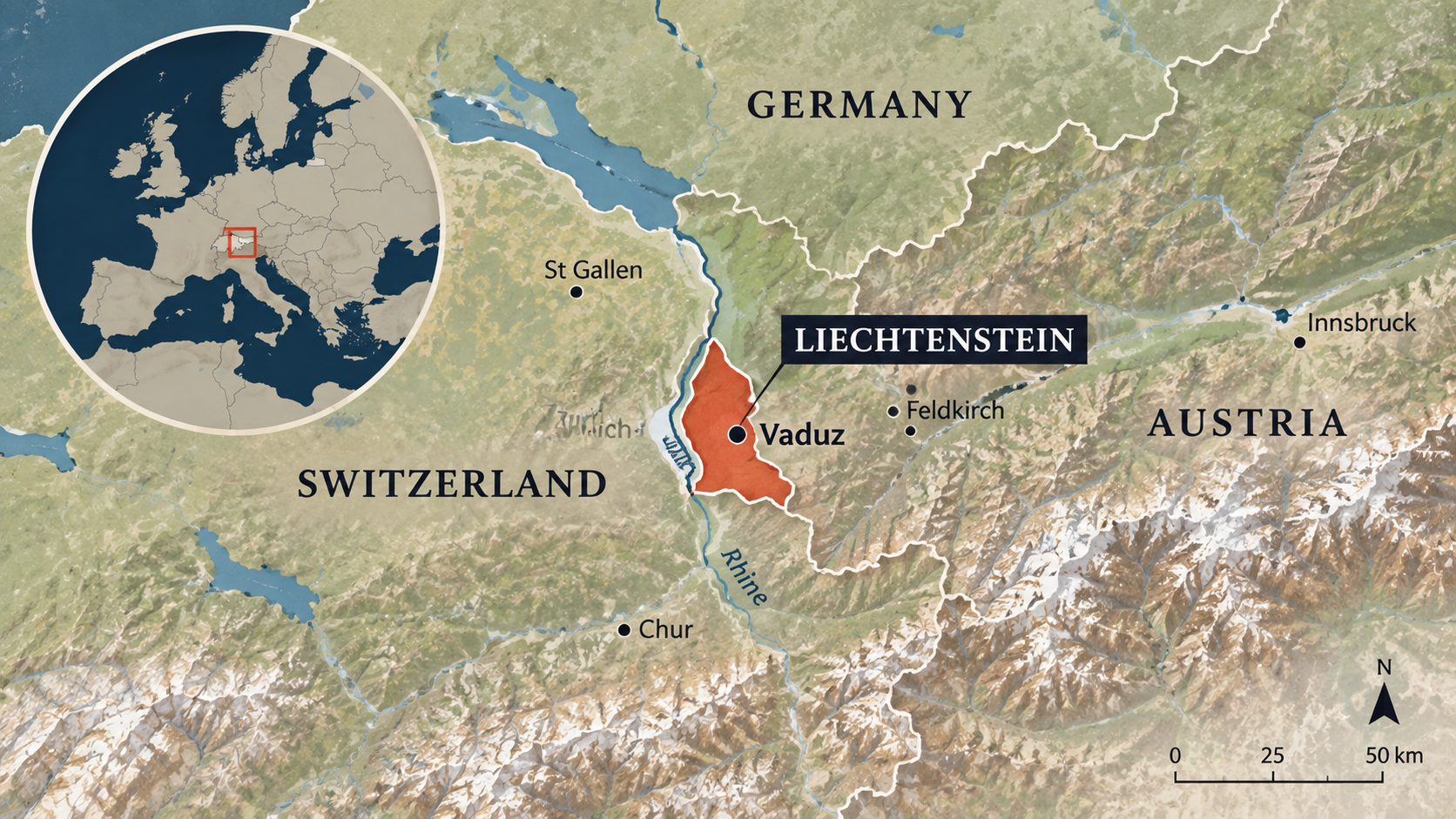
Find it on the map
Liechtenstein is the sort of country you can miss while looking directly at the map.
It is 160 square kilometres, squeezed into the Alps between Switzerland and Austria. From north to south it runs for roughly 25 kilometres. Its population is around 40,000. There is no airport and no seaport. Vaduz, the capital, does not even have a railway station.
Yet this is not a territory waiting to be absorbed by one of its neighbours. Liechtenstein has been sovereign since 1806. It has its own constitution, parliament, government, courts, head of state, passports, laws and foreign policy. It joined the United Nations in 1990 and the European Economic Area in 1995.
The interesting thing is how much of the machinery we associate with a country it has chosen to share.
What it shares
Start with the money in your pocket.
Liechtenstein uses the Swiss franc. It introduced the franc as its official currency in 1924 and later formalised the arrangement through a currency treaty with Switzerland. Swiss monetary and currency rules apply across the shared currency area, while Liechtenstein retains currency sovereignty in principle.
Then look at the border.
A customs treaty signed in 1923 tied Liechtenstein closely to the Swiss economic area. Today the border between the two countries is open, and the relationship has grown into a dense network of agreements covering everything from health and education to police cooperation, road traffic and taxation.
Switzerland has also represented Liechtenstein's interests in countries where the principality does not maintain its own diplomatic representation. For a state with a population comparable to a modest British town, maintaining an embassy network everywhere would be an expensive way to prove a point.
Liechtenstein abolished its military in 1868. That does not mean it has outsourced the whole idea of being a country. It means an army is not one of the institutions it has chosen to maintain.
Transport works in a similar way. There is no national airport. The country is plugged into the roads, rail connections and airports around it. The nearest big infrastructure does not have to sit inside the border to be useful.
This is the trick of the microstate: share the systems where scale matters, keep the decisions where sovereignty matters.
What it decides
And Liechtenstein makes plenty of decisions for itself.
It is a constitutional hereditary monarchy on a democratic and parliamentary basis. The Landtag, its parliament, has 25 members. The country has 11 municipalities. It makes its own laws within the framework of its constitution and international commitments, runs its own public administration and conducts its own foreign policy.
Its international position is unusually layered. Liechtenstein is deeply integrated with Switzerland through customs and currency arrangements, while also belonging to the European Economic Area. That gives it access to the European single market without being a member of the European Union. It is also a member of EFTA, the Council of Europe, the WTO and the UN.
None of those memberships makes it less of a country. They are examples of what countries do: sign treaties that trade some freedom of action for access, security, standards or convenience.
Large states do this too. They just have enough scale that we notice it less.
Liechtenstein makes the arrangement visible because the country is so small. It does not issue its own banknotes to prove independence. It does not build an airport because sovereign states are apparently supposed to have one. It does not maintain an army for ceremonial completeness.
Instead, it has spent two centuries assembling a practical answer to a surprisingly interesting question.
How much infrastructure does a country actually need to own before it stops being a country?
In Liechtenstein's case, far less than you might think.
Share the systems where scale matters, keep the decisions where sovereignty matters.