Go out with one roll of film
Make limited exposures a playful constraint rather than a claim that analogue photographs are superior.
Opening
Go somewhere with a camera and only 27 photographs.
Not 27 good photographs. Not 27 photographs for Instagram. Just 27 chances to press the button.
That's the game.
A phone lets you take six versions of the same pint, check them immediately, delete five, take another three and forget the whole lot by Tuesday. Film puts a small physical limit on things. Once you've pressed the shutter, one of your pictures is gone.
This does something quite enjoyable to a walk. You start looking.
What you need
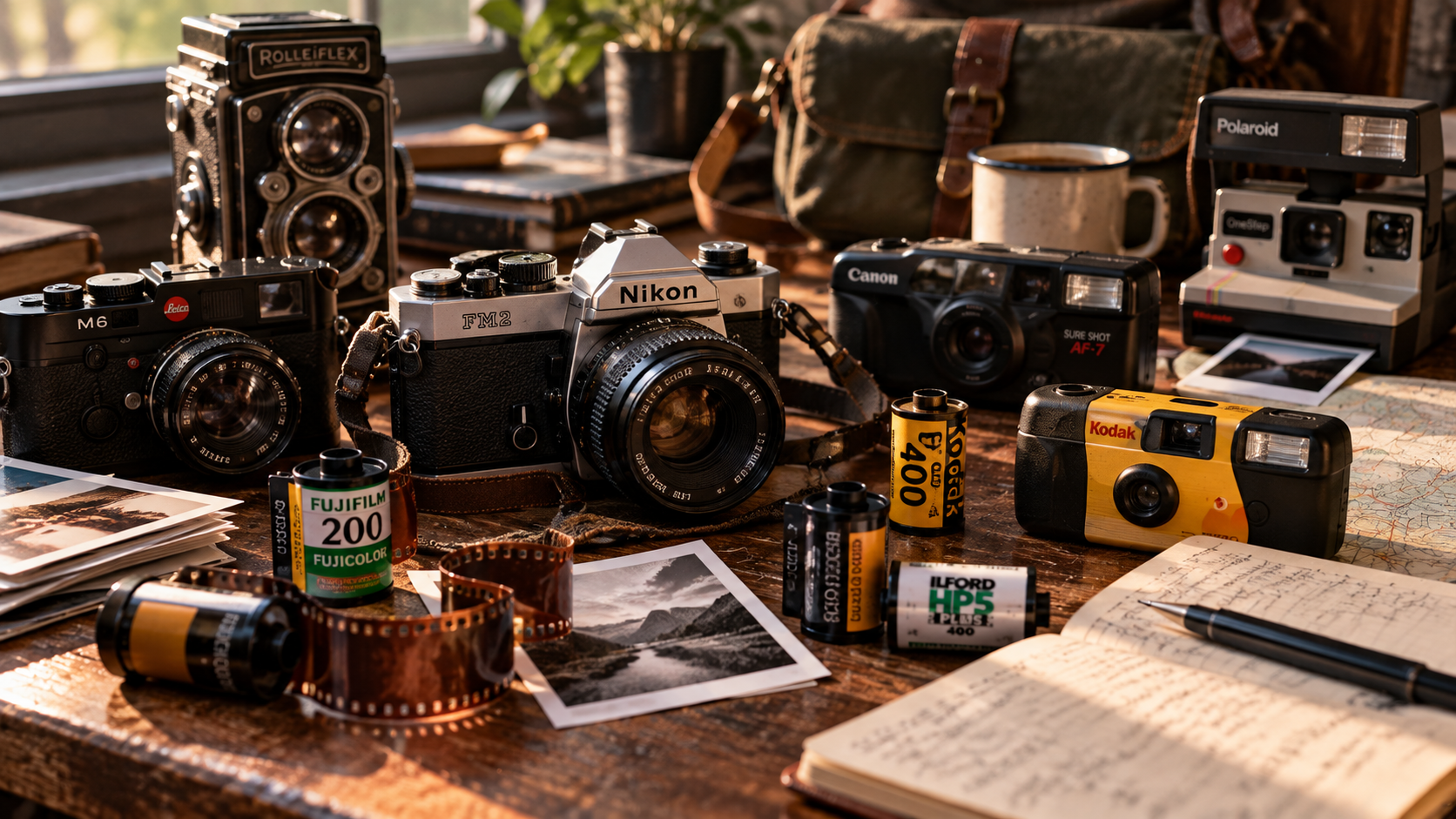
The easiest version is a single-use camera. A Kodak FunSaver, for example, has 27 exposures on 800-speed colour film and a built-in flash. Other single-use cameras have different exposure counts, so check the one you buy.
If you already own a working 35mm camera, even better. Load one roll and use that.
You don't need a beautiful vintage Leica, a light meter hanging around your neck or any knowledge of Henri Cartier-Bresson. The cheap plastic camera is arguably more in the spirit of the thing.
You will also need to pay to get the film developed afterwards, so check the total cost before you start. Depending on the lab and service, you can have the negatives developed, scanned digitally, printed, or some combination of the three.
Then pick somewhere to go. A town you don't know particularly well. The coast in bad weather. A Sunday market. A football match. A day in London. The woods. Your own neighbourhood. Ordinary places are perfectly capable of producing good photographs.
How to do it
- Give the roll a loose theme. Don't write yourself a shot list. That turns a day out into admin. Choose something loose enough to make you notice things: things that are red, old shop fronts, people waiting, signs, your town on a Sunday morning, things you would normally walk past. Or simply decide the roll will be a record of one particular day. The point is to give your attention somewhere to go without deciding in advance what you're going to find.
- Don't spend the first ten frames in ten minutes. This is surprisingly difficult. You'll see something mildly interesting, reach for the camera and then remember that pressing the button uses one of your photographs. Good. Have another look. Move a few steps. Get closer. Wait for someone to walk into the frame. Decide whether you actually want the picture. Sometimes you'll take it. Sometimes you'll realise it wasn't much of a photograph after all. Don't become precious about every exposure, though. Waste one occasionally. Photograph your lunch. Take a terrible picture of your mate. The constraint is there to make the day more playful, not to turn photography into a maths exam.
- Don't look. This is the strange bit if you've grown used to taking photographs on a phone. There is no screen. You don't know whether someone's eyes were shut. You can't zoom in to check the focus. You can't straighten the horizon. You don't get another go because your thumb appeared in the corner. The photograph has happened. Carry on with your day.
Worth knowing
The best part comes later.
Take the camera or film to a lab and get it developed. You can have the pictures scanned so they come back digitally, but getting a set of small prints is worth considering too. Processing prices and turnaround times vary, so check your chosen lab before you go.
Then wait. By the time the pictures arrive, you've partly forgotten what is on them.
There will probably be failures. Someone will be blurred. A picture you were certain would be brilliant will be inexplicably dull. The light will have done something odd. You may discover that your finger is a recurring character in the collection.
And somewhere among them there may be one photograph you absolutely love.
Not because film is better than digital photography. Because you went out looking for it.