Go and stand beside something enormous
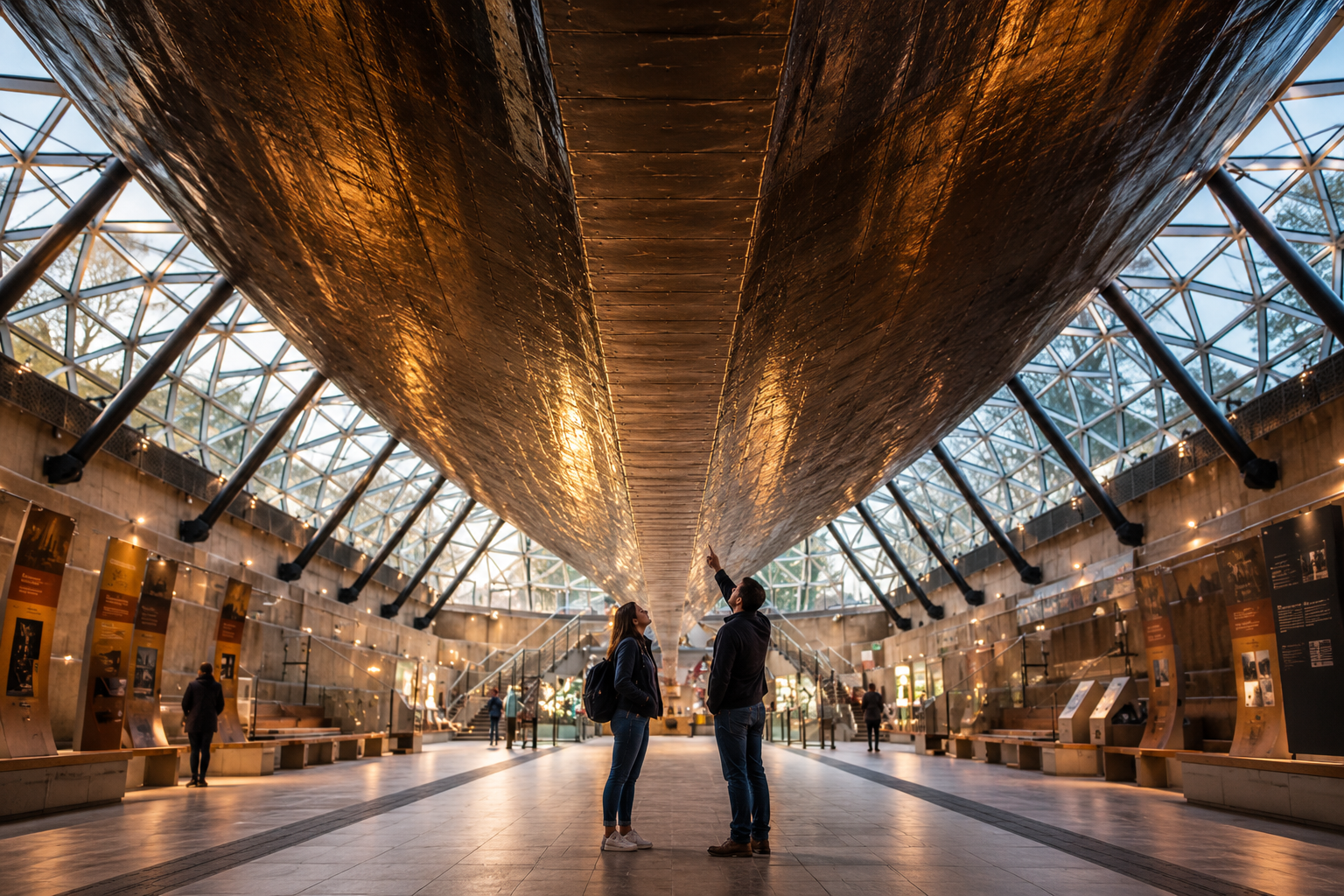
Visit the space beneath Cutty Sark and let the ship’s 64.8-metre hull give scale a physical meaning.
Choose a ship you can get underneath
Some objects suffer from being photographed too well. They fit comfortably into a rectangle, and the rectangle fits comfortably into your hand. A ship becomes a neat arrangement of masts and ropes. Your eyes accept the picture without having to do much about its size.
For an afternoon, try reversing that arrangement. Go to Greenwich and visit Cutty Sark, the nineteenth-century sailing ship whose visitor route takes you beneath the hull. Let the object be inconveniently larger than your field of view.
This is a particularly good place to try because the underside of a ship is usually unavailable while it is doing its job. At Cutty Sark, the dry-berth viewing space lets you see that great curved body from below. You do not need to climb the rigging to find the impressive bit.
Make the visit straightforward
Start with Royal Museums Greenwich’s visitor page. Check opening times, admission and the booking calendar, then look at the separate closure notices. Some dates have early closures. Allow enough time to follow the ship’s visitor route without rushing towards the last entry.
Check your journey on the day, too. Greenwich has rail, river and other public transport connections, but the name of a nearby station is not a guarantee that your preferred service is running.
If access is a consideration, read the ship’s detailed access guide before booking. Lifts serve the main visitor levels and the space beneath the hull, but there are narrow sections and some areas can only be reached by steps. The museum also limits wheelchair occupancy on each deck. Contact the museum about your own requirements rather than assuming the whole ship is equally accessible.
You can make a day of Greenwich, but leave some room around this visit. The experiment needs a little unallocated time more than it needs another attraction.
Find the view that makes the size real
Follow the recommended route through the ship, using the stairs or lifts as appropriate. It takes visitors through the lower hold and decks, then down to the dry berth beneath the hull. Ask staff if you need a different route or help identifying the accessible way through.
When you reach the space below, stop somewhere permitted where you can look along the ship without blocking other visitors. Put the phone away for a moment. Follow the line from one end as far as your eyes can take it. Then look up at the part directly above you.
The museum’s facts pack gives the hull length as 64.8 metres. That measurement is for the main body of the vessel, not its full extreme length including projecting parts. Even the smaller of those two measurements is enough to consider while you are underneath it.
Think of walking that length. Think of turning it, loading it, maintaining it. Then remember that the ship was built in 1869 to carry cargo across oceans. The size had a working purpose. It had to contain goods and support the people and equipment needed to move them.
Look for something made at hand size
After taking in the whole hull, choose one small visible detail: a joint, a fitting, a section of its surface. Look without touching unless the museum explicitly permits it. Ask what work that part does and how someone would reach it to repair it.
An enormous object becomes more interesting when you can see where human hands enter the story. Its scale is made from many pieces that somebody had to measure, shape, fix and inspect. The ship is both a large silhouette and a collection of practical problems solved at close quarters.
If you want a photograph, take one after you have looked. Include a consenting companion for scale where museum rules allow, and avoid making strangers the main subjects. A person in the frame can communicate what a clean, empty photograph leaves out.
There is no required revelation to bring home. You may simply enjoy having stood under a ship. That is a worthwhile afternoon. Next time you see Cutty Sark reduced to a small picture, you will have something the picture cannot supply by itself: a sense of how much room it takes up.