Giants, Watchers and the Book We Forgot
Eleven Aramaic Enoch manuscripts from Qumran transformed an obscure ancient book into evidence for a much bigger and stranger religious world around the Bible. So why did Enoch matter then, and why do most of us barely know it now?
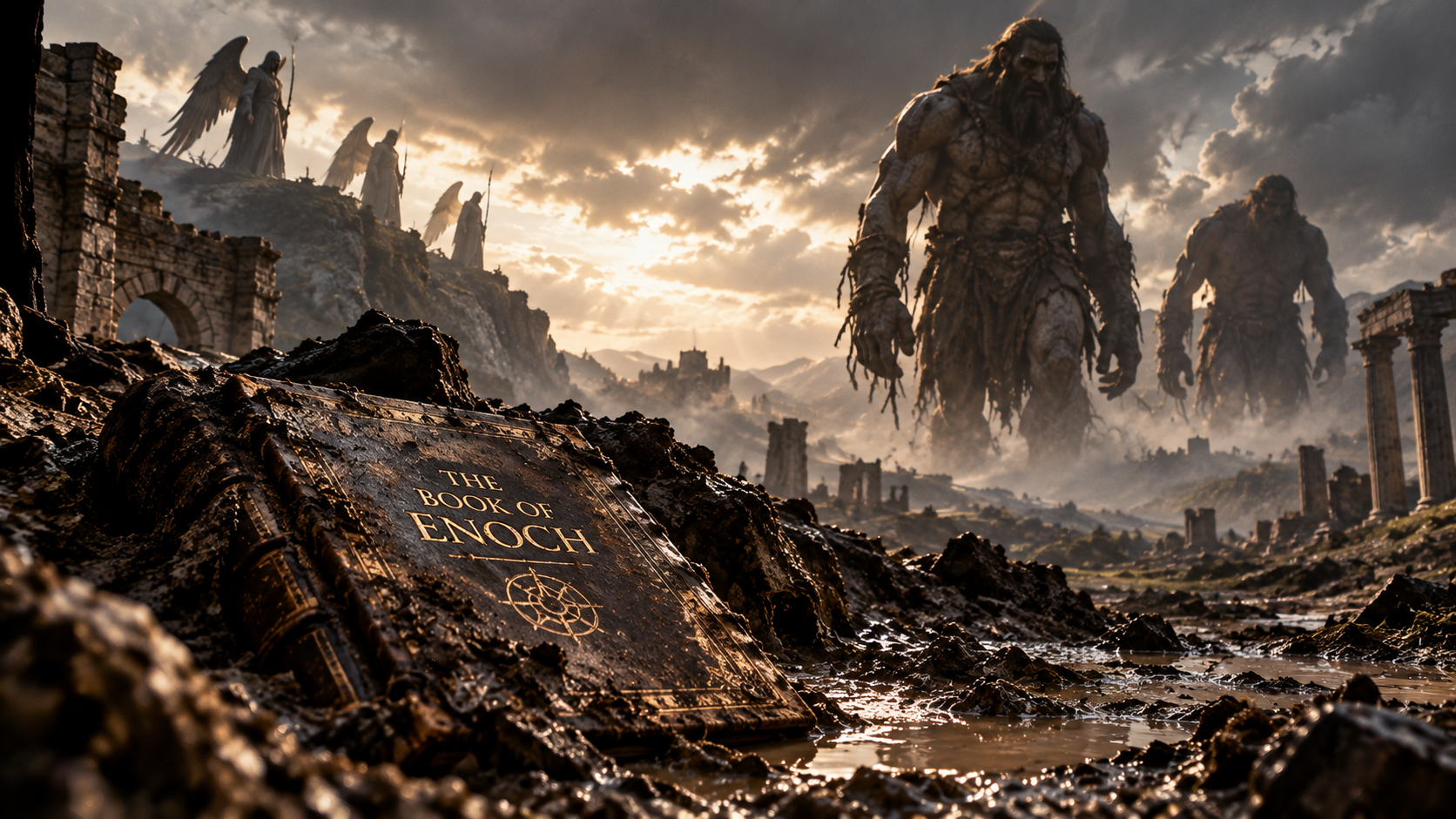
A book in a cave
In 1947, the story goes, a Bedouin shepherd threw a stone into a cave near the Dead Sea and heard pottery break. What followed was one of the great archaeological discoveries of the twentieth century: thousands of manuscript fragments from caves around Qumran, copied roughly two thousand years ago.
Among them were bits of a book that most people with a Bible on their shelf had never read.
They were written in Aramaic. Some were more than two thousand years old. And when scholars pieced together what they could, the words belonged to Enoch.
Not the four brief verses about Enoch in Genesis. A sprawling body of ancient Jewish literature full of rebellious heavenly beings, giants, forbidden knowledge, cosmic journeys, angels, judgement, stars, winds, mountains and the architecture of the universe.
The finds mattered because the Book of Enoch had spent centuries in an odd position. It survived complete in Geʽez, the classical language of Ethiopia, and remained scripture in the Ethiopian Orthodox tradition. Western scholars had recovered the complete work from Ethiopian manuscripts from the late eighteenth century onwards. But the Qumran fragments did something different. They took Enoch back into the Jewish world before Christianity.
Cave 4 produced remains of eleven Aramaic Enoch manuscripts: seven representing parts of the Enoch collection and four manuscripts of its astronomical material. One manuscript of the Book of the Watchers, 4Q201, has been dated to around 200–150 BC; palaeographic study places some Enochic witnesses as early as the third or early second century BC.
Eleven copies does not make Enoch the most common book among the Dead Sea Scrolls. Psalms, Deuteronomy, Isaiah and Genesis are represented by considerably more manuscripts. But eleven copies of a work absent from most modern Bibles is difficult to shrug off.
People in the Jewish world were reading this stuff long before there was a Christianity for it to influence.
Which raises a very good question.
If Enoch mattered enough to be copied again and again in antiquity, and if its ideas reached the earliest Christians, how did it become a book most of us have never heard of?
Four strange verses
The best way into Enoch begins with a piece of the Bible that already feels as though several pages are missing.
Genesis 6 opens with humanity multiplying across the earth. Then the text says that the “sons of God” saw that human women were beautiful and took wives from among them. It mentions the Nephilim being on the earth in those days, and says that the children born in this setting were the mighty men or heroes of old, men of renown.
And then, almost immediately, Genesis moves towards the wickedness of humanity and the story of Noah.
That is essentially all Genesis 6:1–4 gives us. It does not name the sons of God as Watchers. It does not describe two hundred angels landing on Mount Hermon. It does not tell us that they taught humanity magic, metalworking or celestial secrets. It does not give us a detailed war involving ravenous giants.
Enoch does.
The opening section usually called the Book of the Watchers takes that tiny biblical doorway and walks through it into another world.
Here the heavenly beings are Watchers. Two hundred of them descend to Mount Hermon, bind themselves by an oath and take human wives. Their offspring are giants whose violence consumes the earth. The Watchers also reveal knowledge that, in the story, humanity was not meant to possess. Different heavenly figures are associated with weapons and metalworking, adornment, sorcery, astrology and other secrets.
The problem is therefore larger than illicit unions between heaven and earth. Cosmic boundaries have been broken. Knowledge has crossed boundaries with them. Violence spreads through creation.
Enoch, the mysterious patriarch whom Genesis says “walked with God” and was taken by God, becomes the ideal man to move between these worlds. In the Enochic literature he is a scribe, messenger and traveller. He carries the Watchers’ petition towards heaven, receives their judgement and is shown places no ordinary human being could visit.
Genesis gives Enoch a handful of lines. Enochic writers give him the cosmos.
The world above the world
Reading 1 Enoch for the first time can be disorientating because it does not behave like a modern book. What we call 1 Enoch is a collection of ancient works composed at different times, not a single text written from beginning to end by one author. The familiar Ethiopic form contains the Book of the Watchers, the Parables, astronomical material, the Dream Visions and the Epistle of Enoch, along with associated material.
The Qumran discoveries helped prove that at least several of these traditions were already circulating independently in Aramaic centuries before the surviving complete Ethiopic manuscripts. Intriguingly, no Qumran manuscript of the Parables, now 1 Enoch 37–71, has been identified.
The different sections share an appetite for seeing behind the surface of things.
Enoch is shown the places where stars are kept, the courses of heavenly bodies, storehouses of winds, mountains and deep places associated with judgement. Angels explain what he sees. History can appear as vision. The behaviour of the sun and moon becomes part of an ordered sacred cosmos. The invisible world has geography.
To a modern reader, some of this is wonderfully strange. That is worth leaving alone.
The Watchers are not aliens who arrived in spacecraft, and the text gives us no reason to turn ancient Jewish heavenly beings into visitors from another planet. That interpretation tells us more about modern science fiction than it does about Second Temple Judaism.
The interesting thing is what the literature actually does. It imagines evil, knowledge, judgement and the order of creation on a cosmic scale. Human violence is connected to a rebellion that reaches beyond humanity. The heavens are populated and structured. Secrets can be revealed. History is moving towards judgement.
This is apocalyptic literature in the older sense of the word: revelation, an unveiling of things normally hidden.
Once you know that world existed, parts of early Christianity begin to look slightly different.
Enoch walks into the New Testament
Near the back of the New Testament sits the Letter of Jude. It is short enough to miss and strange enough to reward paying attention.
In verses 14 and 15, Jude introduces a prophecy from “Enoch, the seventh from Adam”. What follows corresponds closely to 1 Enoch 1:9: the Lord comes with myriads of holy ones to execute judgement on the ungodly.
This is not merely a vague resemblance. Jude is using Enochic material and explicitly attributes the prophecy to Enoch.
That matters.
It shows that an early Christian author could expect Enochic tradition to do serious work inside an argument. Jude also speaks earlier of angels who abandoned their proper position and were kept for judgement, language scholars have long discussed alongside the Watchers tradition. Recent scholarship continues to debate how deeply Jude is shaped by Enoch beyond the explicit quotation.
But there is a line worth holding.
Jude quoting Enoch does not prove that every early Christian regarded the whole of 1 Enoch as canonical scripture in exactly the same sense, or that there was a universal Christian Bible containing it. Neither Judaism nor Christianity had yet arrived at the neat, uniform bookshelf a modern reader may imagine.
What it does prove is more interesting than the conspiracy version. Enochic tradition was close enough to at least some early Christians that a New Testament writer could invoke Enoch by name and use his words.
Other early Christian writers knew Enoch too. Its reception varied. Tertullian defended it. Other writers used or discussed Enochic traditions. By the late fourth century Jerome could note that some people objected to Jude because it cited what they regarded as an apocryphal book of Enoch.
That sentence catches the world changing. A text can be familiar, useful and authoritative in one setting, disputed in another, and eventually sit outside the canon that becomes standard somewhere else.
Nobody held a meeting to delete Enoch
This is where the story is often flattened into something much less interesting.
Enoch was not simply “removed from the Bible”. There was no original universal Bible with a settled contents page from which a committee later struck out the troublesome giants.
Biblical canons developed over time.
Different Jewish communities in antiquity did not necessarily draw the boundary around authoritative writings in precisely the same place. The Qumran library itself is a reminder of this. Biblical books sit among works such as Jubilees, Enochic writings, community rules, interpretations and other religious texts. Counting surviving manuscripts can tell us that certain works were valued and repeatedly copied. It cannot hand us a tidy Qumran contents page marked CANON.
Christianity inherited Jewish scriptures while producing and circulating its own writings. Across the following centuries, churches debated, used, copied and eventually formalised collections of authoritative books. The process was historical, regional and sometimes messy.
Enoch did not travel through that process in the same way everywhere.
In much of Western Christianity its status declined. The work ceased to circulate widely in its complete form, although Enochic ideas, quotations and fragments remained. Jude stayed in the New Testament. The book it quoted did not become part of the Old Testament canon inherited by most Western Christians.
In Ethiopia, the story went another way.
The complete 108-chapter form of 1 Enoch survives in Geʽez, and Enoch holds a place in the scriptural tradition of the Ethiopian Orthodox Tewahedo Church. This is not a modern attempt to restore a suppressed book. It is a different history of preservation and canon.
That difference is the answer to much of the mystery. We tend to think of “the Bible” as though its boundaries were obvious from the beginning because we encounter it as a finished object. Enoch comes from a period when those boundaries were still developing, and its later fortunes depended on which community was doing the copying.
The book comes back
For Western readers, Enoch effectively disappeared as a complete work for centuries.
Fragments survived in other languages and ancient Christian writers mentioned it, but the whole collection endured in Ethiopic. In 1773 the Scottish traveller James Bruce returned to Europe with Geʽez manuscripts of Enoch. European scholars could once again read a complete text that had become largely inaccessible to them.
Even then, an obvious question remained. How ancient was the material behind these much later manuscripts?
Then came Qumran.
A fragment designated 4Q201, copied around 200–150 BC, preserves parts of the Book of the Watchers. Other Aramaic manuscripts preserve portions of the Watchers, Dream Visions, Epistle and astronomical traditions. These are not medieval echoes of a book invented long after the world of the Hebrew Bible. They are physical scraps of Enochic literature copied by Jewish scribes before Christianity began.
There is something satisfying about the shape of that story.
A collection associated with a man who, according to Genesis, vanished from the earth almost vanished from the Western world too. It survived complete because Christians in Ethiopia kept copying it. Then, in the twentieth century, ancient pieces of its Aramaic past emerged from caves beside the Dead Sea.
Not everything in the Ethiopic Book of Enoch was found at Qumran. The manuscripts are fragmentary, and the history of the collection is complicated. Archaeology did not hand us a pristine original Book of Enoch.
It gave us something better: evidence of a living textual world.
The doorway is still open
The oddest thing about Enoch is not really the giants.
It is that a modern reader can know the Bible reasonably well, recognise Noah, Genesis, angels, judgement and the Letter of Jude, yet know almost nothing about a body of literature that once circulated among Jewish readers in the centuries before Christianity and was familiar enough to leave a direct mark inside the New Testament.
That does not make Enoch a secret Bible, a suppressed truth or the missing key to Christianity.
It makes it evidence.
Evidence that the religious world surrounding the Bible was bigger, stranger and more complicated than the collection of books most of us inherited.
Genesis leaves the door open for four peculiar verses: sons of God, human women, Nephilim, mighty men of old.
Enoch shows us what some ancient Jewish readers saw on the other side.