Get a board game to the table
A short London bus-route game and a considerate introduction can make one evening of board gaming easy to try.
Offer a game with an end
“Do you fancy a board game?” can sound like an invitation to spend three hours discovering how badly somebody explained the rules.
Make a smaller offer. One game, a short explanation, then everyone can decide what happens next.
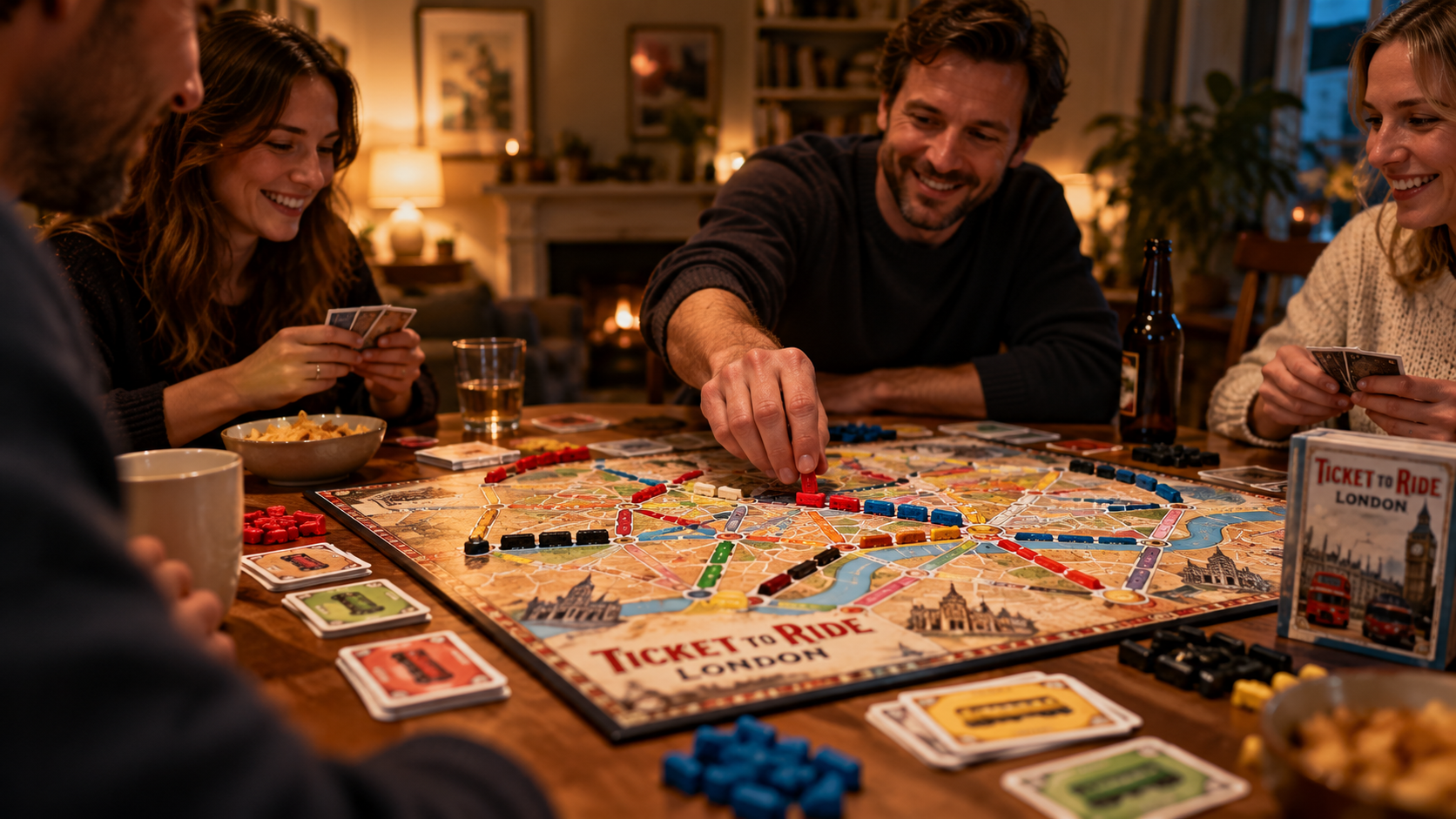
For two to four people, try Ticket to Ride: London, designed by Alan R. Moon. It is a standalone game with a publisher-stated playing time of 10 to 15 minutes and an age guide of eight and up. Allow longer for the first explanation. You do not need a larger Ticket to Ride box. Publisher information.
The board is London, and the little vehicles are buses. That gives you something recognisable to point at before the unfamiliar rules arrive.
Make it easy to see
Choose a table where everybody can reach and read the board. The game asks players to distinguish routes, manage cards and place small pieces. Good lighting and space help. Ask about visual or hand-movement difficulties; a card holder or assistance moving pieces may be useful, but don't assume these remove every barrier.
Nor is being short the same as suiting everybody. It is competitive, and routes other players take can affect your options. Someone may simply dislike that. An invitation works better when declining it doesn't require defending a whole personality.
Borrow a copy if one is available. If buying, Hamleys listed it at £19.99 when checked on 17 September 2026; confirm price and availability before ordering. Ticket to Ride London at Hamleys.
Explain what people are trying to do
Set up using the London rule leaflet. Read it yourself beforehand so the group isn't watching you discover the game in real time.
The aim is to score most points. Players collect cards to claim bus routes, connect the places on their secret Destination Tickets and earn bonuses for completed districts. Unfinished tickets lose points.
On a turn, choose one action: take Transportation cards, claim a route or draw new Destination Tickets. Demonstrate claiming a three-space yellow route by paying three yellow cards and placing three buses. Show the scoring track immediately.
Taking cards usually means two, but a face-up multicoloured Bus card takes the whole draw and cannot be the second card. Grey routes use a matching set of any one colour. In a two-player game, only one side of a double route can be used.
Mention the ending before play: when someone has two or fewer buses left, everyone, including that player, gets one final turn. Official English rules.
That is an introduction, not a replacement rulebook. Show the district example and check any uncertain detail in the leaflet. It is better to pause once than confidently teach a different game.
Help without taking their turn
For a new player, “Here are your options” is usually more useful than “You should do this”. Let them make a choice and see what follows.
Keep secret tickets secret unless someone asks for help and the group agrees how to handle it. Explain rules consistently. Don't reveal a scoring detail halfway through and call the resulting advantage strategy.
You can enjoy the moment somebody spots a route they want without narrating a lesson about connection or cognitive development. It is a small contest involving plastic buses. That is enough.
Let one game be one game
Count the final scores together, including tickets and districts. Then honour the original offer.
If someone wants another, ask everybody. If the answer is no, pack it away and carry on with the evening. There is no need for the enthusiast to conduct a review of why the others failed to appreciate it.
The best result might be a rematch. It might be somebody saying, a week later, “Bring that London one.” A game gets back to the table more easily when the first visit was allowed to finish.