Find a sky dark enough to see the Milky Way
Plan a dark-sky outing at Cawfields and give your eyes time to find the Milky Way’s subtle band.
Choose darkness with somewhere sensible to stand
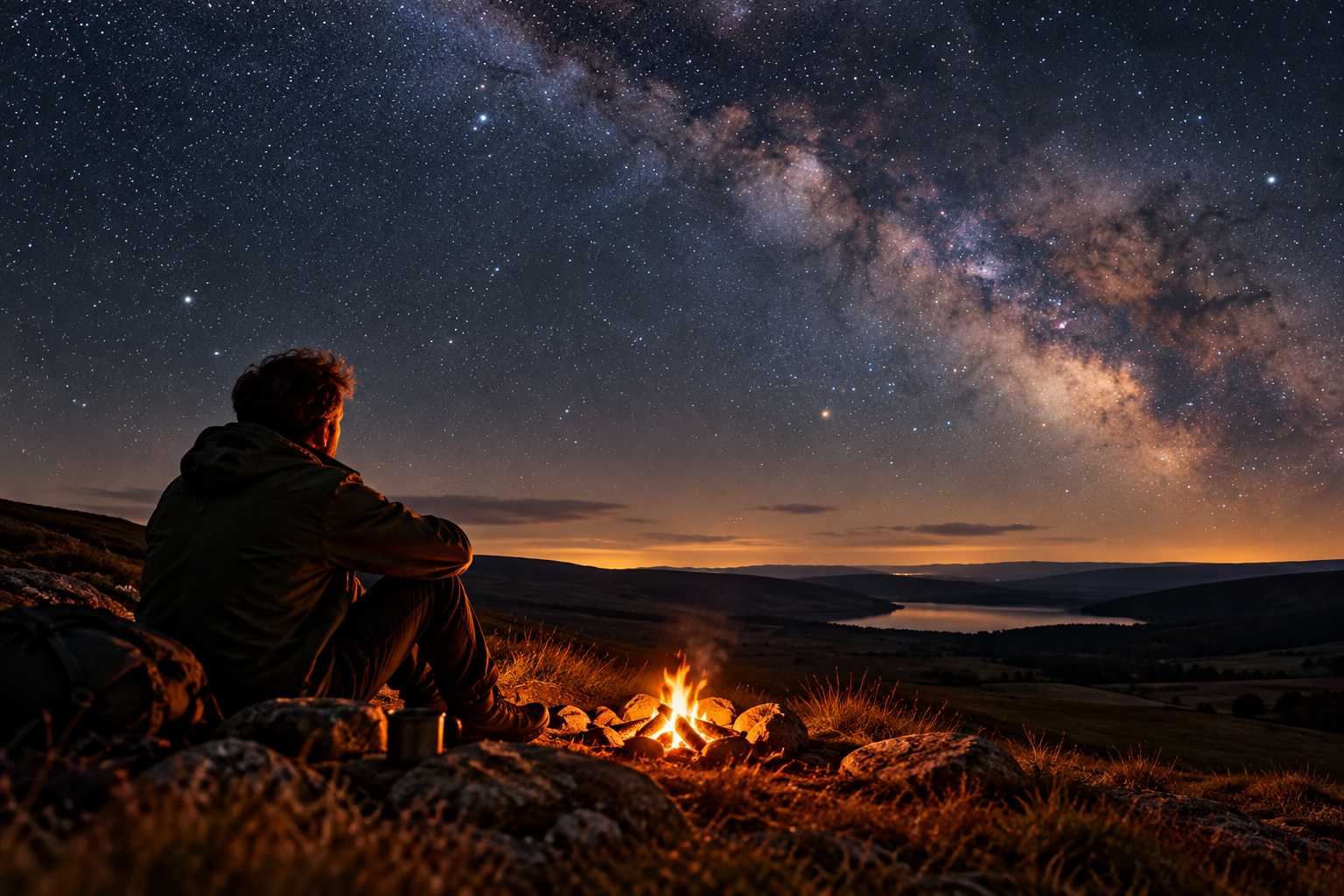
The Milky Way does not usually look like the photographs. Your eyes are unlikely to find a bright purple river pouring over the horizon. In good conditions, the naked-eye view is a pale, uneven band, subtle enough that at first you may wonder whether you are looking at a thin cloud.
Then it becomes clear that the band belongs to the sky in a different way. You are looking along part of the disc of the galaxy that contains our Solar System. The view is large because you are inside it.
For a British outing, Cawfields in Northumberland is a useful starting point. The National Park identifies it as a Dark Sky Discovery Site and directs visitors to a dedicated stargazing platform in the picnic area. Its visitor guidance warns about the quarry lake and prohibits overnight parking. Check the current access and parking arrangements before travelling; a dark-sky designation is not permission to camp or wander wherever you like.
Pick the night before making the journey
You need a clear sky, little interfering moonlight and genuine darkness. A cloudless evening beside a bright Moon may be lovely for looking at the Moon, but less suitable for a faint galactic band.
Look at a moonrise and moonset calendar as well as the lunar phase. A night near new Moon is a straightforward option; on other dates there may be a useful period while the Moon is below the horizon. Check a reputable astronomy chart for the place, date and time you intend to observe.
At northern English latitudes, late summer and early autumn can offer a practical combination of darker evenings and the Milky Way crossing the sky. The bright central region remains low in the south, and midsummer nights do not become fully dark there. A photograph taken farther south is a poor promise of what you will see in Northumberland.
Check the forecast close to departure. Clouds are allowed to cancel the plan. If the journey is substantial, combine it with a visit you would enjoy even if the sky stays shut.
Arrive while you can see the ground
Take warm layers, a charged phone, a torch and something comfortable to sit on if suitable. Tell someone your plan and arrange a safe journey home. Standing still becomes cold more quickly than an active daytime walk suggests.
Arrive before darkness so you can identify the platform, the permitted route and the way back. Stay away from the lake edge and other hazards. Use enough light to move safely; protecting night vision never outranks seeing where you are putting your feet.
Once settled, give your eyes time to adjust and keep bright screens away. Allow roughly twenty minutes or more rather than glancing upwards between phone checks. A dim red light can help you consult a chart, provided it is still adequate for the task. The Royal Observatory’s naked-eye astronomy guide explains what can be seen without a telescope and why looking slightly aside can help with faint objects.
Let the band appear
Use your chart to locate the Milky Way for that hour, then look across a broad area. You are searching for an extended glow and dark interruptions, rather than one sharply outlined object. A telescope is unnecessary and its narrow view can miss the scale of what you came for.
Visibility varies with transparency, local lighting and your eyesight. You may see much less than expected. Give the sky a fair chance, but do not turn the evening into a test of observational worthiness.
If the band appears, leave the camera alone for a moment. Follow it as far as you can. There is something worth enjoying in a sight too broad to take in all at once, and too faint to demand attention from anyone who has not stopped to look.