Could a passenger land an airliner?
What aircraft automation can do, what people still need to understand, and why a simulator attempt can't settle the question.
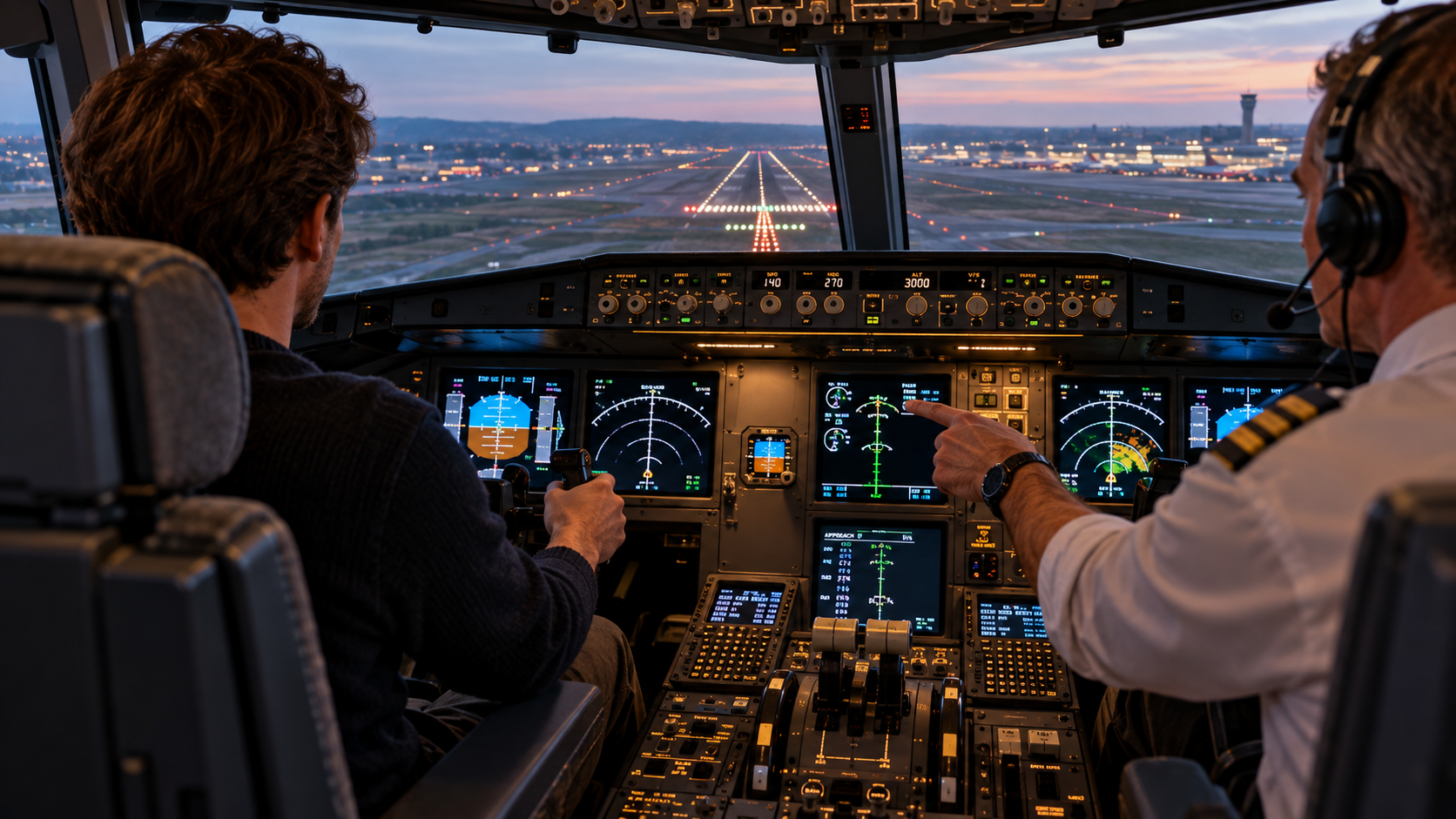
The announcement in your imagination
The pilots are incapacitated. A cabin crew member asks whether anyone can fly. You have spent some time with a flight simulator and, in the privacy of your own head, have been preparing for this moment for years.
Could you land the airliner?
There isn't an honest universal yes or no. In a sufficiently favourable set of circumstances, automation and expert help might make a successful outcome possible. That is very different from saying an untrained passenger could reliably take over a passenger jet.
The question hides most of the problem inside the word “land”. Before the wheels touch a runway, someone has to get a particular aircraft, in its particular condition, to a suitable place in a suitable state.
A cockpit already doing something
Imagine a serviceable Airbus A320-family aircraft in stable flight, with fuel available, working communications and time to obtain help. That is already a carefully favourable scenario. It excludes many of the things which could make the situation substantially harder.
Modern airliners have automation capable of controlling much of a flight. Appropriately equipped aircraft can also perform automatic landings when the relevant conditions and requirements are met.
But automation is carrying out selected tasks. It isn't simply understanding that the humans are in trouble and inventing a complete rescue plan. A person unfamiliar with the cockpit might not even know what the aircraft is currently set to do.
That is the first gap between watching a simulation and assuming responsibility for a real aircraft. Knowing that a system exists doesn't mean knowing its present state, its limitations or what will happen next.
Autoland is a capability with conditions
Conventional airliner autoland belongs to an operating system which includes the aircraft's equipment, the approach and runway facilities, weather limits, procedures and a trained crew supervising the operation. It is not a general promise to put any aircraft down at any airport in any conditions.
On aircraft such as the A320 family, automatic landing systems can control the final stages of an approved approach and landing, including runway guidance where the system supports it. The pilots still monitor what is happening and are prepared to intervene. SKYbrary's autoland overview.
That final sentence is the awkward one for the passenger fantasy. The system is designed to work with people who can recognise a problem. Removing that expertise doesn't make the system useless, but it changes the situation considerably.
There are also emergency-autoland products for selected smaller aircraft, designed to handle an incapacitated pilot and capable of passenger activation. Garmin markets such a system. It should not be confused with the conventional autoland equipment on an arbitrary airline flight. Garmin Autoland.
The runway is only part of it
Air traffic control and appropriately qualified pilots on the ground could be valuable sources of assistance in an emergency. Yet help delivered by radio depends on the person aboard being able to communicate clearly, identify the relevant information and understand what they are being told.
There is also the aircraft's energy to manage: its height and speed, and how those relate to the approach ahead. Jet aircraft have characteristics and performance demands which are not interchangeable with a small training aeroplane. The FAA devotes an entire handbook chapter to the transition to jet-powered aircraft. FAA Airplane Flying Handbook.
A long runway in good weather, an undamaged aircraft and plenty of time present a different problem from poor visibility, limited fuel or a fault. A successful account involving one kind of aeroplane cannot simply be transferred to another.
This is why a percentage would be so misleading. Whose ability are we estimating, in what aircraft, under which conditions, with how much help? Until those are specified, the number would mostly measure the confidence of the person making it up.
What a simulator can show
A simulator attempt can be an enjoyable way to discover how demanding the task is. It can also show that a novice, given the right starting conditions and guidance, can complete a defined exercise.
Look carefully at what the exercise includes. Was the aircraft already lined up? Was an instructor sitting beside the participant? Had they practised? Could the scenario be paused? What counted as success?
Those questions don't make the attempt worthless. They tell you what it demonstrates. A controlled exercise cannot reproduce every source of uncertainty, stress and consequence in the imagined emergency.
The most interesting answer is therefore conditional. Technology can do far more of the physical flying than the old heroic picture suggests. Understanding what it is doing, arranging the conditions it needs and recognising when the plan has stopped working remain substantial tasks.
In a real emergency, passengers should follow cabin crew instructions. For the rest of us, a simulator is an excellent place to find out how much of our confidence survives the first unfamiliar display.