Britain has rainforests
Britain's Atlantic woodlands hold a world of mosses, liverworts and lichens. Start by looking at one branch.
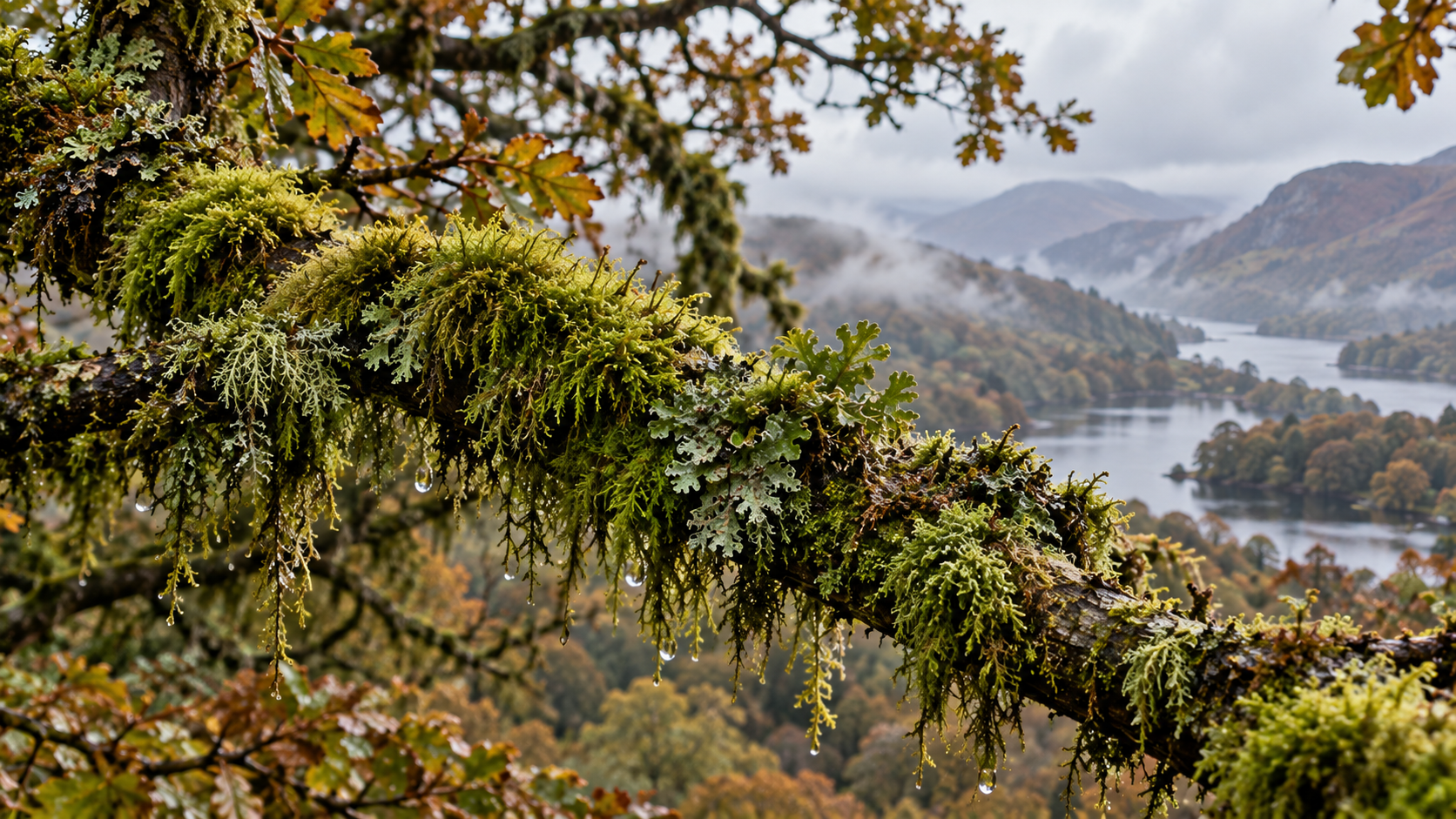
A tree with things growing on it
The Woodland Trust has a photograph from Crinan Wood in Argyll which rewards a second look. On a branch sits a large, leafy lichen, its surface ridged and puckered. It is tree lungwort. Behind it, the woodland is busy with further shades and textures of green.
The tree is only part of the scene. Its bark provides somewhere for other life to live. Once you notice that, a wood starts to look less like a collection of trunks and more like a set of stacked habitats.
This is British rainforest. The word belongs here. It describes temperate woodland shaped by persistent moisture and a mild oceanic climate, rather than a promise of heat or parrots. Woodland Trust's rainforest guide and Crinan photograph.
The weather we complain about
The western side of Britain faces the Atlantic. In suitable places, high rainfall, humid air and relatively limited temperature extremes allow moisture-loving organisms to flourish. Western Scotland, Wales and parts of south-west England contain surviving examples; the rainforest zone also reaches into Cumbria.
Rain alone doesn't turn any patch of trees into this habitat. The pattern through the year matters, as do local conditions and the organisms living there. A soaked plantation is not automatically a temperate rainforest. Nor does a mossy trunk provide a complete ecological diagnosis.
But the small life is a good place to begin looking. Ferns can occupy forks and ledges. Mosses and liverworts cover surfaces which, in a drier wood, might look comparatively bare. Branches gain another outline around the wood underneath.
It's an appealing reversal of how we usually see a forest. We give the trees most of the attention because they are big. Here, some of the most interesting inhabitants could fit inside your hand.
What exactly is a lichen
A lichen isn't simply a small plant. It brings together a fungus and a partner capable of photosynthesis, usually an alga, sometimes a cyanobacterium, or both. Other microorganisms can be involved too. What looks like a single little growth is a living association.
Mosses and liverworts are plants, but they don't produce flowers. These groups belong to the bryophytes. You needn't remember the vocabulary to notice their variety: tight cushions, trailing growth, little fronds, flat layers.
Plantlife provides rainforest identification guides precisely because all this green is easy to overlook. A closer look reveals different organisms occupying different surfaces and conditions. Recognising even one gives you something to find again on another walk. Plantlife's temperate rainforest guide.
There is no need to peel anything off for inspection. A photograph, a hand lens and a little patience can do the job without disturbing what you're looking at. The living branch is rather more useful to its inhabitants where it is.
Why the surviving woods need help
A wood can look old and richly covered while its future is in trouble. If grazing repeatedly removes young growth, the next generation of trees may struggle to establish. The standing trees can conceal that absence for years.
Invasive rhododendron is another problem. It can occupy the space and shade out the vegetation that makes the habitat valuable. Removing it takes work, and keeping it under control requires follow-up. Ash dieback, air pollution and fragmented patches of habitat add further pressures.
Plantlife's conservation work therefore includes practical management of grazing, invasive plants and the conditions needed by lichens and bryophytes. “Leave it alone” is not a complete answer where those pressures already exist. Plantlife on rainforest restoration.
That changes what a conservation success might look like. Sometimes it is a young tree surviving long enough to grow. Sometimes it is a patch of light returned to a shaded trunk. The work may be less photogenic than the forest, but it helps keep the forest there.
Go slowly enough to see it
Crinan Wood is one of the rainforest sites the Woodland Trust lists for visitors. Use its current visitor information to plan access, and follow local signs and paths. The same applies to other advertised rainforest woods: a beautiful photograph doesn't tell you whether a route suits your mobility, the weather or your footwear.
Take the wide view, then spend a minute on a branch, a rock or a fallen trunk. Look for different shapes instead of trying to identify everything. If you want to get more specific, take an identification guide rather than guessing from colour alone.
You can cover a woodland path briskly and see plenty of trees. Give one moss-covered branch your attention and the scale changes. Suddenly there is a whole landscape on it.