Band of Brothers: The Company of Heroes
Easy Company gave millions of us names and faces for the American airborne war. Go back to the veterans, records and other units, though, and a bigger story appears: thousands of young men dropped into confusion, improvised when the plan disappeared, depended on one another and carried the cost long after the fighting stopped.
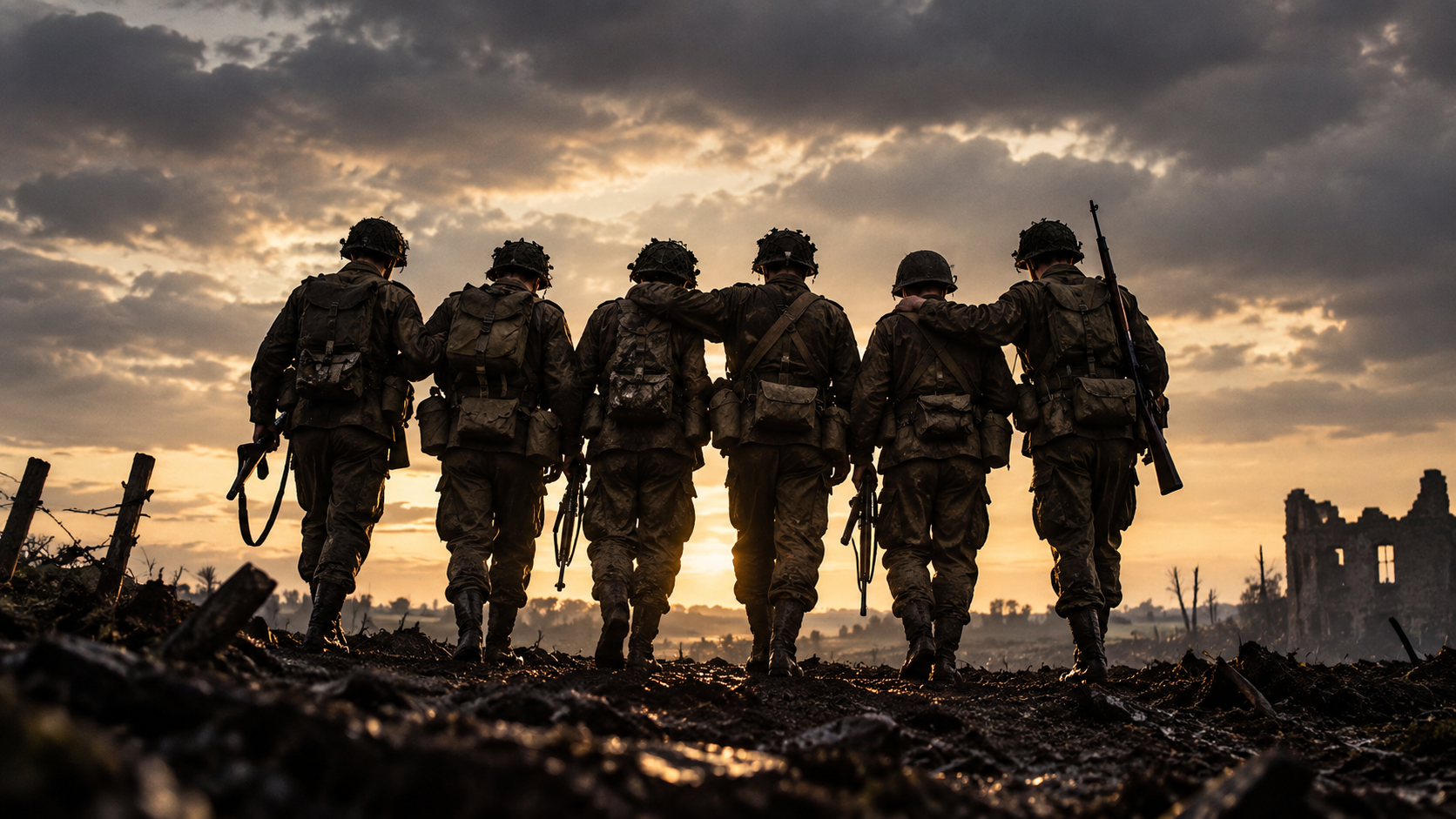
Before they became characters
There is a strange thing that happens when you have watched Band of Brothers enough times.
Dick Winters walks into a scene and you know what he is going to do. Lewis Nixon appears and you know what sort of line is coming. Guarnere, Toye, Lipton, Speirs, Malarkey: the faces arrive before the names do.
The television series is so good at making Easy Company legible that it is easy to forget the real men had no idea what episode they were in.
On the night of 5 June 1944, none of them knew that Normandy would work. They did not know that there would be Holland, Bastogne, Germany or a television series half a century later. They knew the aircraft was loud, the equipment was heavy, France was occupied and somewhere beyond the Channel people were going to shoot at them.
Stephen E. Ambrose gave Easy Company a narrative in his 1992 book. HBO gave that narrative faces in 2001. Together they made E Company, 2nd Battalion, 506th Parachute Infantry Regiment, one of the best-known small military units of the Second World War.
That fame is deserved.
It can also distort the view.
Easy Company was not a collection of characters waiting for history to happen to them. It was one company inside a vast airborne operation involving thousands of Americans, alongside British and Canadian airborne troops on the eastern flank. Men landed in the wrong fields, lost weapons, lost officers, drowned, got captured, found strangers in the dark and carried on with whoever happened to be standing nearby.
The book was brilliant. The television series was unforgettable.
The real accounts are more extraordinary still.
The night the plan disappeared
The airborne part of D-Day depended on precision.
Before the seaborne landings began, the US 82nd and 101st Airborne Divisions were to drop behind Utah Beach. They had bridges, road junctions, causeways and towns to seize. The 101st was meant to secure routes leading inland from the beach and disrupt German movement. The 82nd had objectives around Sainte-Mère-Église and the Merderet River.
Maps gave every regiment a drop zone. Training gave every man a unit, a stick, an assembly point and a job.
Then the aircraft reached France.
Cloud, darkness and German anti-aircraft fire broke up formations. Pilots climbed, dived and took evasive action. Some aircraft crossed their intended drop zones too fast or too high. Pathfinders themselves were not always where they were meant to be. Men jumped into a black landscape they had studied in photographs and sand tables but could barely recognise from the air.
The official post-war report of the Supreme Allied Commander gives a brutal measure of the result. The 6,600 parachute elements of the 101st were scattered over an area roughly 25 miles by 15 miles. About 60 per cent of their equipment was lost.
Some men landed reasonably close to their objectives. Others came down miles away. Men of the 82nd's 507th and 508th landed around low ground deliberately flooded by the Germans along the Merderet. Heavily laden paratroopers who hit deep water could drown under parachutes and equipment before they fired a shot.
The most famous unlucky landing belonged to John Steele of the 82nd, whose parachute caught on the church at Sainte-Mère-Église. He hung there for around two hours before being taken prisoner. He later escaped.
But the more revealing story may be the one told by pathfinder Jake McNiece.
McNiece and the men with him came down miles from the bridge they were supposed to secure. For a time he was alone. He later wrote that the isolation was so complete he began to wonder whether the invasion had been cancelled and he was the only American down there.
That is what a military plan looks like from inside it when the map has stopped being useful.
Find somebody. Work out where you are. Move.
The scattering should have been disastrous.
In one sense, it was. Units lost cohesion. Equipment vanished. Commanders could not find their men and men could not find their commanders. Carefully trained organisations had been shaken apart before they reached the ground.
Then something interesting happened.
Paratroopers began assembling themselves.
A lieutenant might collect men from his own regiment, another company, perhaps even the other airborne division. Enlisted men joined whoever seemed to know where they were going. Small groups moved towards objectives, roads, bridges or simply the sound of fighting.
The US Army's own account describes men from both divisions intermixed across the countryside, fighting scores of small actions as they tried to orient themselves. The same dispersal that disrupted the Americans also confused the Germans, who struggled to work out where the main airborne threat actually was.
The organisation had fractured. The mission had not.
This is one of the details that gets lost when D-Day becomes a set of arrows moving neatly across a map. Airborne training was not only about jumping from aircraft. These troops had been trained to operate aggressively and with initiative after landing, because everybody knew a night parachute assault might scatter them.
On 6 June, that stopped being theory.
Winters lands without his weapon
Dick Winters jumped into Normandy as Easy Company's executive officer.
He did not land with Easy Company.
Like so many others, he came down away from his intended drop zone. His leg bag, carrying much of his equipment, tore away during the jump. He landed with a knife and little else.
Winters began moving, found other Americans and gradually collected men. Easy Company's commander, Thomas Meehan, was missing. His aircraft had been hit and crashed, killing Meehan and the men aboard, although the company did not immediately know what had happened.
By morning Winters was effectively in command of Easy.
Near Brécourt Manor, he was ordered to deal with German guns firing towards Utah Beach. The assault that followed became one of the most studied small-unit actions of the day. Winters had only a small group. He organised a base of fire, moved along the German trench system and attacked the gun positions in sequence. Reinforcements joined as the fight developed.
The television series depicts it brilliantly.
The part worth holding onto is what came before it.
A few hours earlier, Winters had been a lieutenant hanging beneath a parachute somewhere over occupied France, separated from most of his company and missing his weapon. By morning he was commanding an improvised assault on an enemy battery.
That movement from confusion to action was not unique to him.
A man called Charles DeGlopper
Three days later, west of the Merderet, another airborne soldier faced a much smaller problem with a much more immediate answer.
Private First Class Charles DeGlopper belonged to Company C of the 325th Glider Infantry, part of the 82nd Airborne Division. On 9 June his platoon was trying to establish a bridgehead near La Fière when it became cut off.
German fire was closing on the men in a shallow roadside ditch. They needed to withdraw through a gap in a hedgerow.
DeGlopper stood up.
According to his Medal of Honor citation, he fired his automatic rifle from an exposed position while the rest of the platoon pulled back. He was hit, continued firing, was hit again and kept going until he was killed.
The men behind him got through.
DeGlopper is not in Band of Brothers because he was not in Easy Company. That is precisely why he belongs in this story.
Once you move a few miles across the Normandy map, the famous company stops looking like an exception and starts looking like one sharply focused example of something much larger.
Holland did not behave like the television version either
Three months after Normandy, the 101st went back into combat during Operation Market Garden.
This time the jump was in daylight. The plan was audacious: Allied airborne divisions would seize a chain of bridges through the Netherlands while a ground column raced north along a narrow corridor. The 101st had objectives around Eindhoven, Son and Veghel. The 82nd was farther north around Grave and Nijmegen. British and Polish airborne forces were committed towards Arnhem.
Easy Company's part of that campaign contains some of the series' most familiar scenes. The reality, again, was messier.
On 5 October, for example, five Easy Company men went out to occupy an outpost near a dike by Randwijk. Joe Lesniewski reached the top and saw a German machine-gun position and a soldier preparing to throw a grenade. Lesniewski shouted a warning. The grenade exploded and wounded four of the five Americans.
They had stumbled into a much larger SS force.
A tiny patrol suddenly had a company-sized problem.
The broader campaign produced hundreds of moments like this: plans colliding with roads, rivers, enemy units, broken communications and simple bad luck. The 101st held sections of the vulnerable corridor for weeks. The 82nd fought for the Nijmegen crossings. At Arnhem, the British 1st Airborne Division was mauled and much of it was captured or killed.
Market Garden is remembered as a grand operational gamble. For the men inside it, it could be five people walking up a dike.
Then came the trees
Easy Company reached Bastogne in December 1944 with little warning.
The German Ardennes offensive had torn open the front. The 101st was rushed north from its rest area in France to defend the vital road network around Bastogne. Winter clothing and equipment were not ideal. The weather was bitter. German forces closed the roads around the town.
The famous part is Brigadier General Anthony McAuliffe's one-word answer to a German surrender demand: 'Nuts!'
The less quotable part was what being surrounded did to wounded men.
Most of the 101st Airborne Medical Company's personnel and equipment were captured west of Bastogne on 19 December. Once the roads were cut, casualties accumulated inside the perimeter. A contemporary Army medical history records that by 21 December the division surgeon reported around 1,300 casualties, roughly 150 of them very seriously wounded.
Out in the woods, men dug into frozen ground and waited for artillery.
Bill Guarnere later remembered German shells bursting in the trees above the foxholes and spraying fragments downwards. On 3 January 1945, Joe Toye was badly hit during a barrage.
Guarnere went out to him.
In Guarnere's later account, Toye's leg was mangled and he was bleeding heavily. Guarnere tried to get his friend out. Another shell burst. It tore into Guarnere's right leg.
Both men lost a leg.
There is an easy way to turn that story into a paragraph about brotherhood.
The harder thing is to leave it as it happened: one wounded man lying in snow, another man leaving cover because he heard his friend calling, then two stretchers instead of one.
They did not all like each other
The title Band of Brothers comes from Shakespeare's Henry V, but combat units are not friendship clubs.
Easy Company contained men who admired one another, men who irritated one another and men who actively disliked one another. Personalities clashed. Officers were judged harshly. Replacements entered groups whose older members already shared experiences they could not possibly understand.
Brotherhood in that setting meant something more practical than universal affection.
The man beside you had to do his job.
You needed him to stay awake on watch, cover the right field of fire, carry ammunition, pass a message, hold his position and come for you when you could not move. He needed the same from you.
Guarnere did not crawl towards Toye because somebody had explained the concept of military fellowship to him. Toye was down.
So Guarnere went.
The replacements
Band of Brothers is unusually good at showing how difficult it could be to join a unit after the unit had already become itself.
The real problem was even larger.
American infantry organisations were constantly changed by wounds, deaths, transfers and promotions. A 2025 National WWII Museum study of another wartime company, Company I of the 157th Infantry, makes the point starkly: the stable group of men who trained together and then fought together all the way through the war was unusual. Attrition repeatedly tore units apart and replacements had to be absorbed.
Easy Company retained a particularly strong identity because of its demanding airborne training and the core of veterans who survived from campaign to campaign. But it was not sealed off from the replacement system.
New men arrived in Normandy, Holland and later. They entered foxholes beside veterans who had private jokes, dead friends and instincts learned the hard way.
Some became part of the company quickly. Some died before anybody knew them well.
That is another cost hidden by the word 'unit'. A company can retain its name while the people inside it keep changing.
What survival looked like afterwards
The war did not stop being expensive when the shooting ended.
Joe Toye spent months in hospitals. The loss of his leg meant he could no longer simply return to the heavy industrial work he had known before the war.
Bill Guarnere also returned home without his right leg.
Donald Malarkey lived into his nineties, but people who knew him during the making of the television series recalled how reluctant and emotional he could be when discussing the war. Malarkey himself wrote that hardly a day passed without his thinking about the men of Easy Company.
Dick Winters survived Normandy, Holland, Bastogne and the advance into Germany. In a 1990 oral-history interview with Ambrose, he discussed the psychological progression of men under prolonged combat: the early belief that it could not happen to you, followed by the realisation that it could.
Survival did not produce one standard ending.
Some men built families and careers. Some drank too much. Some rarely spoke about the war. Some attended reunions for decades. Some spent years answering questions once Band of Brothers made strangers feel as though they knew them.
The series ends. They had to keep living.
Easy Company wasn't alone
This is the part of the story that fame can accidentally hide.
Easy Company deserves to be remembered. So does Dick Winters. So do Toye, Guarnere, Lipton, Nixon, Malarkey, Speirs and the rest.
But on the same night that Winters lost his leg bag, thousands of other paratroopers were dropping into the same darkness.
The 82nd Airborne's John Steele hung helplessly from a church tower while fighting went on below him. Charles DeGlopper stood in a road three days later and fired until the men behind him escaped. Men of the 507th and 508th came down in flooded country along the Merderet. Some drowned under the weight of the equipment they had been issued to keep them alive in battle.
Farther east, British airborne troops were doing the same dangerous work on the other side of the invasion front.
Lieutenant David Hunter of the British 6th Airborne Division later remembered moving through Bénouville in the dark after the capture of the bridges over the Caen Canal and Orne. He was 21. When he sent Lance Corporal McAra through a hedge to see what was on the other side, German fire killed McAra. Hunter wrote decades later that he had lived with the guilt of sending him through that gap for fifty years.
That is not an Easy Company story.
It sounds like one because the underlying experience was everywhere.
The gift Ambrose gave us
Stephen Ambrose found Easy Company veterans at a reunion in New Orleans in 1988 and began recording their stories. He eventually interviewed Winters for more than thirteen hours. Those interviews, letters and memories became the foundation of Band of Brothers.
That method was the book's great strength.
It was also a weakness when memory became the only source.
Veterans can remember a firefight with extraordinary clarity and still be wrong about what another unit was doing ten miles away. Memories conflict. Stories harden through repetition. Ambrose occasionally accepted recollections that later records complicate or contradict. His claim that Easy Company reached Berchtesgaden first is one example: official histories place elements of the US 3rd Infantry Division there before the 506th arrived.
That does not make the veterans' accounts worthless. Quite the opposite.
It tells us how to read them.
An after-action report can tell you where a battalion was supposed to be. A veteran can tell you what it felt like to discover he was nowhere near it. The useful history happens when those kinds of evidence are allowed to talk to each other.
HBO then performed another transformation. It compressed people, rearranged moments and built ten hours of drama out of a war that had no obligation to provide satisfying character arcs.
The remarkable thing is how much truth survived the process.
A company of heroes
At the end of the television series, the real Dick Winters tells a story that has since become attached to him so firmly that it is often misquoted.
The original attribution matters.
Winters was recalling words written by fellow Easy Company veteran Mike Ranney. Ranney described a grandson asking his grandfather whether he had been a hero in the war. The answer was: no, but he had served in a company of heroes.
Over the years, the internet has frequently turned the grandson into Winters's grandson and the line into Winters's own answer. Even some later accounts blur it.
Ranney's version is better.
One Easy Company veteran sent the thought to another. Winters kept it. Decades later he used it to close the story of the company.
And even then, 'company' is probably too small.
Easy Company was extraordinary.
The mistake is to think it was extraordinary because nobody else was like it.
There were men scattered across Normandy who found strangers in the dark and moved towards the fighting. There were glider infantrymen at La Fière, paratroopers drowning in flooded fields, British soldiers moving past burning vehicles at Bénouville, replacements climbing into foxholes beside men whose names they barely knew, medics working without enough supplies at Bastogne.
Most never had Stephen Ambrose turn up at their reunion.
Most never had Tom Hanks and Steven Spielberg put their names on television.
Easy Company gave us a way to see them.
Once you widen the frame, that may be the most extraordinary thing about Band of Brothers.
We learned the names of one company.
There were thousands more.