A Sunday afternoon with Master and Commander
Peter Weir’s seafaring adventure offers the pleasure of a working ship and a friendship with room to disagree.
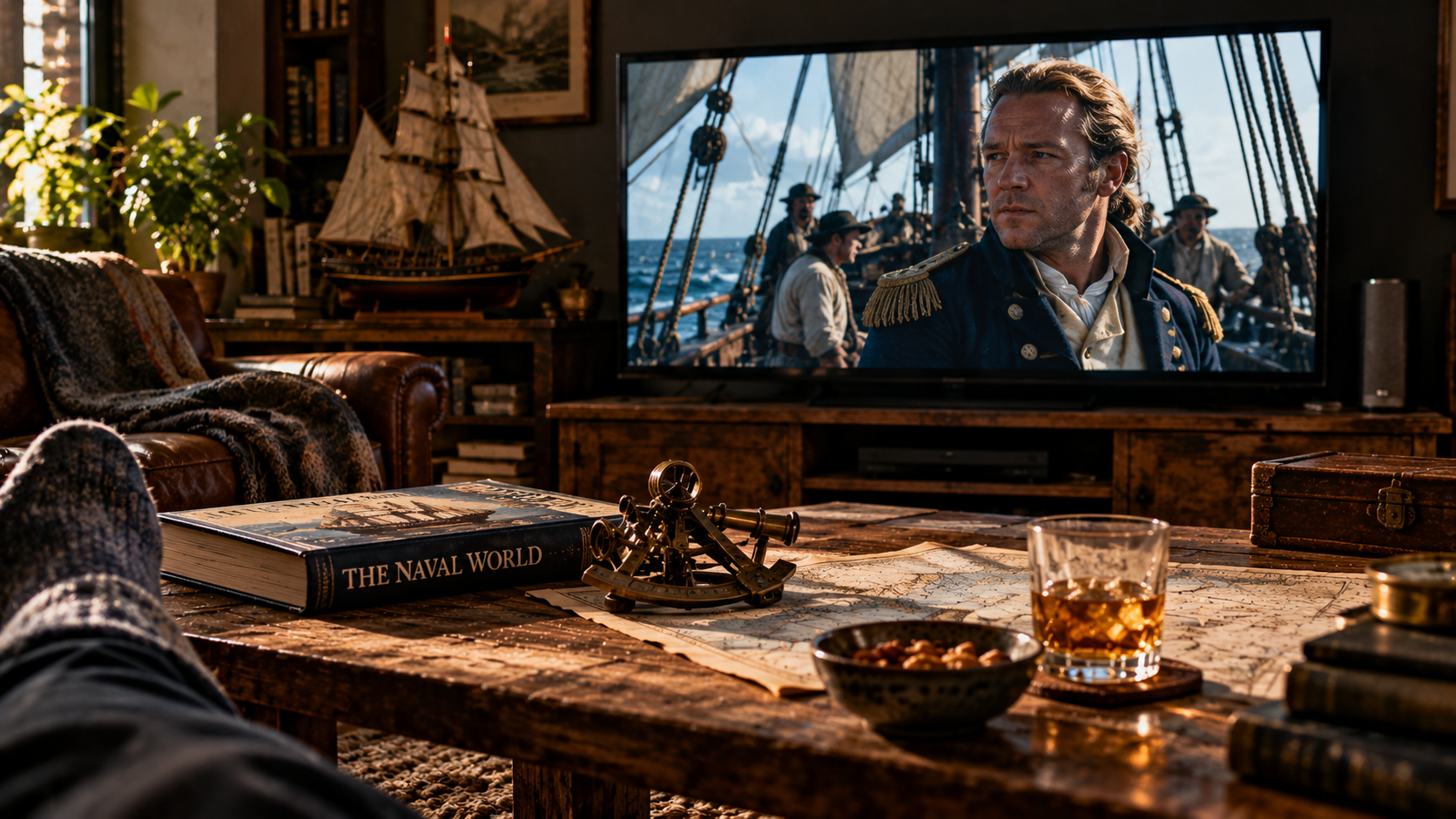
Step aboard
A ship is a particularly good place to set a film. Everyone is stuck with everyone else, the weather can change the story at any moment, and every creak suggests the building might be considering retirement.
Master and Commander: The Far Side of the World makes excellent use of all three. Peter Weir’s 2003 film follows Captain Jack Aubrey and the crew of HMS Surprise as they pursue a French warship during the Napoleonic Wars. Russell Crowe plays Aubrey; Paul Bettany is Stephen Maturin, the ship’s surgeon, naturalist and the captain’s friend.
That is enough preparation. You do not need to know the difference between every sail, or to have read Patrick O’Brian’s novels. The film draws on the Aubrey–Maturin series rather than simply filming the first book. Its world becomes understandable through what people do inside it.
Watch the work
The pleasure is partly practical. Orders travel across the deck. Men haul, climb, repair and make room for one another. A decision from the captain becomes physical work for somebody else, often somewhere wet, cramped or dangerous.
Weir lets the ship feel occupied. There are people beneath the main plot, carrying on with jobs that remain necessary whether or not the camera is interested. You begin to understand how much effort is required merely to keep this community moving.
That makes the violence more troubling. Cannon fire does not arrive in an empty action arena. It tears into a place whose routines you have started to recognise. The film includes bloody injuries and surgery; its appeal is not based on pretending that naval warfare was a picturesque way to see the world.
Nor does its convincing surface make it a documentary. The story selects, combines and dramatises. Enjoying the detail does not require you to certify every rope and uniform as historically exact.
Stay for the friendship
Aubrey and Maturin give the film its second rhythm. They disagree because their interests are real. The captain’s pursuit can consume the attention that the doctor would rather give to observation, exploration or the welfare of the men.
Neither becomes interesting merely by being the other’s opposite. Aubrey can be warm, amused and socially awkward alongside his authority. Maturin’s curiosity is a substantial appetite of its own. Their friendship has room for irritation because it has already acquired depth.
Look at the music they make together, violin and cello filling the cabin. After the noise and hierarchy of the ship, two men concentrating on the same piece offer another way of being in company. The scene needs no speech about what friendship means. They have something they like doing together, and the film gives it time.
It is one of the reasons the voyage feels larger than the chase. There is an entire life aboard, with meals, jokes, loyalties and things people would rather be doing.
Give it the afternoon
The studio lists a running time of two hours and eighteen minutes. Allow it that space. Check a legitimate rental, disc or streaming option where you live, get comfortable and let the opening bring you aboard.
A decent speaker helps you enjoy the timbers, weather and distant activity, but no equipment purchase is required. Turn it up enough to hear the ship without making your neighbours join the Navy.
There are films that leave you with a message and films that leave you wanting to stay in their company. This one offers the latter. By the time the afternoon is over, an ordinary room can feel unusually still.